
The Quiet You Need: What Heavy Duty Acoustic Doors Actually Deliver
Heavy duty acoustic doors are specialized doors engineered to block significant amounts of sound — far beyond what a standard interior door can do. Here’s a quick look at the performance tiers covered in this roundup:
| Performance Tier | STC Rating | Best For |
|---|---|---|
| Ultra-Heavy Double-Door | Up to STC 70 | Extreme industrial noise |
| Premium Commercial Single-Leaf | STC 51–64 | Commercial offices, theaters |
| High-Density Studio Door | STC mid-60s | Studios, home theaters |
| Professional Studio Door | Up to STC 56 | Recording studios, offices |
| Industrial Swing Door | STC 45–56 | Factories, test cells |
| Oversized Acoustic Door | STC 45–59 | Aviation, sports venues |
| Standard-Duty Acoustic Door | STC 55 walls | Enhanced privacy spaces |
| Entry-Level Acoustic Door | STC upper 40s | Home offices, vocal booths |
| Budget Acoustic Door | STC 34 | Film studios, enclosures |
If you work from home, you already know the problem. A dog barks. Someone runs the dishwasher. A lawnmower fires up outside. Suddenly, your focus is gone.
A standard hollow-core door blocks almost nothing — typically in the STC 20–25 range. That means most everyday noise passes right through.
Heavy duty acoustic doors change that equation completely. They use mass-loaded cores, precision seals, and engineered framing to stop sound before it reaches you. The best models can cut noise by 50–70 decibels — enough to turn a loud room into near-silence.
The difference isn’t subtle. It’s the difference between hearing every word of your neighbor’s phone call and hearing nothing at all.
This roundup compares the leading heavy duty acoustic door performance tiers on the market so you can find the right fit for your space, your wall assembly, and your budget.

Defining STC Performance and Heavy Duty Acoustic Doors
When we talk about heavy duty acoustic doors, the gold standard for measurement is the Sound Transmission Class (STC). Think of STC as a miles-per-gallon rating, but for silence. The higher the number, the better the door is at stopping sound from traveling from one side to the other. For a broader definition of the standard itself, see Sound Transmission Class.
A standard residential door usually sits around STC 20 to 25. You can hear a conversation through it clearly. Once you step into heavy duty acoustic doors, you are looking at ratings starting at STC 34 and climbing all the way to a staggering STC 70.
Decibel Attenuation and Frequency Focus
It is important to understand that sound isn’t just one “thing.” There are high-pitched sounds (like a whistle) and low-pitched sounds (like the rumble of a home theater subwoofer).
- High-Frequency Focus: Most standard “soundproof” solutions handle high frequencies well.
- Low-Frequency Focus: This is where true heavy duty acoustic doors shine. Products specifically engineered for low-frequency attenuation tackle low-to-mid frequency rumbles that standard doors simply can’t touch.
If you aren’t ready to replace your entire door yet, you might start by learning how to soundproof a door gap effectively to see how much of a difference a tight seal can make.
STC Ratings and Real-World Noise Reduction
To give you an idea of what these numbers mean in your daily life, we’ve put together a comparison of performance levels:
| STC Rating | What You Hear | Common Application |
|---|---|---|
| 20-25 | Normal speech heard easily | Standard hollow-core door |
| 30-35 | Loud speech heard but not understood | Entry-level acoustic door |
| 45-50 | Loud speech heard as a faint murmur | Mid-range acoustic doors |
| 55-60 | 95% of noise is blocked; shouting is inaudible | Professional studio-grade doors |
| 65-70+ | Total isolation; extreme machinery noise blocked | Ultra-heavy double-door systems |
Anatomy of High-Performance Heavy Duty Acoustic Doors
What makes these doors so heavy? It’s all about the “M” word: Mass. Sound is a vibration, and it is much harder to vibrate a 300-pound slab of steel and wood than a light piece of plywood.
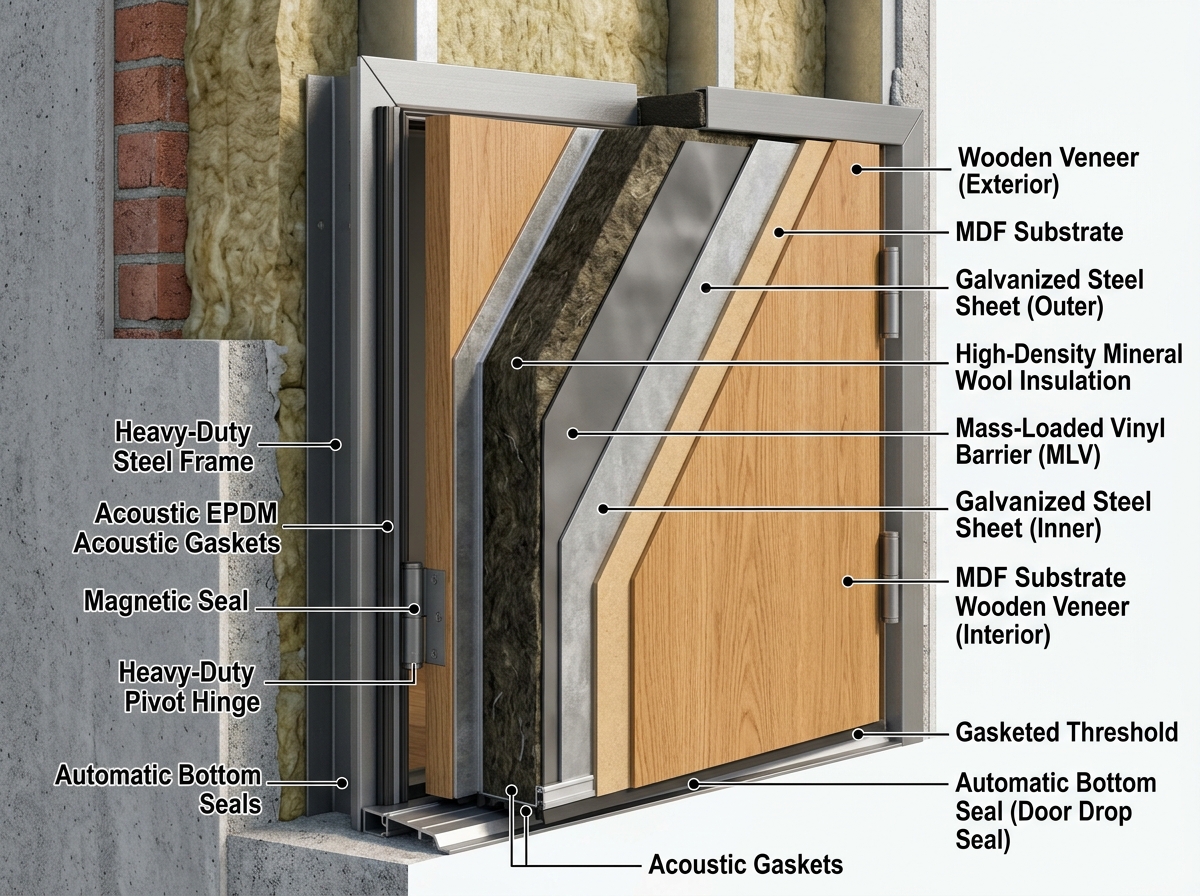
Material Composition
Heavy duty acoustic doors are built like a multilayer sandwich.
- Outer Skins: These can be beautiful wood veneers for an architectural look or rugged 14-gauge galvanized steel for industrial settings.
- The Core: This isn’t air. It’s usually a combination of non-combustible sound-absorbing mineral wool, high-density polyurethane foam, or specialized acoustic composites.
- Internal Stiffeners: Steel doors often include internal ribs to ensure the door doesn’t warp under its own massive weight.
For example, a high-density acoustic door can weigh roughly 17 pounds per square foot. For a standard 3’x7′ door, that is nearly 360 pounds of sound-blocking muscle! If you’re looking for the best hardware to keep these seals tight, check out these top-rated soundproof door seals on the market.
Custom Sizing and Scale
While most of us think of a standard bedroom door size, heavy duty acoustic doors can be massive. Some oversized acoustic door lines, for instance, can be manufactured in double-door configurations up to 30’x30′ for aviation test cells. Whether you need a small vocal booth door or a giant hangar entrance, the construction principles remain the same: mass plus airtight seals equals silence.
Essential Hardware for Heavy Duty Acoustic Doors
A heavy door is useless if it doesn’t seal perfectly. In acoustics, “if air can pass, sound can pass.”
- Cam-Lift Hinges: These are ingenious. As you open the door, the hinge lifts it slightly. As you close it, the hinge drops the door down, compressing the bottom seal firmly against the floor. This eliminates the need for a high, tripping-hazard threshold.
- Three-Point Latching: To ensure the door is pressed equally against all perimeter seals, high-end models use a three-point system that grips the top, middle, and bottom of the frame.
- Automatic Door Bottoms: These mechanical seals drop down only when the door is fully closed. You can learn more about how these work in our guide on door sweeps as a practical solution for noise reduction.
- Magnetic Perimeter Seals: Similar to a refrigerator door, these use magnets to pull the seal tight against the door leaf, ensuring a zero-gap fit every time.
Industrial vs. Architectural Heavy Duty Acoustic Doors
Not all heavy duty acoustic doors look like they belong in a factory.
- Architectural Doors: Premium acoustic door models offer over 100 species of wood veneer. They look like luxury office doors but perform like industrial barriers.
- Industrial Doors: These focus on “Hybrid Performance.” They might combine STC ratings with bullet resistance (up to UL Level 3), blast protection, or fire ratings up to 3 hours. They are often finished with UV-resistant coatings for harsh environments like power plants or paper mills.
Selecting the Right Door for Your Wall Assembly
We often see a common mistake: someone buys an STC 60 door and installs it in an STC 35 wall. This is like putting a bank vault door on a cardboard box. The sound will simply go through the wall instead of the door.
Wall-to-Door STC Matching
As a rule of thumb, your door should be within 5 to 10 points of your wall’s STC rating.
- If you have a standard wall, an entry-level heavy duty acoustic door rated around STC 45 is a great match.
- If you have a professional studio wall with resilient clips and double drywall, you need something rated STC 60 or higher.
Communicating Door Assemblies
For the ultimate in silence, we recommend “communicating doors.” This involves two doors installed in a single extra-thick frame, with an air gap between them. This setup can achieve NIC ratings of 70+, which is effectively “silent” even if there is a jet engine on the other side.
If you are on a budget and want to try a more hands-on approach before buying a professional unit, see our guide on the DIY soundproof door for some intermediate steps.
Compliance and ROI
When selecting a door, don’t forget the “boring” stuff that matters:
- Fire Ratings: Many heavy duty acoustic doors carry 20, 60, or 90-minute fire labels.
- ADA Compliance: Look for doors with cam-lift hinges and low-profile thresholds (1/2″ or less) to ensure accessibility.
- Price Ranges: A high-performance door is an investment. While a seal kit might cost $400, a fully engineered, pre-hung STC 55 door can range from $3,000 to over $12,000 for custom industrial models. The ROI comes in the form of increased productivity and property value.
Frequently Asked Questions about Acoustic Doors
Where are heavy duty acoustic doors most commonly used?
While we love them for home offices, their primary homes are in high-stakes environments:
- Recording Studios & Theaters: To keep the “outside world” out of the microphone.
- Industrial Test Cells: To protect workers from the roar of engines or turbines.
- SCIF Facilities: Secure Compartmented Information Facilities require specialized doors to prevent eavesdropping.
- Mechanical Rooms: To keep the hum of HVAC systems from ruining a quiet hotel lobby or hospital wing.
How do I maintain an acoustic door’s performance?
Because these doors rely on “airtightness,” maintenance is key.
- Seal Inspection: Check your rubber and magnetic seals for cracks or compression set.
- Hinge Lubrication: These doors are heavy! Keep those ball-bearing or cam-lift hinges greased so they don’t sag.
- Latch Alignment: If the door doesn’t latch easily, it isn’t compressing the seals. Periodic adjustment is necessary.
- Gasket Replacement: Most professional doors allow you to swap out seals every few years to keep performance at peak levels.
For more tips on maintaining a quiet seal, read our article on how to soundproof a door gap effectively.
Can I install a 300-pound door on standard framing?
In short: No. A standard 2×4 stud frame will likely bow or twist under the weight of a 300-pound heavy duty acoustic door.
- Structural Requirements: You must use “king and jack” studs (doubled-up vertical studs) to support the weight.
- Continuous Hinges: We recommend using continuous (piano) hinges to distribute the weight across the entire height of the frame rather than just three points.
- Split-Frame Designs: Many manufacturers offer split-frame designs that wrap around the wall, providing extra stability and making installation easier for contractors.
Conclusion
At Finance No Vax, we believe that silence shouldn’t be a luxury—it’s a necessity for a productive, healthy life. Whether you are building a world-class recording studio or just trying to get some peace and quiet in your home office, choosing the right heavy duty acoustic doors is the single most important decision you will make.
Remember to match your door to your wall, insist on high-quality cam-lift hardware, and never underestimate the power of a good seal. If you’re ready to take the next step in your acoustic journey, we’re here to help you navigate the decibels.
For more tips on transforming your space, explore our More DIY soundproofing solutions and start building your sanctuary today!
