
Why Sound Leaks Through Doors (And How to Stop It)
Acoustic door insulation materials are the practical tools you use to block sound from traveling through and around your door. Here’s a quick overview of your main options:
| Material | Best For | Key Benefit |
|---|---|---|
| Polyurethane foam tape | Door frame perimeter gaps | Lightweight, self-adhesive, easy to install |
| Rubber/neoprene seals | Heavy-duty or high-traffic doors | Durable, airtight, moisture resistant |
| Door sweep (foam or rubber) | Gap under the door | Blocks the largest sound entry point |
| Mass-loaded vinyl (MLV) | Adding mass to thin doors | Blocks direct sound transmission through the door panel |
| Acoustic gaskets | Jamb and frame sealing | Precise perimeter seal for higher STC ratings |
| Automatic door bottoms | Studios, offices, serious soundproofing | Mechanical drop seal, highest performance |
Even a door that looks tightly closed can leak a surprising amount of sound. Tiny air gaps around the frame and under the door act like open windows for noise — sound travels through air just as easily as light travels through a crack.
This is a real problem if you’re working from home. A noisy hallway, loud neighbors, or a barking dog can completely break your focus — even through a closed door.
The good news: sealing those gaps is one of the fastest and most affordable soundproofing upgrades you can make.

Types of Acoustic Door Insulation Materials
When we look at the science of silencing a door, we aren’t just looking for “padding.” We are looking for materials that provide two things: mass and an airtight seal. If air can pass through, sound will follow. Therefore, the choice of acoustic door insulation materials determines whether you’re just muffling the noise or truly blocking it.
Common materials include open-cell foams, high-density rubbers, and specialized synthetic fibers. For example, using weather stripping for enhanced soundproofing is a fantastic entry point for DIYers. However, for professional results, we often look toward industrial-grade solutions.
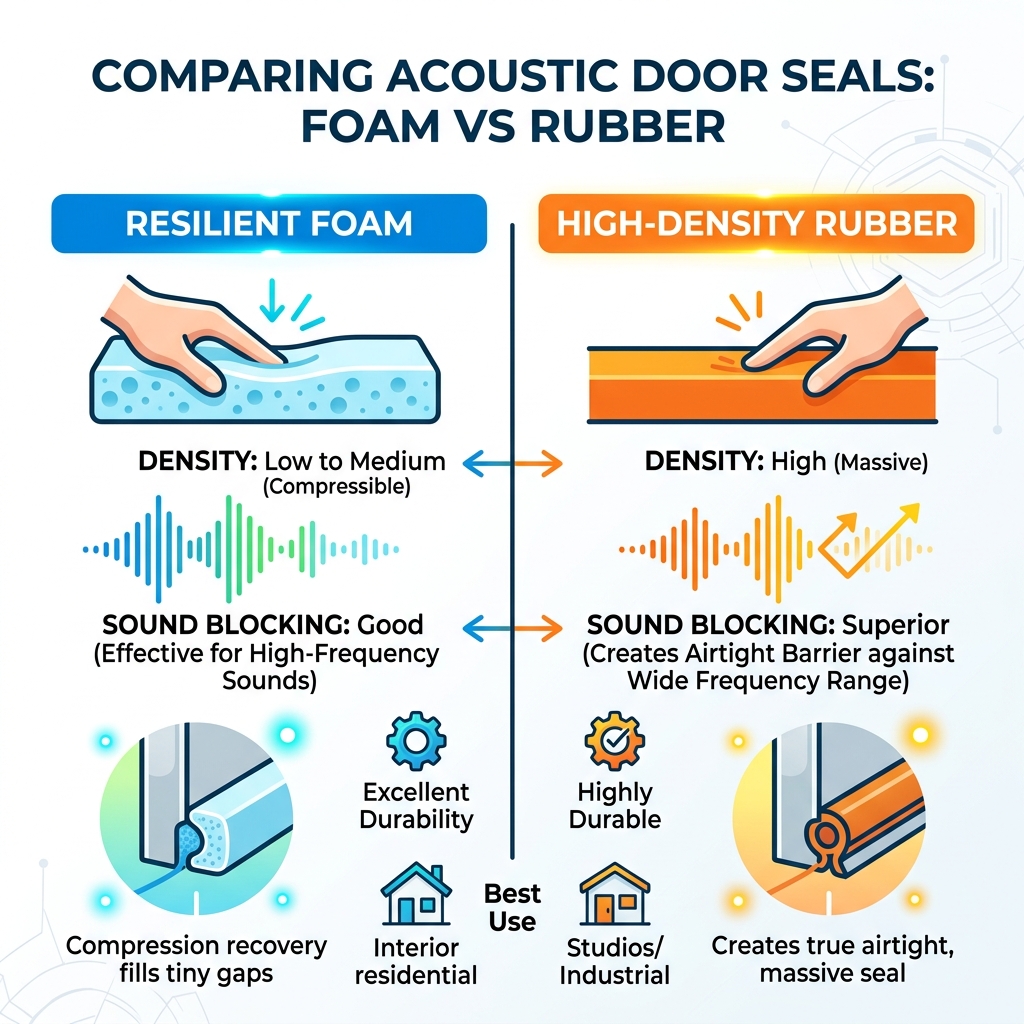
| Feature | Resilient Foam | Neoprene/Rubber | Polyurethane |
|---|---|---|---|
| Density | Low to Medium | High | Medium |
| Durability | Moderate | Excellent | High |
| Acoustic Seal | Good (Compressible) | Superior (Airtight) | Very Good |
| Best Use | Interior residential | Studios/Industrial | High-traffic areas |
Resilient Foam and Polyurethane Acoustic Door Insulation Materials
Open-cell foam and polyurethane are the “bread and butter” of residential door kits. These materials are prized for their “compression recovery.” This means when you close the door, the foam squishes down to fill every tiny nook and cranny of the door frame, then pops back to its original shape when the door opens.
Polyurethane foam is often non-toxic and non-carcinogenic, making it safe for homes and apartments. Because it is lightweight and usually features a self-adhesive backing, it’s the go-to for quick fixes. While it doesn’t have the heavy mass of rubber, it is incredibly effective at stopping high-frequency sounds like whistling wind or distant voices.
High-Density Rubber and Silicone Acoustic Door Insulation Materials
If you are serious about silence—think recording studios or home theaters—you need the “heavy hitters”: Neoprene and EPDM rubber. These acoustic door insulation materials are much denser than foam.
High-density rubber creates a true airtight seal that is nearly impossible for sound waves to penetrate. These materials are also moisture-resistant and highly durable, meaning they won’t degrade after a few thousand “opens and closes.” In heavy-duty applications, silicone or rubber gaskets are often used because they can handle the weight of solid core doors without losing their sealing properties.
Essential Components: Seals, Sweeps, and Gaskets
To treat a door completely, we have to look at it as a system. You can’t just slap a piece of foam on the side and call it a day. You need to address the top, the sides, and the dreaded bottom gap.
- Perimeter Seals: These line the “jamb” (the frame) where the door hits when it closes.
- Adjustable Jamb Seals: These are mechanical pieces that can be tightened to ensure the seal is perfectly snug against the door leaf.
- Door Sweeps: These attach to the bottom of the door. Door sweeps a practical solution for noise reduction because the gap between the door and the floor is usually the largest “sound leak” in the room.
- Astragal Seals: Used specifically for double doors (French doors) to seal the vertical gap where the two doors meet.
Standard vs. Heavy-Duty Seal Kits
Not all doors are created equal. A standard interior door in a modern home is often a “hollow core” door—essentially two thin pieces of wood with air or cardboard inside. A heavy-duty kit is designed for solid core doors, which can weigh over 100 pounds.
Standard kits usually include self-adhesive foam tape and a simple screw-on sweep. Heavy-duty kits, like those found among the top rated soundproof door seals on the market, often feature anodized aluminum housings and thick rubber gaskets that provide much higher noise reduction.
Automatic Door Bottoms and Thresholds
The “gold standard” of door soundproofing is the automatic door bottom. Unlike a standard sweep that drags across the floor (and eventually wears out or leaves a gap), an automatic door bottom uses a mechanical “plunger.”
When the door closes, a hidden button hits the frame, triggering a thick neoprene seal to drop straight down onto the floor or threshold. This creates a pressurized, airtight seal that can drastically improve the Sound Transmission Class (STC) of any door. If you have carpet, you’ll want to install a hard threshold transition for the seal to land on, ensuring the best possible result. For more on this, see how to soundproof a door gap effectively 2.
Performance Metrics: STC Ratings and Effectiveness
How do we actually measure if these acoustic door insulation materials are working? We use the Sound Transmission Class (STC) rating. This is a lab-tested integer that tells us how much sound a partition (like a door) stops.
The statistics are quite revealing:
- Standard 1-3/4″ Solid Core Door (No Seals): STC 22 (You can hear almost everything).
- Same Door (With Door Soundproofing Seals): STC 33 (Voices become a faint murmur).
- Heavy 7 lbs/sf Door (With Seals): STC 46 (Loud music is reduced to a whisper).
The magic happens through “friction-to-heat conversion.” Materials like 3M™ Thinsulate™ 3M™ Thinsulate™ Acoustic Insulation AU6020 | 3M United States use millions of tiny microfibers. When sound waves hit these fibers, they vibrate. That vibration creates friction, which turns the sound energy into tiny amounts of heat. The sound doesn’t just “stop”—it is literally transformed and dissipated.
Installation Guide for Acoustic Door Insulation Materials
Installation is the part where most people get nervous, but we promise it’s easier than it looks! The most important step isn’t the sticking; it’s the measuring.
Measuring for a Perfect Fit
You need to measure the “nominal dimensions” of your door. A standard door is typically 36″ x 80″. However, you should also measure the “shadow joints”—the actual air gaps between the door and the frame.
Pro Tip: Use the “Flashlight Test.” Have a friend stand on the other side of the closed door with a bright flashlight and run it along the edges. If you see light peeking through, sound is definitely getting through. This is exactly how to soundproof a door gap effectively—find the light, and you’ve found the leak.
Step-by-Step Application Process
- Clean the Surface: This is vital. Use rubbing alcohol to remove dust and oils from the door frame so the adhesive sticks permanently.
- Cut to Length: Use sharp shears to cut your acoustic door insulation materials to the exact height of your jambs.
- Adhere the Seal: Peel the backing and press the seal into the corner of the door stop. You want it positioned so the door compresses the seal when it latches.
- Install the Sweep: If using a screw-on sweep, mark your holes while the door is closed to ensure it touches the floor evenly.
- Test the Closure: The door should require a tiny bit of extra push to latch—that’s how you know the seal is airtight!
For a more detailed walkthrough, check out our guide on the DIY soundproof door.
Advanced Strategies: Beyond Simple Seals
If you’ve sealed the gaps and still hear noise, the sound might be coming through the door itself. This happens often with hollow core doors.
In these cases, we recommend adding “mass.” You can use sound barrier sheets or Mass-Loaded Vinyl (MLV). These are heavy, flexible sheets that you can adhere to the face of the door. Combining these with perimeter seals creates a “systemic” solution.
You should also look for “hidden” leaks. Sound can travel through electrical boxes or under the door casing. Using OSI® SC-175 Acoustical Caulk or putty pads around outlets can prevent the “triple leaf effect,” where sound bounces between layers of a wall or door and actually gets louder at certain frequencies.
We often suggest using specialized automotive-grade insulation for interior cavities, such as 3M™ Thinsulate™ Acoustic Insulation TC1803 or 3M™ Thinsulate™ Acoustic Insulation TC3303 , which are designed to fill irregular spaces and absorb high-frequency noise.
Frequently Asked Questions about Door Insulation
How do I know if my door needs insulation?
If you can hear a conversation from the hallway as if the person were in the room, or if you can see light under the door, you need insulation. The “Flashlight Test” mentioned above is the easiest diagnostic tool.
Can I soundproof a hollow core door effectively?
Effectively? Yes. Completely? No. A hollow core door lacks the density to stop low-frequency bass. While acoustic door insulation materials like seals and sweeps will help significantly with voices and air-borne noise, you may eventually want to replace the door with a solid core model for maximum silence.
Will acoustic seals damage my door’s paint?
Most high-quality kits use “residue-free” adhesives. However, if you are worried about removal, use a hair dryer or heat gun to gently warm the adhesive before peeling it off. This softens the glue and protects the paint underneath. For temporary setups, products like DOORIE Pure -Door insulation set for replacement | aixFOAM offer specific mounting options for easy removal.
Conclusion
At Finance No Vax, we believe that your home should be your sanctuary. Whether you are building a professional recording studio or just trying to get some peace and quiet in your home office, choosing the right acoustic door insulation materials is the first step toward a quieter life.
Start by sealing the gaps with a high-quality kit, and if the noise persists, consider adding mass-loaded barriers. These small upgrades offer a massive return on investment in terms of focus, privacy, and comfort.
Ready to take the next step in your soundproofing journey? Check out more info about DIY soundproofing solutions to see how you can silence the rest of your space!
