
Why Neighbor Noise Is Harder to Escape Than You Think
How to block sound from neighbors is one of those problems that sounds simple until you’re deep in your third hour of your neighbor’s bass thumping through your wall during a video call.
Here’s a quick overview of the most effective methods:
- Seal all gaps around doors and windows with acoustic caulk and door sweeps
- Add mass to shared walls using bookshelves, mass-loaded vinyl, or a second layer of drywall
- Layer your floors with thick, high-KPSI rugs and felt pads
- Install window inserts for up to 70-90% noise reduction
- Hang heavy curtains (12-18 oz/yd fabric) to absorb sound at windows
- Use white or brown noise machines to mask what gets through
- Build an outdoor buffer with tall fences and dense evergreen hedges
Noise from neighbors isn’t just annoying. It affects your focus, your sleep, and over time, your health. In England alone, a noise complaint is filed for every 160 people in the country. And 20% of the population lives in areas where traffic noise reaches levels that are actively harmful.
For remote workers, the stakes are even higher. Your home is your office. Every thud, shout, or bass drop chips away at your concentration.
The good news? You don’t need to gut your walls or spend a fortune to make a real difference. But you do need to understand how sound travels before you can stop it.
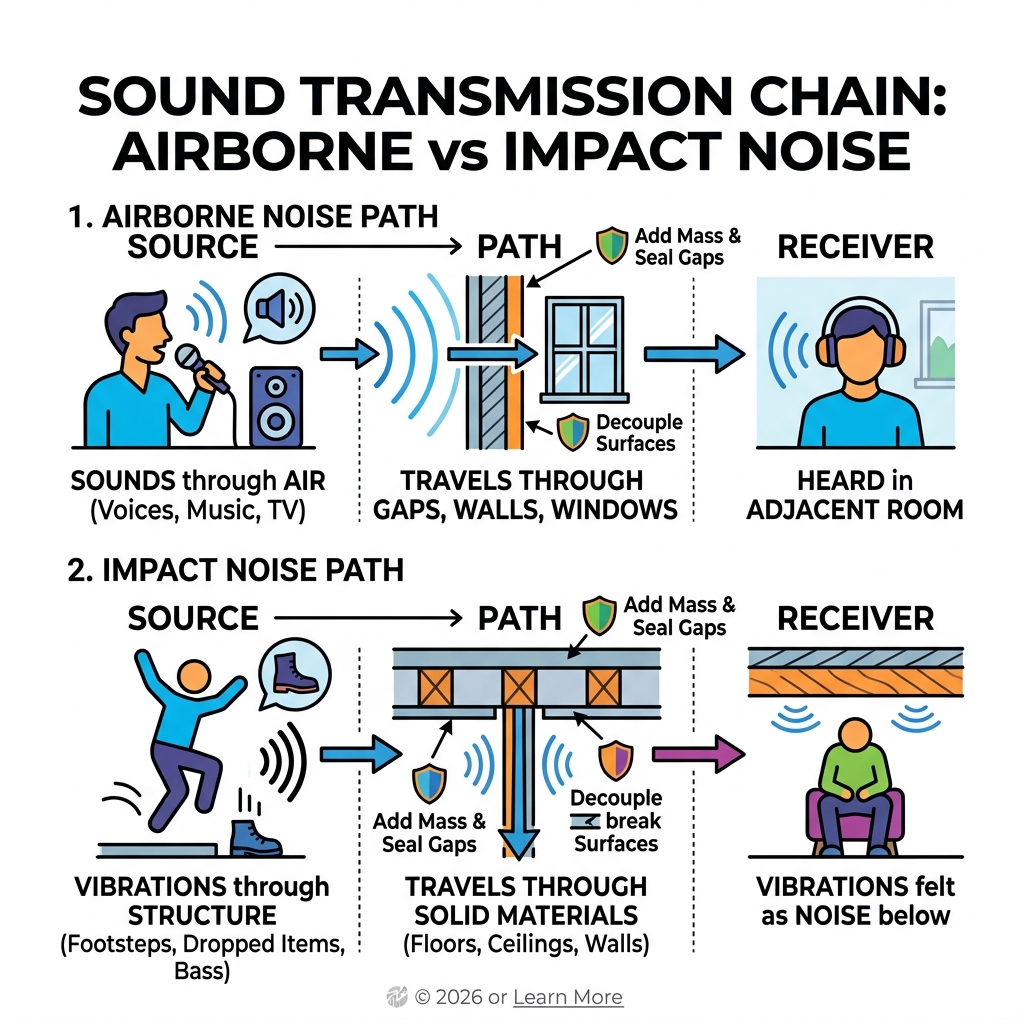
Sound moves in two ways:
- Airborne noise – voices, music, TV – travels through the air and passes through walls and windows
- Impact noise – footsteps, dropped items, bass vibrations – travels directly through solid surfaces like floors and walls
Stopping either type comes down to three core principles: mass (heavier materials block more sound), airtightness (even a 1% gap leaks up to 30% of sound), and decoupling (breaking the physical connection between surfaces so vibrations can’t travel through).
Most DIY fixes fail because they ignore at least one of these. We’ll make sure you don’t. For a deeper look at how sound actually moves through your home, check out our guide on understanding noise and how it travels through walls.
How to Block Sound from Neighbors Using Structural Upgrades
If you own your home or have a landlord open to improvements, structural upgrades provide the most “pro-level” silence. These methods rely on the science of Sound Transmission Class (STC) ratings. A typical interior wall has an STC of about 33; you can still hear loud speech. Once you hit an STC of 45–50, loud speech becomes a faint murmur.
Adding Mass and Damping
The most common structural fix is adding a second layer of drywall. However, simply nailing another sheet up won’t do much. You need a damping compound like Green Glue between the layers. This non-hardening polymer converts sound energy into heat. Adding a second layer of drywall with a damping compound can improve your wall’s STC rating by 8 to 15 points.
The Power of Mass-Loaded Vinyl (MLV)
MLV is a dense, flexible material used since the 1960s to quiet everything from luxury cars to boat engines. It’s essentially a “limp mass” that stops sound waves in their tracks. You can staple it directly to studs or sandwich it between layers of drywall to create a formidable barrier against both airborne and impact noise.
Decoupling with Resilient Channels
Decoupling is the “holy grail” of soundproofing. It involves breaking the physical connection between the two sides of a wall so vibrations can’t pass through the framing. Using resilient channels—thin metal rails that keep the drywall slightly separated from the studs—creates a flexible “spring” that absorbs vibration. A fully decoupled wall system can achieve an STC of 63, which is enough to block even heavy bass and loud music.
Insulation: Filling the “Echo Chamber”
Empty wall cavities act like the body of a guitar, amplifying sound. Filling these gaps with mineral wool (like Rockwool) or fiberglass insulation helps absorb mid-to-high frequency sounds.

| Wall Type | Estimated STC Rating | Noise Perception |
|---|---|---|
| Standard 2×4 Stud Wall | 33 | Loud speech clearly heard |
| Wall with Mineral Wool | 37-39 | Loud speech heard but not understood |
| Double Drywall + Green Glue | 45-50 | Loud speech is a faint murmur |
| Decoupled Wall (Clips/Channels) | 55-63 | Music and shouting are effectively blocked |
7 Clever Hacks to Block Out Your Noisy Neighbors
While structural changes are great, they aren’t always feasible for renters or those on a tight budget. Fortunately, you can achieve significant noise reduction using “maximalist” interior design and clever DIY tricks. Our renters guide to soundproofing covers many of these in detail, but let’s dive into the seven most effective hacks to reclaim your peace.
1. Seal the Gaps: How to Block Sound from Neighbors via Doors and Windows
Sound behaves exactly like water; if there is a hole, it will pour through. A gap as small as 1% in a door or window frame can leak up to 30% of the sound from the other side. If that gap reaches 5%, you might as well have the door wide open, as 90% of the noise will get through.
Acoustic Caulking
Check the perimeter of your window frames and electrical outlets on shared walls. Use acoustic caulk (which stays flexible over time) to seal these micro-gaps. Standard caulk eventually cracks, letting noise back in.
The Door Problem
Most interior doors are “hollow core,” which are essentially two thin sheets of veneer over a cardboard honeycomb. They act like drums for noise. If you can, replace your bedroom or office door with a solid-core door. These typically weigh around 66 lbs and provide the mass necessary to block voices.
Don’t forget the bottom of the door! We’ve written extensively about how to soundproof a door gap effectively. Use a heavy-duty door sweep and adhesive weather stripping to create an airtight seal.
Window Inserts
If street noise or neighbor yard noise is the culprit, window inserts are a game-changer. These are acrylic panels that press-fit into your existing window frame. They create an airtight seal and an insulating air gap, often reducing noise by 70% to 90%.
2. Use Furniture as a Shield: How to Block Sound from Neighbors with Bookshelves
One of the oldest tricks in the book (literally) is using heavy furniture to add mass to a shared wall. A wall-to-wall, floor-to-ceiling bookshelf filled with books is a fantastic sound dampener.
Why It Works
- Mass: Books are incredibly dense. A full shelf adds hundreds of pounds of mass to the wall.
- Surface Area: The irregular shapes of book spines help diffuse sound waves, preventing them from bouncing back into the room.
- Vibration Dampening: Heavy furniture pressed against a wall can help reduce the vibration of the wall itself.
For the best results, use hardwood bookshelves rather than softwood or particle board. Hardwoods block sound more effectively, while softwoods tend to absorb it. If you want to go the extra mile, you can even hide a layer of Mass Loaded Vinyl or foam panels behind the bookshelf for an invisible sound barrier. This is a staple of quiet living in apartments.
3. Layer Your Floors with High-KPSI Rugs
If you have a “lead-footed” neighbor living above you, or if you’re trying to prevent your own noise from bothering the neighbors below, rugs are your best friend. However, not all rugs are created equal.
The KPSI Factor
When shopping for rugs, look for KPSI (Knots Per Square Inch). A rug with 100+ KPSI is good, but 300+ KPSI is great for sound blocking. These rugs are woven so tightly that they become a dense barrier. Vintage Turkish, Persian, or Moroccan rugs are often excellent choices for this.
Don’t Skip the Pad
The rug itself only does half the work. The real magic happens in the rug pad.
- Felt Pads: A 1/2-inch thick felt pad is the best for absorbing speech and music because the dense fibers trap sound waves.
- Memory Foam: A 7/16-inch memory foam pad is better for “impact noise” like footsteps.
Adding a thick rug and a high-quality pad can reduce the echo in your room and dampen the thuds from above. It’s a simple, non-permanent fix that landlords love because it protects the flooring too!
4. Install Sound-Dampening Window Treatments
Windows are often the weakest link in a room’s soundproofing. While standard blinds do nothing for noise, specialized curtains can make a noticeable dent in the “hum” of the outside world.
What to Look For
To actually block sound, a curtain needs mass. Look for fabric that weighs at least 12–18 oz/yd. Heavy velvet or specialized “blackout” drapes are usually the best candidates.
The “Fullness” Rule
For curtains to be effective, you need 100% fullness. This means if your window is 50 inches wide, you should buy 100 inches worth of curtain width. This creates deep pleats that trap sound waves. Additionally, mount your curtain rod so it extends 3–4 inches past the window frame on all sides and hangs as close to the wall as possible to prevent “light and sound leaks.”
While these won’t stop a jackhammer, they can reduce external noise by a few decibels and significantly improve the “quiet feel” of your room.
5. Decorate with Acoustic Art and Tapestries
If you have large, bare walls, you’re living in an echo chamber. Sound bounces off hard surfaces, making every neighbor’s cough or TV show sound twice as loud. You can fix this while improving your home’s aesthetic by choosing the right decor.
Acoustic Art Panels
You can now buy acoustic panels that look exactly like canvas art. These are filled with sound-absorbent material (like fiberglass or rockwool) and can absorb over 90% of the airborne noise that hits them.
The “Panty Liner” Hack
For a budget-friendly DIY version, take your existing framed art and tack felt, foam, or even panty liners (yes, really—it’s a famous Reddit hack!) to the back of the frame. This creates a small buffer of absorption between the art and the wall, helping to deaden vibrations.
Tapestries and Gallery Walls
Hanging heavy fabric tapestries or creating a dense “gallery wall” with many small frames also helps break up the flat surface of the wall, reducing the “flutter echo” that makes noise so annoying. Learn more about the difference between soundproofing and acoustic treatment to see which your room needs most.
6. Mask Disturbances with White and Brown Noise
Sometimes, you can’t stop the noise from entering, so you have to hide it. This is called sound masking. It doesn’t actually “cancel” the noise, but it raises the “noise floor” of your room so that sudden sounds (like a neighbor’s door slamming) aren’t as jarring.
White vs. Brown Noise
- White Noise: Contains all frequencies. It sounds like a “hiss” or a radio between stations. It’s great for masking high-pitched sounds like talking or whistling.
- Brown Noise: Has more energy at lower frequencies. It sounds like a deep rumble or a distant waterfall. This is much more effective at masking low-frequency sounds like thumping bass, snoring, or idling cars.
Using a dedicated sound machine or even a high-quality box fan can create a “privacy curtain” of sound that helps you sleep or focus through the chaos.
7. Create an Outdoor Sound Buffer
If the noise is coming from a neighbor’s yard—think barking dogs or loud patio parties—you need to address the “line of sight.” If you can see the noise source, you can hear it.
Fences and Walls
A standard chain-link fence does absolutely nothing for noise. To block sound, you need a solid, heavy barrier.
- Height: Fences should be at least 6–12 feet tall to effectively diffract sound waves upward and away from your ears.
- Material: Thick wood, vinyl, or masonry (brick/concrete) are the best choices.
Landscaping
While plants aren’t as effective as solid walls, a vegetation belt of 100 feet or more can provide a 5–8 dB reduction. For most residential yards, a dense row of evergreens or bamboo acts as a “diffuser,” breaking up sound waves so they aren’t as sharp when they reach your house. Adding a water feature, like a bubbling fountain, can also provide natural sound masking for your outdoor space.
Common Soundproofing Mistakes to Avoid
In our years of helping people find peace and quiet, we’ve seen the same mistakes repeated over and over. Avoid these to save your time and money:
- Using Egg Crates: This is a myth. Egg crates are thin cardboard; they do not block sound, and they are a massive fire hazard.
- Foam “Acoustic” Panels for Blocking: Those cheap foam pyramids you see on Amazon are for absorption (stopping echoes inside a room). They have almost zero mass and will not stop your neighbor’s music from coming through the wall.
- Ignoring the Gaps: You can spend $1,000 on a soundproof door, but if there’s a half-inch gap at the bottom, it’s useless.
- Treating the Wrong Surface: If you hear footsteps from above, soundproofing your walls won’t help. You must address the ceiling or the floor above.
- Overestimating Curtains: “Soundproof” curtains are great for dampening, but they won’t stop a loud neighbor’s party. They are a supplementary tool, not a primary solution.
Frequently Asked Questions about Soundproofing
Can you completely soundproof a room?
Technically, yes, but not in a standard residential home. To achieve “true” silence, you would need an anechoic chamber, which involves massive structural decoupling and thick layers of specialized materials. For most of us, “completely soundproof” is an unrealistic goal. Instead, aim for “noise reduction”—lowering the volume to a point where it no longer disturbs your daily life.
Do plants actually block neighbor noise?
Plants are better at diffusing and absorbing sound than blocking it. A single potted plant won’t do much, but a thick “green wall” or a dense hedge can reduce noise by 5–8 dB. They are most effective when used as a supplement to a solid fence or wall.
What is the cheapest way to block noise?
The most budget-friendly move is rearranging your furniture. Move your heavy dresser or bookshelf to the shared wall. After that, use acoustic caulk to seal gaps and download a white noise app on an old phone. These three steps cost almost nothing but can make a surprising difference.
Conclusion
At Finance No Vax, we believe your home should be your sanctuary. Dealing with noisy neighbors is a test of patience, but with the right combination of mass, sealing, and masking, you can reclaim your quiet.
Before you start any major project, it’s always worth a polite “neighbor diplomacy” chat or checking your local noise ordinances via tools like Municode. Sometimes, a simple conversation—or a well-placed rug—is all it takes to resolve the issue. If the noise persists, use the hacks above to build your own fortress of solitude.
For more tips on creating a tranquil home environment, explore our full range of quiet living solutions. Peace and quiet are within reach!
