
When Your Neighbour’s TV Becomes Your Problem
How to block out neighbours tv noise is something millions of people deal with every day — especially those working from home.
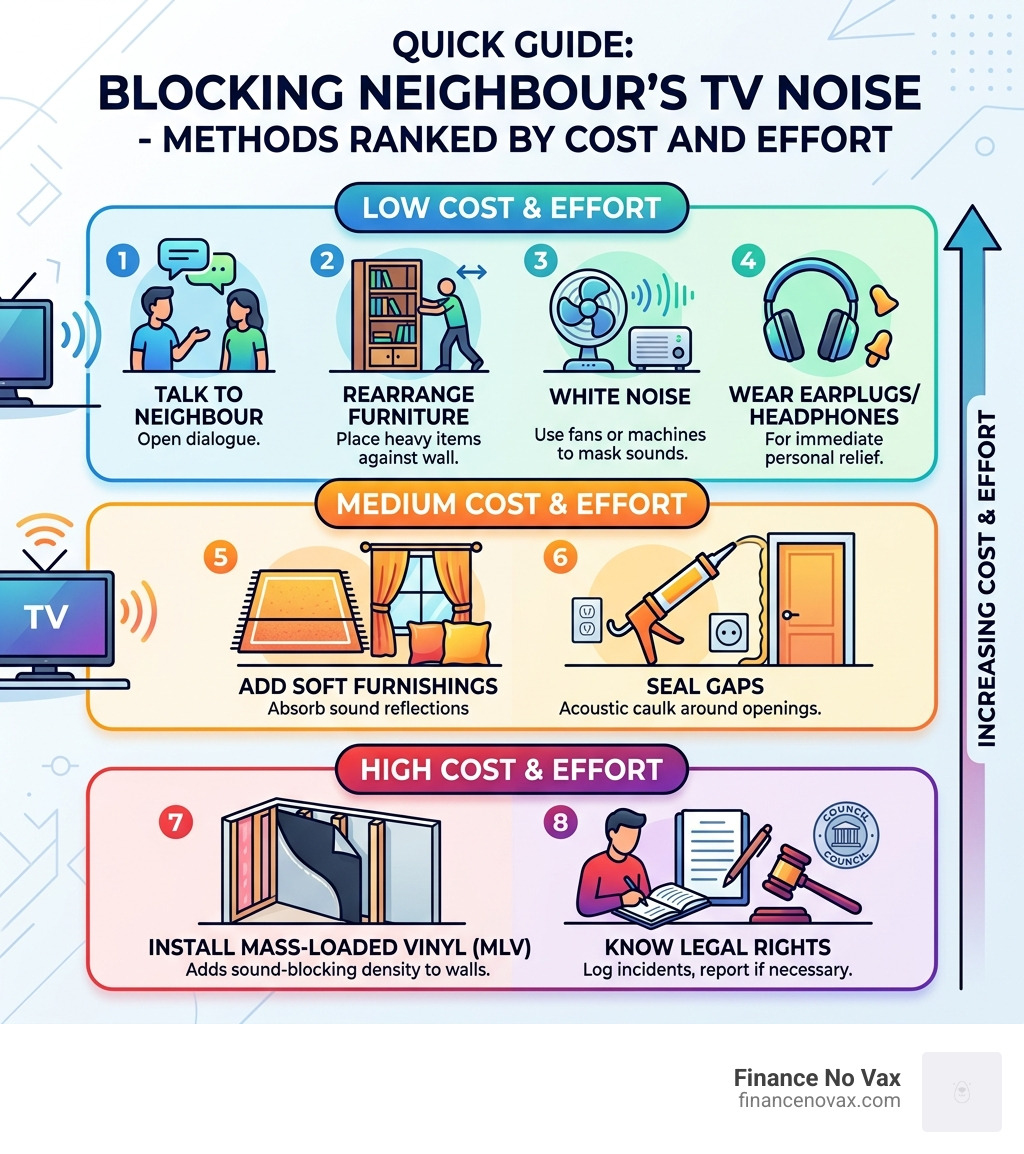
Here are the most effective ways to tackle it:
- Talk to your neighbour first — they may not realise how loud their TV is
- Rearrange furniture — place bookshelves or sofas against the shared wall
- Add soft furnishings — thick rugs, heavy curtains, and cushions absorb sound
- Seal gaps — use acoustic caulk around outlets, doors, and window frames
- Install mass-loaded vinyl (MLV) — a dense material that blocks sound through walls
- Use white noise — a fan, air purifier, or white noise machine masks TV frequencies
- Wear noise-cancelling headphones or earplugs — for immediate, personal relief
- Know your legal rights — log noise incidents and report to your local council if needed
Sound travels further than most people expect. TV audio doesn’t just pass through the wall in front of you. It vibrates through joists, sneaks through outlet gaps, and bounces off hard floors. In older homes or thinly built apartments, even a moderately loud TV next door can feel like it’s in the same room.
If you’re working from home, this isn’t just annoying — it breaks your concentration, raises your stress levels, and chips away at your productivity hour by hour.
The good news? You don’t need a full renovation to get meaningful relief. There are solutions at every budget, from free furniture rearrangement to DIY wall treatments to personal noise-blocking devices.
Understanding How TV Sound Travels Through Your Home
Before we start throwing blankets at the wall, we need to understand the enemy. Sound is a bit like water; it finds the path of least resistance. When your neighbour turns on their TV, the sound doesn’t just travel in a straight line.
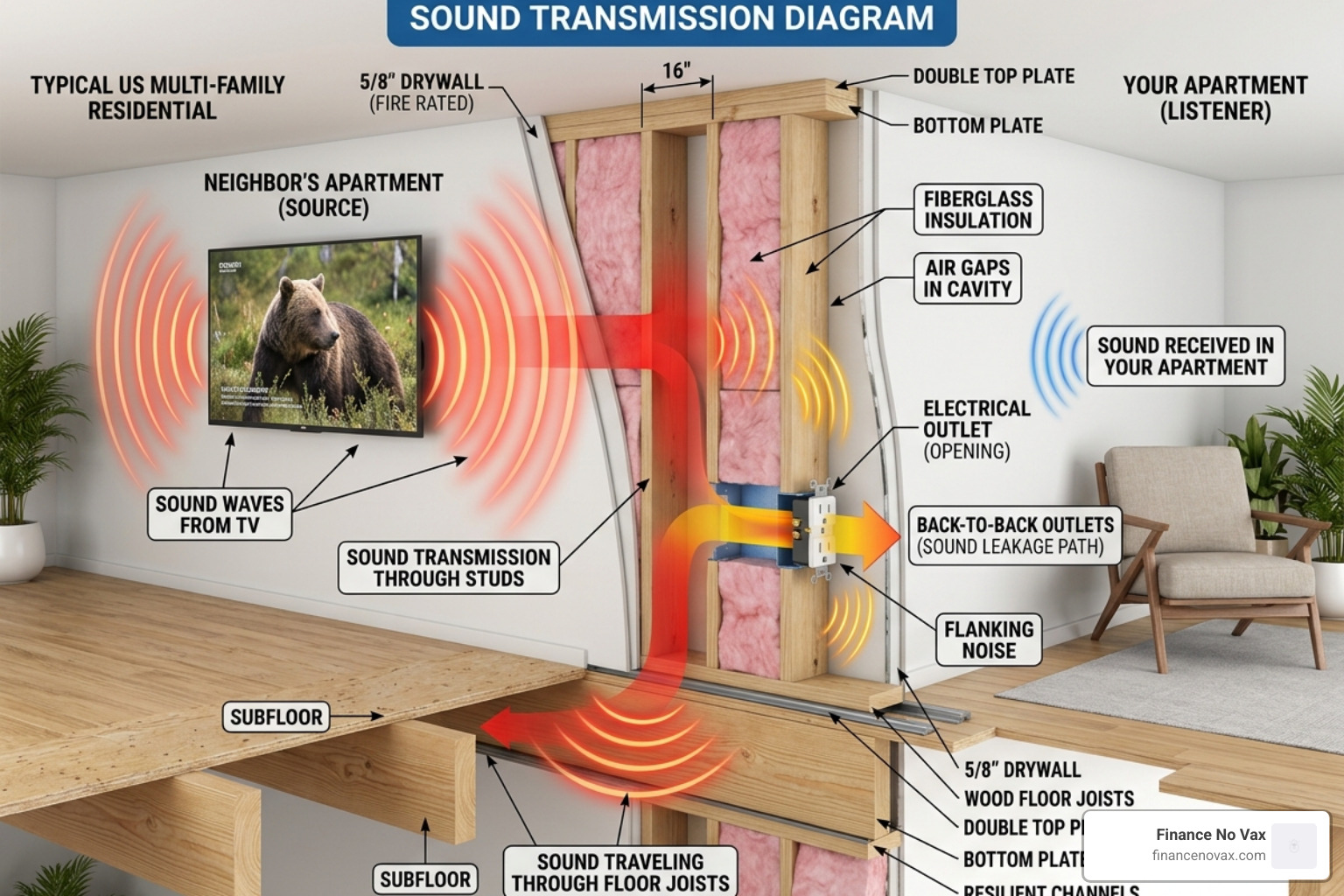
There are two primary ways TV noise reaches your ears:
- Airborne Noise: This is the sound traveling through the air. It leaks through gaps under doors, through vents, or even through porous wall materials. When you hear the dialogue of a sitcom, that’s usually airborne noise.
- Structure-borne Vibration: This is more common with high-volume setups or TVs with subwoofers. The sound waves hit the wall, causing the wall studs and floor joists to vibrate. These vibrations travel through the “bones” of the building and exit on your side as audible sound.
We also have to watch out for “flanking paths.” This is sound that travels through shared ducts, pipes, or floorboards rather than directly through the wall. To learn more about the physics of this, check out our guide on Understanding Noise: How Noise Travels Through Walls.
Why Thin Walls Amplify Television Frequencies
Many modern apartments and older converted houses suffer from “thin wall syndrome.” In the UK, many 1940s-1960s homes use breeze block party walls which are notoriously bad at stopping sound.
Furthermore, the “dot and dab” method of plastering—where plasterboard is stuck to the wall with dabs of adhesive—creates a small air gap between the brick and the board. This gap can actually act like a drum, amplifying the sound of the neighbour’s TV. If you live in a compact space, these architectural quirks can make life very loud. For more on this, see our tips on Silence in Close Quarters: Soundproofing for Small Spaces.
First Steps: Communication and Legal Rights
We always recommend that the very first thing you do—before spending a penny on soundproofing—is to have a friendly chat. Often, neighbours have no idea that their TV is audible next door. They might have their sofa right against the shared wall, or perhaps they have a slight hearing impairment.
When you approach them, be polite and calm. Avoid going over while the noise is happening and you’re already frustrated. Instead, try saying, “Hey, I’ve noticed the TV sound carries quite a bit into my living room. Would you mind turning it down a notch or moving the speakers away from the wall?” For more strategies on maintaining a quiet home, read Home Peace: Best Ways to Reduce Noise at Home.
When to Talk to Your Neighbor About TV Volume
If a polite chat doesn’t work, you may need to look into your legal options. In the UK, the Noise Act 1996 sets specific limits for “night hours” (11 pm to 7 am). During these times, noise shouldn’t exceed 10 dBA above the background noise level if that background is over 24 dBA. If the background is lower, the limit is a flat 34 dBA.
If the noise is a constant problem, start a noise log. Record the date, time, duration, and the impact it has on your life (e.g., “couldn’t sleep,” “interrupted work meeting”). You can even use a decibel meter app on your phone to get a rough idea of the volume. If the situation becomes unbearable, you can report it to your local council as a “statutory nuisance.”
Low-Cost and DIY Ways to Block Out Neighbours TV Noise
If the neighbour is unwilling to change or the building is simply too thin-walled, it’s time to take matters into our own hands. You don’t always need a construction crew to see results.
The secret to blocking sound is mass. The heavier and denser an object is, the harder it is for sound waves to move it. This is why a thick brick wall is quieter than a sheet of plywood. You can find more ideas in our article on Budget-Friendly Ways to Soundproof a Wall.
Using Decor to Block Out Neighbours TV Noise
Decor isn’t just for looks; it can be a functional sound barrier.
- Acoustic Tapestries: Hanging thick, heavy fabric on the shared wall can help absorb mid-to-high frequency sounds.
- Canvas Art with a Twist: A popular hack is to take a large canvas painting and stuff the back with acoustic foam or even fiberglass insulation. This turns your art into a hidden sound absorber.
- Heavy Drapes: If the sound is coming through windows or shared balconies, blackout curtains are your best friend. They are thick enough to dampen incoming sound waves significantly.
For more on using aesthetics to fight noise, see Taming Echoes: Indoor Noise Reduction Tips.
Strategic Furniture Placement for Sound Absorption
One of the most effective “free” ways to how to block out neighbours tv noise is to rearrange your room.
- The Bookshelf Barrier: A floor-to-ceiling bookshelf filled with books is one of the best sound absorbers you can have. Place it directly against the shared wall. The uneven surfaces of the books also help diffuse sound, preventing it from echoing.
- Wardrobes and Cabinets: Large, heavy wooden furniture can act as an extra layer of “wall.”
- Upholstered Furniture: Moving a large, plush sofa against the noisy wall can help soak up vibrations.
If the noise is keeping you up at night, check out our Budget-Friendly Bedroom Soundproofing Solutions.
Advanced Soundproofing for Walls, Floors, and Ceilings
When the “easy fixes” aren’t enough, we have to look at structural solutions. This involves adding density and decoupling the surfaces so vibrations can’t travel through.
One of the gold standards for DIYers is Mass-Loaded Vinyl (MLV). This is a heavy, flexible material (usually 1 lb per square foot) that you can staple to the wall or sandwich between layers of drywall. It is incredibly effective at deadening TV noise. For a more permanent project, you might consider adding a second layer of acoustic plasterboard with a layer of Green Glue (a noise-damping compound) in between.
If you’re ready for a bigger project, our DIY Projects: Step-by-Step Guide to Soundproofing a Room is a great place to start.
| Method | DIY Cost | Professional Cost | Effectiveness |
|---|---|---|---|
| Furniture Rearrangement | £0 | N/A | Low-Medium |
| Heavy Curtains/Rugs | £50 – £200 | N/A | Medium |
| Mass-Loaded Vinyl (MLV) | £150 – £400 | £800 – £1,500 | High |
| Independent Stud Wall | £300 – £600 | £1,500 – £3,000 | Very High |
Structural Fixes to Block Out Neighbours TV Noise
Sometimes the sound isn’t coming through the wall, but through the gaps around the wall.
- Acoustic Caulk: Use this to seal cracks around window frames, baseboards, and electrical outlets. Sound leaks through these tiny holes like air through a whistle.
- Door Sweeps and Weatherstripping: If the TV noise is coming from a shared hallway, a solid door with a good sweep can make a world of difference. Check out How to Soundproof a Door Gap Effectively and our guide on Door Sweeps: A Practical Solution for Noise Reduction.
Renter-Friendly Non-Permanent Solutions
If you’re renting, you probably can’t tear down walls or add extra drywall. However, you still have options:
- Acoustic Blankets: These are heavy-duty blankets (often used by movers) that you can hang using command hooks or tension rods.
- Interlocking Floor Mats: If the TV noise is coming from the neighbour below, thick rubber gym mats placed under your area rug can help decouple the floor.
- Tension Rod Curtains: You can create a “false wall” of heavy fabric without drilling a single hole.
For more renter-specific advice, see our Renter’s Guide: Soundproofing for Renters and Quiet Living: Soundproofing for Apartments.
Personal Noise Masking and Blocking Alternatives
Sometimes, the best way to deal with noise is to make sure you can’t hear it, even if it’s still there. This is especially useful if you need peace right now.
Noise-cancelling headphones are a lifesaver for many. They use active noise control to create “anti-noise” that cancels out the incoming sound waves. For sleeping, many people swear by Loop earplugs. These are designed to be comfortable for side-sleepers and can reduce sound by up to 24 decibels. With over 10 million happy customers, they are a proven way to find some quiet.
If you prefer not to wear something on your head, look into Keeping Quiet: Affordable Noise Reduction Ideas.
Effective Sound Masking Devices
Sound masking doesn’t “block” the TV noise; it raises the background noise level so the TV becomes indistinguishable.
- White Noise Machines: These produce a steady “shhh” sound that covers a wide range of frequencies.
- Fans and Air Purifiers: A simple box fan on a medium setting can create enough ambient noise to drown out a neighbour’s muffled TV dialogue.
- Pink Noise: Similar to white noise but with more power at lower frequencies, which is often better for masking the “thump” of a TV’s bass.
For more masking tips, read Top Ways to Soundproof Your Bedroom on a Budget.
Common Mistakes to Avoid When Soundproofing
We see people make the same mistakes over and over again. Save your time and money by avoiding these:
- The Egg Carton Myth: Egg cartons do nothing to block sound. They might slightly reduce echo inside a room, but sound waves will pass right through them.
- Acoustic Foam for Blocking: Those grey foam pyramids you see in recording studios are for “treatment” (reducing echo), not “blocking” (stopping sound from entering). They are too light to stop a neighbour’s TV.
- Ignoring the Gaps: You can soundproof 99% of a wall, but if there’s a gap under the door or an unsealed outlet, the sound will find its way in.
- Over-tightening Screws: When installing soundproofing panels, over-tightening can create a “bridge” that allows vibrations to pass through.
For more budget-conscious advice, see Affordable Solutions: Cheap Soundproofing Methods.
Frequently Asked Questions about Neighbor Noise
Can I soundproof my apartment without losing my security deposit?
Absolutely! Focus on “soft” soundproofing. Use heavy rugs, floor-to-ceiling bookshelves (not attached to the wall), and heavy blackout curtains. You can also use acoustic blankets hung with damage-free Command hooks.
How much does it cost to professionally soundproof a shared wall?
Professional soundproofing usually starts around £1,500 and can go up to £5,000 depending on the size of the wall and the materials used. While expensive, it is often the only way to achieve near-total silence.
Are white noise machines better than earplugs for TV noise?
It depends on your preference. White noise machines are great for “blurring” the sound so your brain stops focusing on it. Earplugs provide a more literal reduction in volume. Many people use both for the best results!
Conclusion
Reclaiming your peace and quiet from a neighbour’s TV doesn’t have to be an impossible task. Whether you start with a polite conversation, move your heavy wardrobe against the wall, or invest in a set of high-quality earplugs, every step brings you closer to a calmer home.
At Finance No Vax, we believe that a quiet home is an investment in your mental health and productivity. While some solutions require an upfront cost, the “ROI” of a good night’s sleep and a focused workday is immeasurable.
Reclaim your quiet home today and start enjoying the silence you deserve!
External Resources for Further Reading:
