
What It Really Costs to Soundproof a Floor (Quick Answer)
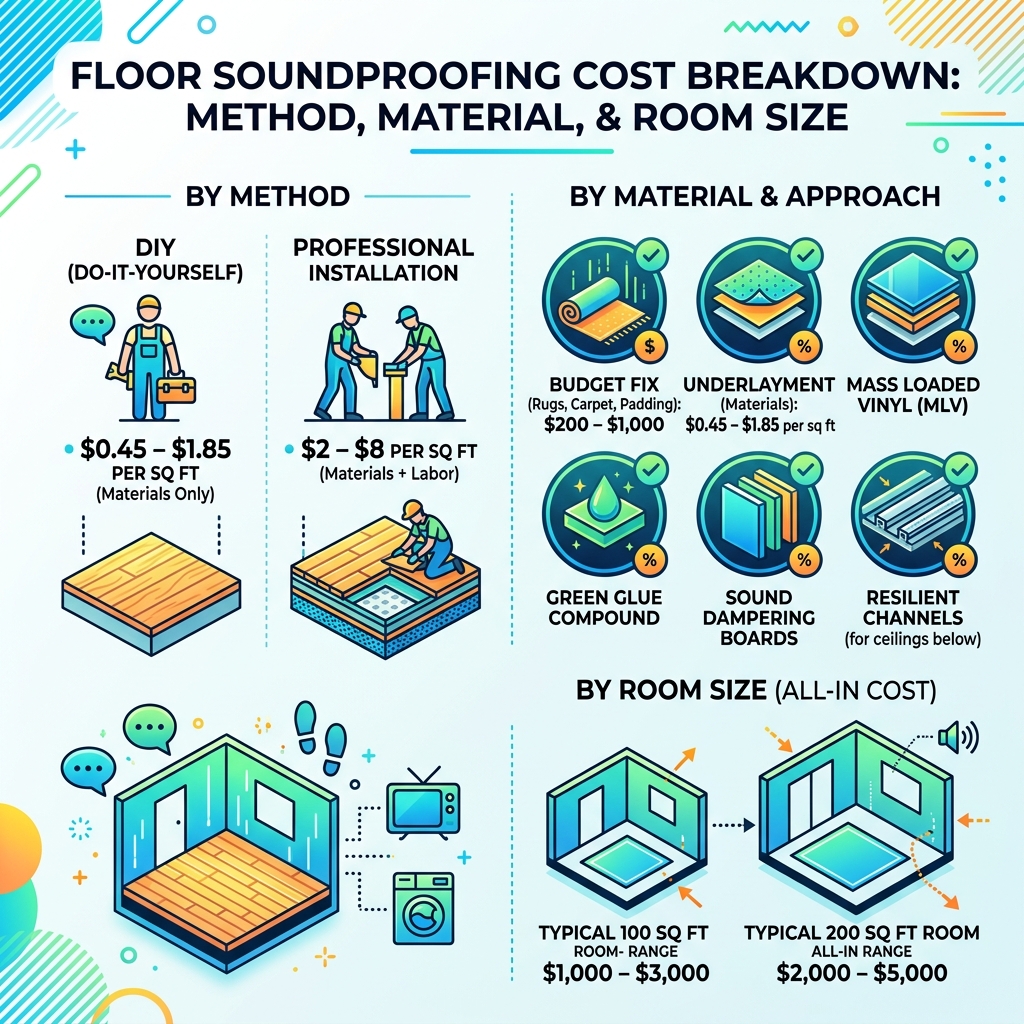
How much does it cost to soundproof a floor depends on your room size, materials, and whether you hire a pro — but here’s a fast breakdown:
| Approach | Estimated Cost |
|---|---|
| DIY underlayment materials only | $0.45 – $1.85 per sq ft |
| Full floor soundproofing (materials + labor) | $2 – $8 per sq ft |
| Typical 100 sq ft room (all-in) | $1,000 – $3,000 |
| Typical 200 sq ft room (all-in) | $2,000 – $5,000 |
| Budget option (rugs, carpet, padding) | $200 – $1,000 |
If you work from home, you already know the feeling. Footsteps from upstairs. The hum of a washing machine below. A neighbor’s TV bleeding through the floor. It kills focus and adds up to real stress over time.
The good news? Soundproofing a floor doesn’t always mean a massive renovation. There’s a wide range of options — from cheap DIY fixes to professional-grade installations — and the right choice depends on your budget, your flooring type, and how much noise you’re dealing with.
Most homeowners spend between $2 and $8 per square foot for floor soundproofing, but that number shifts a lot based on what you use and how it gets installed. A roll of budget underlayment might cost less than $50. A full professional retrofit of a large room could run $5,000 or more.
This guide walks you through every cost factor so you can plan a project that actually fits your budget.
Understanding the Average Cost to Soundproof a Floor
When we talk about the price of peace and quiet, we have to look at the two types of noise we’re trying to kill. First, there is airborne noise, like voices or music. Second, there is impact noise, which is the “thud-thud” of footsteps or a dropped remote.
To measure how well a floor handles these, the industry uses two ratings: STC (Sound Transmission Class) for airborne sound and IIC (Impact Insulation Class) for impact sound. Generally, the higher the number, the better the performance – and often, the higher the price tag.
On average, how much does it cost to soundproof a floor falls between $2 and $8 per square foot for a standard residential project. This range covers the basic materials and the labor required to put them in place. If you are looking at specialized high-performance materials or complex structural changes, those costs can climb toward $10 to $30 per square foot, especially in high-end home theaters or recording studios.

How much does it cost to soundproof a floor for a standard room?
Budgeting by the room is often easier than calculating every single inch. For a typical 100 square foot room (like a small home office or nursery), you can expect to pay between $1,000 and $3,000 for a professional job that includes mid-range materials.
If you have a larger 200 square foot room, the price typically scales to the $2,000 to $5,000 range. These estimates usually include the removal of existing flooring, the installation of a high-quality acoustic underlayment, and the laying of new top-layer flooring. If you are a fan of specialized solutions, you might want to start by looking into soundproof mats for floors to see if a localized fix works for your specific noise “hot spots.”
Material costs for how much does it cost to soundproof a floor project
If you’re planning to handle the installation yourself, the bulk of your budget will go toward materials. Here is what you can expect to pay for the “heavy hitters” in the soundproofing world:
- Mass-Loaded Vinyl (MLV): This is the gold standard for adding “limp mass” to a floor. It usually costs between $2 and $5 per square foot. It is incredibly dense but thin, making it perfect for sliding under carpets or hardwood. For a deeper dive, check out our complete guide to mass loaded vinyl for soundproofing.
- Eco Cork Foam: A popular retail choice that balances moisture protection with sound dampening, costing roughly $0.62 per square foot.
- QuietWalk: Another favorite for laminate and engineered wood, typically priced around $0.45 to $0.50 per square foot.
- Acoustic Insulation: If you have access to the floor joists from below, blown-in or loose-fill insulation can cost $1 to $3 per square foot for materials.
Key Factors Influencing Your Soundproofing Budget
Not all floors are created equal, and neither are the bills for fixing them. Several variables will dictate whether you’re looking at a three-figure or a five-figure invoice.
| Underlayment Type | Price per Sq. Ft. | Best Use Case |
|---|---|---|
| Basic Foam | $0.15 – $0.30 | Budget laminate installs |
| Recycled Rubber | $0.50 – $1.85 | Tile and high-traffic areas |
| Cork (Natural) | $0.60 – $1.10 | Eco-friendly, sustainable |
| Fiber/Felt | $0.35 – $0.60 | Hardwood and engineered wood |
| MLV (Premium) | $2.00 – $5.00 | Maximum noise blocking |
Room Size and Shape Larger rooms naturally cost more in materials, but they also require more labor time. Oddly shaped rooms with lots of corners or closets increase the “waste” factor for materials, meaning you’ll need to buy about 10-15% more than the actual square footage.
Flooring Type What goes on top matters! Soundproofing under a carpet is significantly cheaper than soundproofing under ceramic tile. Tile requires high-density rubber or cork that won’t compress over time, which can drive up costs. You can learn more about the specifics in our guide on different types of soundproof insulation and their benefits.
Subfloor Preparation If your subfloor is uneven, squeaky, or damaged, it must be fixed before soundproofing begins. This prep work can add hundreds to your total. Additionally, if you live in a basement or a humid climate, you must invest in moisture barriers to prevent mold, which adds another $0.20 to $0.50 per square foot.
Additional expenses and hidden costs
We’ve all been there—starting a project only to realize the “hidden” fees are piling up. When calculating how much does it cost to soundproof a floor, don’t forget these:
- Material Removal: Tearing up old carpet or hardwood can cost $1 to $2 per square foot.
- Disposal Fees: Getting rid of that old debris usually requires a dumpster or a trip to the dump, costing between $100 and $800 depending on the volume.
- Structural Modifications: If you are adding significant weight (like multiple layers of MLV and heavy cement board), you might need to reinforce the floor joists.
- Door Trimming: Adding soundproofing layers can raise the floor height by half an inch or more. This often means you’ll need to shave the bottom of your doors so they can actually close!
To keep your wallet happy, make sure you avoid these common soundproofing mistakes that lead to expensive re-dos.
Professional vs. DIY Installation Costs
This is the big question: Can I do this myself?
If you are just rolling out an underlayment like QuietWalk and clicking laminate planks over the top, you can save a fortune. However, for complex jobs involving subfloor decoupling or joist insulation, a pro might be worth the investment.
Labor Rates Professional soundproofing contractors generally charge between $60 and $120 per hour. For a standard room, labor often starts at a $300 base just to get the crew to your house. In total, labor usually accounts for about 25% to 30% of the total project cost.
The DIY Path By doing it yourself, you effectively cut the “all-in” price of $2 to $8 per square foot down to just the material costs (often under $2 per square foot). If you’re feeling handy, our guide on how to achieve soundproofing on a budget is a great place to start.
Cost-effective alternatives for budget-conscious homeowners
If the thousands of dollars mentioned above made your eyes water, don’t panic. You can achieve a noticeable reduction in noise without opening a single toolbox.
- Thick Rugs and Carpets: Simply adding a high-pile rug with a dense felt pad can reduce impact noise by 20-30%. This is often the best cheap alternative for soundproofing with rugs and carpets.
- Furniture Placement: A heavy bookshelf or a plush sofa can help “break up” sound waves in a room.
- Door Sweeps: Often, the noise isn’t coming through the floor, but through the gap under the door. A $15 heavy-duty door sweep can work wonders.
Best Soundproofing Materials for Different Flooring Types
Selecting the right “sandwich” of materials is key to ensuring your investment actually works.
Laminate and Vinyl Plank (LVP) These floors are notorious for being “clicky.” You need a thin, dense underlayment. Products like QuietWalk or Eco Cork Foam are industry favorites here because they provide a vapor barrier and sound absorption in one.
Hardwood and Engineered Wood For these, you want something that offers “compression resistance.” You don’t want your expensive oak floors to feel bouncy. Natural cork is a fantastic, sustainable choice for this application. If you’re interested in green building, check out how cork panels are a sustainable option for soundproofing.
Tile and Stone Tile is the hardest to soundproof because it’s prone to cracking if the floor underneath moves even a tiny bit. Recycled rubber mats (usually 2mm to 5mm thick) are the preferred choice here. They are dense enough to block sound but firm enough to support the tile.
Selecting the right underlayment for how much does it cost to soundproof a floor
When shopping, look at the thickness. Most retail underlayments range from 1.4mm to 6mm.
- 1.4mm to 3mm: Standard for floating floors; good for basic noise reduction.
- 5mm to 6mm: Premium thickness; best for high-impact areas like home gyms or upstairs hallways.
Always prioritize budget-friendly soundproof materials worth considering that include a built-in vapor barrier if you are installing over concrete.
Frequently Asked Questions about Floor Soundproofing
Is it possible to completely soundproof a floor?
In a word: No. Total sound isolation (zero noise) is nearly impossible in an existing home. This is because of flanking noise – sound that travels through the walls, pipes, and ductwork rather than just the floor itself. While you can achieve a massive reduction (making a loud TV sound like a faint whisper), 100% silence requires “room-within-a-room” construction, which is incredibly expensive. However, for most of us, quiet living in apartments is about reduction, not perfection.
Do building codes or apartment rules require specific soundproofing?
Yes, especially in multi-family housing. The International Building Code (IBC) often requires a minimum STC and IIC rating of 50 for floors between units. If you are a condo owner, your HOA might have even stricter rules – sometimes requiring an IIC of 60 or higher. Always check your lease or bylaws before starting, as our renters guide to soundproofing explains.
How effective are retail products like QuietWalk or Eco Cork Foam?
Surprisingly effective! These products often carry 4.5 to 4.8-star ratings for a reason. They are “10-in-1” solutions that handle moisture, minor subfloor smoothing, and sound reduction all at once. For a DIYer, they offer the best “bang for your buck” and are much easier to install than heavy rolls of MLV. They make it simple to make your home a haven with an easy soundproofing guide.
Conclusion
At the end of the day, how much does it cost to soundproof a floor is an investment in your quality of life. Whether you spend $200 on a heavy rug or $5,000 on a professional acoustic retrofit, the reduction in stress and the increase in privacy are well worth the price.
By understanding the difference between impact and airborne noise, choosing the right underlayment for your flooring type, and being honest about your DIY skills, you can create a quiet, comfortable home without breaking the bank.
Ready to get started on your journey to a quieter home? We are here to help you navigate the technical side of home improvement. For more tips on managing your home projects and finances, visit Finance No Vax.
