
How to Reclaim Your Focus in a Noisy Open Plan
Why Open Plan Offices Are Stealing Your Focus (And What to Do About It)
Office open plan blockers are physical, acoustic, and spatial solutions designed to reduce noise, limit distractions, and restore privacy in shared workspaces.
Here are the most effective types at a glance:
| Type | Examples | Best For |
|---|---|---|
| Physical barriers | Desk screens, cubicle extenders, partitions | Visual privacy, territory |
| Acoustic panels | Wall panels, ceiling baffles, PET felt | Reducing echo and reverberation |
| Sound masking | White noise machines, masking systems | Covering speech frequencies |
| Privacy pods | Phone booths, acoustic booths | Focused work, confidential calls |
| Zoning strategies | Library zones, quiet rooms, ABW layout | Separating focus and collaboration |
Open offices were supposed to unlock collaboration. In many cases, they did the opposite.
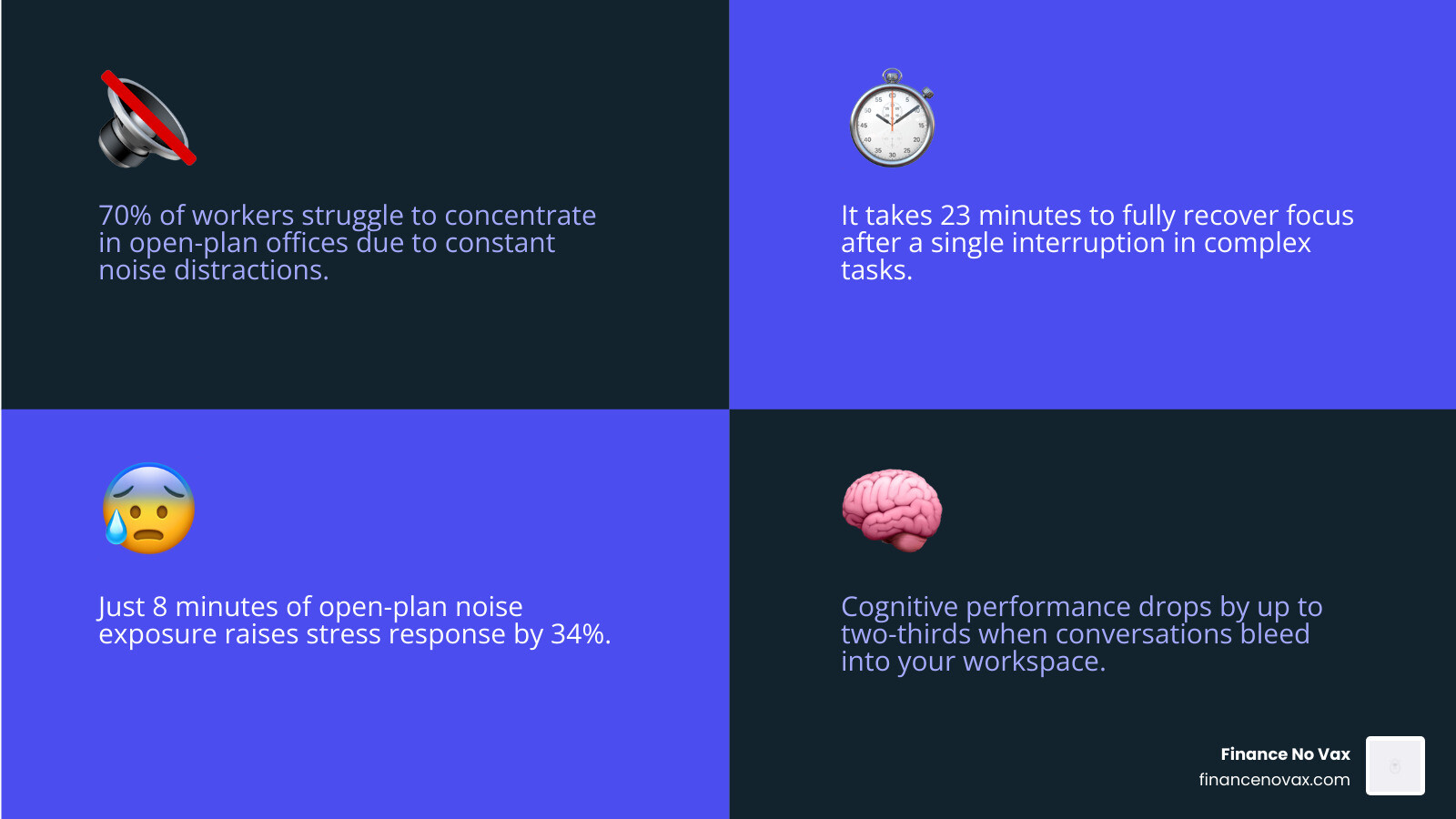
Research shows that 70% of workers struggle to concentrate in open-plan environments. And the cost of a single interruption isn’t just the interruption itself — it takes more than 23 minutes to fully return to a complex task after being pulled away from it. For a team of 40, that adds up fast.
The noise isn’t just annoying. It’s measurably harmful. Just eight minutes of exposure to open-plan office noise raises the body’s stress response by 34%. Cognitive performance can drop by as much as two-thirds when a colleague’s conversation bleeds into your work.
Whether you manage a busy office or work from a noisy home setup, the challenge is the same: how do you protect your focus without tearing down walls or blowing your budget?
This guide walks you through every practical option — from quick, low-cost fixes to longer-term acoustic investments — so you can build a solution that actually fits your space and your needs.
Explore more about office open plan blockers:
The Physiological and Cognitive Impact of Office Noise
As we navigate the workplace landscape of April 2026, we’ve learned that the “relentless hum” of an open office is more than just a nuisance. It is a biological trigger. When we talk about office open plan blockers, we aren’t just talking about furniture; we are talking about protecting our nervous systems.
Research into Visual Noise in Open-Plan Offices Is Silently Sabotaging Focus reveals that acoustic distractions act like “visual noise,” cluttering our mental field of vision. When voices exceed the 55-decibel threshold, our brains stop treating the sound as background and start processing it as a priority. This triggers a measurable sweat response, increases our heart rate, and heightens negative moods by roughly 25%.
Our working memory is a finite resource. When we hear a colleague discussing their weekend plans three desks away, our auditory cortex engages in “involuntary semantic processing.” Essentially, your brain decodes that speech whether you want it to or not. This is why Distraction in the Workplace: Open Office Solution That Work emphasizes that it is the intelligibility of speech, not just the volume, that destroys productivity.
The Communication Paradox in Modern Design
There is a strange irony in modern office design that we call the “communication paradox.” While open layouts were designed to increase face-to-face interaction, studies show that face-to-face time actually falls after employees move to open offices.
Why? Because when we feel constantly exposed, we tend to withdraw. We put on large headphones (the ultimate “do not disturb” sign) and rely more on digital messaging to avoid being the person who “breaks the silence” or disturbs the whole floor. Without the psychological safety provided by office open plan blockers, spontaneous collaboration actually withers away, replaced by an over-reliance on Slack or email.
Essential Office Open Plan Blockers: Physical Barriers and Privacy Screens
If we want to reclaim our focus, we have to start with the most immediate fix: physical boundaries. In the early 2020s, many offices stripped away everything to create a “clean” look. By 2026, we’ve realized that people need a sense of “territory” to feel secure and focused.
Modular desk partitions and cubicle extenders are the front-line soldiers in this battle. You can Quiet Your Workspace With These Desk Enclosure Solutions by adding height to existing desks. These extenders do two things: they block the visual “flicker” of people walking by and provide a physical substrate to absorb sound.
- Sliding Panels: These allow for a dynamic workspace. You can slide them open for a quick brainstorm or shut them tight when it’s time for deep work.
- Portable Partitions: Great for smaller offices, these can be moved to create “pop-up” meeting zones.
- Privacy Screens: Often made of PET felt, these can be clamped onto any desk to provide immediate visual and acoustic relief.
Selecting the Right Office Open Plan Blockers for Your Budget
We know that not every business has the budget for a full architectural overhaul. Fortunately, the ROI on focus is high. If an employee loses over an hour a day to preventable distractions, a $200 desk screen pays for itself in weeks.
When weighing 8 Solutions to Open-Plan Office Issues, we recommend looking for modularity. Fixed walls are expensive and permanent. Modular blockers can move with you if your team grows or your layout changes. Look for materials that offer durability and high sound-dampening properties—don’t just buy a plastic sheet that will reflect sound right back at you!
How Office Open Plan Blockers Support Neurodiversity
Inclusive design is no longer optional; it’s a competitive advantage. For neurodivergent team members—particularly those with ADHD or sensory processing sensitivities—the open office can be a nightmare of constant stimuli.
By Designing The Ultimate Calm Workspace Desk Setup, we create an environment where everyone can thrive. Sensory-friendly settings include:
- Low-stimulus zones: Areas with reduced visual clutter and muted colors.
- Visual triggers: Using blockers to hide high-traffic walkways, which reduces the “startle response” in sensitive individuals.
- Adjustable lighting: Combining physical blockers with personalized task lighting to reduce the glare of harsh overhead fluorescents.
Acoustic Engineering: Soundproofing Your Workspace
Now, let’s talk about the science of sound. If you’ve ever been in a room that feels “echoey,” you’re dealing with a high reverberation time. To fix this, we need materials with a high Noise Reduction Coefficient (NRC). An NRC of 0 means the material reflects all sound; an NRC of 1 means it absorbs it all.
We recommend using Office Soundproofing Solutions For A Productive Workplace that target the “pancake geometry” of modern offices. Because office ceilings are often low relative to the floor’s width, sound travels like a wave trapped in a tube.
Everything You Need To Know About Office Acoustic Panels explains that PET felt (made from recycled plastic) is one of the most effective and sustainable materials available today. Installing just ten acoustic panels in a medium-sized room can reduce reverberation time from 1.74 seconds down to a crisp 0.61 seconds.
According to the AcousPlan Open Plan vs Enclosed Offices research, ceiling baffles are particularly effective because they catch sound as it rises, preventing it from bouncing off the hard ceiling and back down to your ears.
Sound Masking vs. White Noise Machines
Many people use these terms interchangeably, but they serve different purposes. We’ve broken down the differences in the table below:
| Feature | White Noise Machines | Sound Masking Systems |
|---|---|---|
| Primary Goal | Creating a soothing background | Making speech unintelligible |
| Frequency | Wide range (sounds like a fan) | Targeted at human speech frequencies |
| Installation | Plug-and-play (local) | Professionally tuned (ceiling-wide) |
| Best For | Personal cubicles or home offices | Large open-plan floors |
You can find Quiet Please Diy Soundproofing Ideas For Your Workspace that include using small white noise machines near the entrance of your cubicle to “blur” the sound of passing conversations.
Strategic Layouts and Activity-Based Zoning
Sometimes the best office open plan blocker isn’t an object—it’s a strategy. Activity-Based Working (ABW) is the gold standard for 2026. This design philosophy recognizes that we don’t do the same task all day, so we shouldn’t sit in the same place all day.
By creating “Library Zones” (strictly no talking) and “Collaboration Hubs” (loud and proud), we can manage the “distraction distance.” In an untreated office, a conversation can be distracting up to 12 meters away. With proper zoning and Top Rated Meeting Pods And Phone Booths For Modern Offices, we can shrink that distance to just 4 or 5 meters.
Rerouting circulation paths is another low-cost layout win. If the path to the coffee machine goes right past the “deep work” desks, you’ve designed a distraction factory. Reroute the traffic, and you reroute the noise.
Implementing Privacy Pods and Phone Booths
If you have the space, acoustic pods are the ultimate “blocker.” These are self-contained, soundproof rooms that provide total confidentiality. This is vital for HR discussions, legal calls, or just an hour of intense coding.
When looking at Top Rated Soundproof Booths For Your Home Office, ensure they meet the ISO 23351-1 standard for speech level reduction. Also, for commercial offices, don’t forget fire egress compliance—your pods need to play nice with your building’s sprinkler and alarm systems.
Frequently Asked Questions about Office Open Plan Blockers
What are the most effective low-cost office open plan blockers?
You don’t need a million-dollar budget to make a difference. We recommend starting with:
- High-back chairs: These act as a personal acoustic cocoon.
- Desk plants: A “living wall” or even a few large leafy plants can scatter sound waves and reduce perceived noise by up to 30%.
- Noise-canceling headsets: While not a physical blocker, they are a vital personal tool.
- Etiquette rules: Sometimes the best blocker is a shared agreement. Implement “Quiet Hours” or “No-Meeting Wednesdays.”
- Check out Shhh The Definitive Guide To A Soundproof Home Office Setup for more DIY tips.
How many quiet rooms are needed per employee?
A good rule of thumb is the 1:10 rule. We suggest aiming for one quiet room or focus pod for every 10 to 15 desks. This ensures that when someone needs to take a private call, they don’t have to wander the halls looking for an empty corner. For more on this, see Windows To Silence Top Soundproof Office Treatments.
Do acoustic panels actually reduce colleague distractions?
Yes, but with a caveat: they don’t stop the sound from happening, they stop it from lingering. By reducing reverberation, panels make speech much clearer for the people talking, which often leads to them speaking more quietly. They also prevent the “cocktail party effect,” where everyone speaks louder and louder to be heard over the room’s echo.
For high-traffic areas, consider Shhh Top Rated Acoustic Doors For Your Home Office or heavy acoustic curtains to create a soft barrier that swallows decibels.
Conclusion
At Finance No Vax, we believe that your workspace should work for you, not against you. Reclaiming your focus in a noisy open plan isn’t about being anti-social; it’s about being pro-productivity. By combining physical office open plan blockers, acoustic treatments, and smart zoning, you can create a high-performing environment that respects both collaboration and the need for deep, uninterrupted thought.
Whether you’re looking for a quick desk enclosure or a full suite of acoustic pods, the data is clear: an investment in silence is an investment in your team’s well-being and your company’s bottom line.
Ready to transform your workspace? Design Your Ideal Office – Start Here!
