
How to Soundproof Ceilings Effectively
Why Noise Coming Through Your Ceiling Is Harder to Fix Than You Think
Soundproofing for ceilings is one of the most effective ways to block noise from upstairs neighbors and create a quieter home workspace. Here’s a quick overview of the best methods:
| Method | Best For | Difficulty |
|---|---|---|
| Add drywall + Green Glue | Airborne noise | Easy–Medium |
| Blow-in insulation | Existing finished ceilings | Medium |
| Isolation clips + hat channel | Impact and airborne noise | Medium–Hard |
| Mass-loaded vinyl (MLV) | Airborne noise, low headroom loss | Medium |
| Soundproof the floor above | Impact noise (footsteps) | Easy if neighbor cooperates |
If you work from home, a noisy ceiling can kill your focus fast. Footsteps, dropped objects, muffled conversations — they all travel through the structure above you and land right in your ears.
The frustrating truth? Ceilings are one of the hardest surfaces to soundproof. They carry two types of noise:
- Airborne noise — voices, TV, music traveling through the air and then through building materials
- Impact noise — footsteps, furniture scrapes, vibrations traveling directly through the structure
Most people reach for acoustic foam or decorative panels first. That’s a mistake. Those products only reduce echo inside your room — they do almost nothing to block noise coming through your ceiling.
Effective soundproofing requires a different approach entirely: adding mass, decoupling the ceiling from the structure, absorbing sound in the cavity, and damping vibrations. These four principles work together, and skipping any one of them weakens the whole system.
This guide walks you through every realistic option — from quick DIY fixes to full isolation systems — so you can choose what works for your budget, your ceiling, and your sanity.
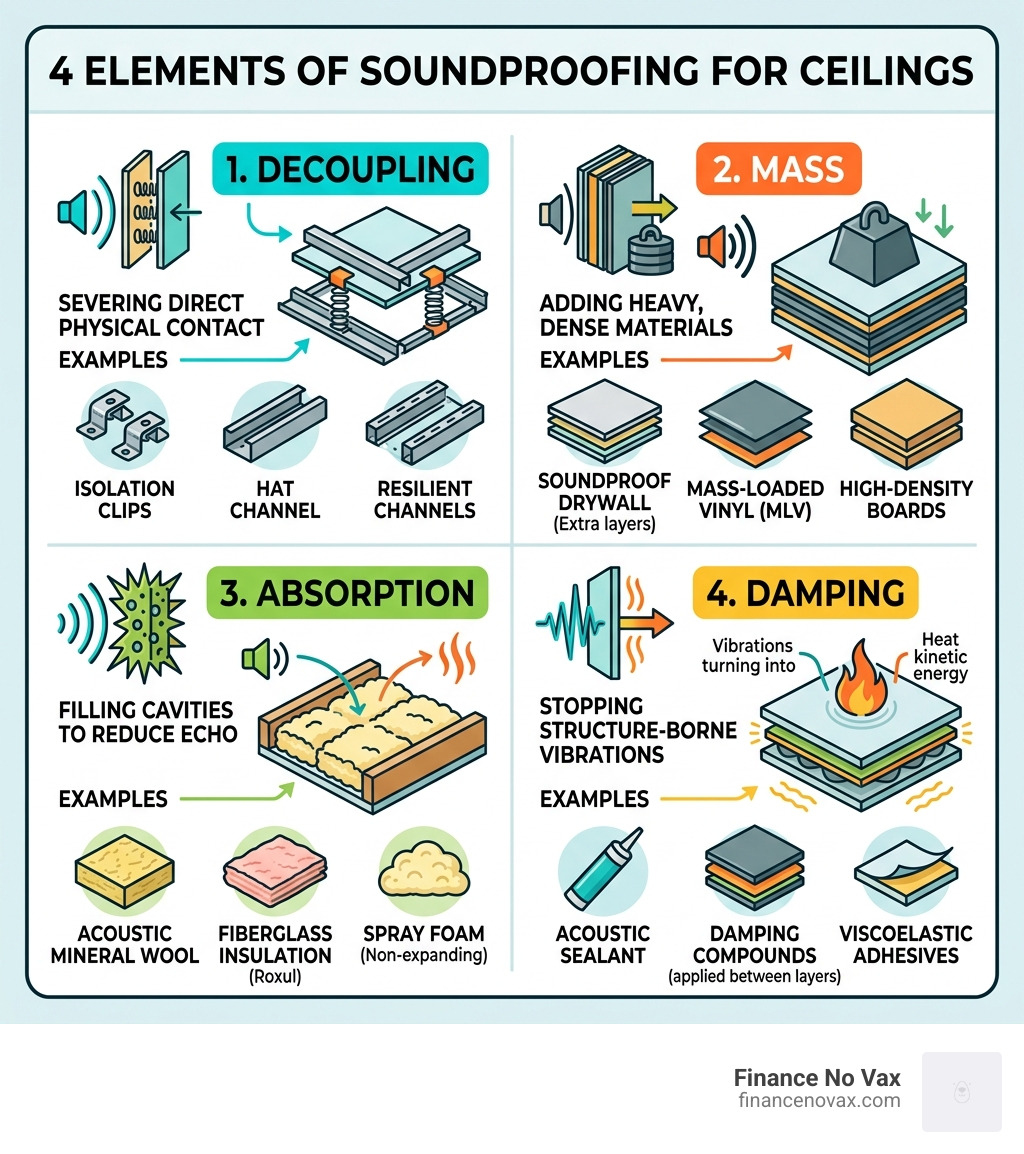
Soundproofing for ceilings terms you need:
Understanding Noise: Airborne vs. Impact Transmission
To win the war against noise, we first have to know our enemy. In acoustics, noise isn’t just “noise.” It falls into two distinct categories that require different treatment strategies.
Airborne Noise
Think of this as sound that travels through the air. Conversations, the neighbor’s TV, or a barking dog are classic examples. These sound waves hit your ceiling, vibrate the material, and pass through into your room. We measure a material’s ability to stop airborne noise using STC (Sound Transmission Class) ratings. A standard 2×4 stud wall with drywall usually lands around an STC of 35. With high-performance systems like the isoTRAX® package, you can achieve STC ratings up to 61, which is the difference between hearing a neighbor’s conversation and absolute silence.
Impact Noise
This is the “thud-thud-thud” of footsteps or the “scrape” of a chair. Impact noise is structural; it’s a physical vibration traveling through the floor joists and down into your ceiling. This is measured by IIC (Impact Isolation Class) ratings. Stopping impact noise is significantly harder because you aren’t just blocking air; you’re trying to stop a physical vibration from moving through a solid object.
The Role of High-Density Mineral Wool
One of our best weapons for both types of noise is Acoustic Ceiling Insulation. Products like ROCKWOOL Safe ‘n’ Sound are made from stone wool, which is much denser than standard pink fiberglass. It acts like a sponge for sound waves, trapping them within its fibers. For airborne noise, it adds much-needed absorption to the empty cavity between joists. While it doesn’t stop impact noise on its own, it prevents the “drum effect” where the empty space in your ceiling amplifies vibrations.

Best Methods for Soundproofing for Ceilings
When we talk about soundproofing for ceilings, we usually look at three main heavy hitters: Decoupling, Mass-Loaded Vinyl, and Damping compounds like Green Glue.
Decoupling: The “Room Within a Room”
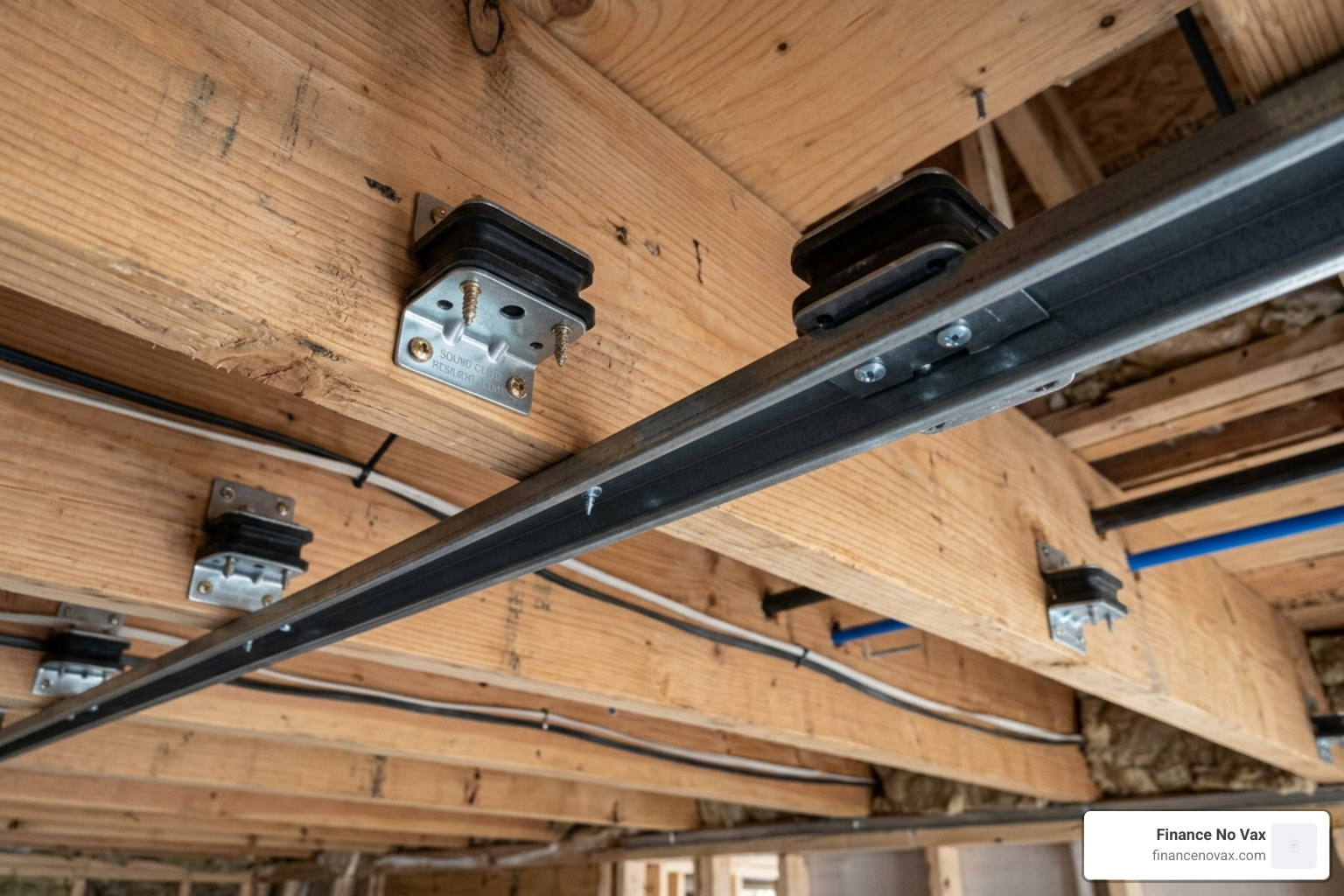
Decoupling is the gold standard. It involves separating the ceiling drywall from the floor joists so they aren’t touching directly. Imagine a car hitting a pothole; the tires and suspension absorb the shock so you don’t feel it in your seat. Decoupling does the same for sound. By using isolation clips and hat channels, we create a “floating” ceiling. We’ve written extensively about The Art Of Making Your Ceiling Float And Your Neighbors Disappear because, frankly, it’s the only way to truly kill impact noise.
Mass-Loaded Vinyl (MLV)
MLV is a dense, floppy material that adds significant mass without adding much thickness. It’s often called “limp mass” because it doesn’t vibrate easily. Hanging MLV across your joists before adding drywall is a fantastic way to block airborne noise. It’s like trying to move a heavy velvet curtain with a whisper — the mass simply absorbs the energy.
Green Glue Damping Compound
Green Glue is a visco-elastic damping compound. You sandwich it between two layers of drywall. It works by converting sound energy (vibration) into a tiny amount of heat. It is incredibly effective for low-frequency noises (like bass from a subwoofer) and is one of the most cost-effective upgrades you can make to a multi-layer drywall system.
Retrofitting Soundproofing for Ceilings Without Demolition
We get it — not everyone wants to rip down their entire ceiling and start from scratch. If you’re looking for a less invasive route, you have options.
Blow-in Insulation
If your ceiling is already finished but the cavity is empty, you can use the “drill and fill” method. We recommend cutting small holes between every joist, usually close to a wall. Use an inspection camera to ensure there are no blockages (like wiring or pipes), then use a blower machine to pack the cavity with cellulose or mineral wool. Once filled, you patch the holes and paint. It’s a messy Saturday, but it significantly improves STC ratings.
Adding Drywall Layers
The simplest “no-demo” fix is to add a second layer of 5/8″ Type X drywall directly over your existing ceiling. For the best results, use Green Glue between the layers. This adds mass and damping without the need for demolition. Just remember: you’ll need longer screws to reach the joists, and you might need to add extra screws to support the weight of the new layer. We detail this process in our guide on How To Soundproof A Ceiling Without Losing Your Mind.
High-Performance Systems: Isolation Clips and Channels
If you are serious about silence, you need a system designed for high performance.
- Resilient Sound Isolation Clips (RSIC): These clips screw into your joists and hold a metal “hat channel.”
- Hat Channels: These are long metal rails that snap into the clips. Your drywall then screws into the channel, not the wood.
- The Result: The drywall is physically separated from the structure by a rubber buffer.
Systems like isoTRAX® or MuteClip are engineered specifically for this. An isoTRAX® Ceiling Package can cover up to 64 sq. ft. and includes rails and visco-elastic pads designed to handle the heavy load of a ceiling. Ceiling systems often require double the pads and screws compared to walls because gravity is working against you!
Height Loss Considerations: This is the “tax” you pay for silence. A standard MuteClip system might drop your ceiling by about 74mm (roughly 3 inches). If you have low ceilings, look for “low-profile” versions that can get that drop down to about 40mm.
For a deep dive into the hardware, check out The Best Tools To Decouple Your Ceiling And Kill The Noise.
Step-by-Step DIY Installation Guide
Ready to get your hands dirty? Here is how a typical high-level soundproofing project looks.
Preparation and Tools
You will need:
- T-square and utility knife
- Drywall lift (trust us, rent one)
- Impact driver
- Tin snips (for cutting metal channels)
- Ceiling Acoustic Treatment Materials
- Acoustical sealant and a large caulking gun
The Process
- Expose the Joists: (Optional but recommended for Level 3 soundproofing). Remove existing drywall and old insulation.
- Seal the Gaps: Use acoustical sealant to plug any holes where wires or pipes pass through the subfloor above.
- Install Insulation: Friction-fit ROCKWOOL Safe ‘n’ Sound batts between the joists. Do not compress them; they need to stay fluffy to absorb sound.
- Attach Clips: Screw isolation clips into the joists. Standard spacing is usually 24 inches apart vertically and 48 inches horizontally, but always check the manufacturer’s guide.
- Snap in Channels: Click your metal hat channels into the clips.
- Hang Drywall: Use a drywall lift to raise 5/8″ Type X drywall. Screw it into the channels (NOT the joists!).
- Seal the Perimeter: Leave a 1/4 inch gap around the entire edge of the ceiling. Fill this gap with acoustical sealant. This prevents “flanking noise” and keeps the ceiling truly decoupled.
| Material | DIY Cost (10×10 Room) | Pro Labor Est. |
|---|---|---|
| 5/8″ Drywall | $100 – $200 | $300 – $600 |
| Green Glue (2 cases) | $250 – $350 | Included in labor |
| Isolation Clips | $150 – $300 | Included in labor |
| Hat Channels | $80 – $150 | Included in labor |
| Acoustical Sealant | $50 – $100 | Included in labor |
Essential Materials for Soundproofing for Ceilings
To get the best results, don’t cut corners on materials.
- 5/8″ Type X Drywall: It’s denser and more fire-resistant than standard 1/2″ drywall. Mass is your friend.
- Acoustic Cotton or Stone Wool: Avoid standard fiberglass if budget allows. Stone wool is the king of Acoustic Ceiling Insulation.
- Acoustical Sealant: This stays flexible forever. Standard caulk will crack over time, letting sound leak through like water through a sieve.
For more kit ideas, browse our Top Ceiling Soundproofing Kits For Your Home.
Critical Considerations: Lighting, Height, and Renters
One of the biggest mistakes we see is people spending $2,000 on a soundproof ceiling and then cutting six massive holes for canned lights.
The “Swiss Cheese” Problem
Canned (recessed) lights are soundproofing nightmares. Every light is a hole that lets noise pour through. If you must have them, you need to use fire-rated, sound-insulating covers. These are boxes that sit over the light fixture in the ceiling cavity to maintain the acoustic seal. A better option? Surface-mounted LED lights or hanging pendant fixtures that only require a tiny hole for a wire.
Renter-Friendly Options
If you can’t tear down walls or screw into joists, look into Acoustic Drop Ceiling Tiles. While they won’t stop a neighbor’s heavy footsteps, high-quality tiles with a high CAC (Ceiling Attenuation Class) rating can help block voices and mid-range frequencies. Some tiles, like the PrivacyShield® High CAC Foam, are designed specifically for speech privacy.
For a list of non-invasive panels, check out Look Up The Best Easy Soundproofing Ceiling Panels.
Frequently Asked Questions about Ceiling Soundproofing
Is it better to soundproof my ceiling or the neighbor’s floor?
If the problem is impact noise (footsteps), it is always better and cheaper to treat the floor above. Adding a high-quality underlayment like Serena Mat or MuteMat under the neighbor’s carpet or hardwood stops the vibration before it ever enters the structure. However, if your neighbor isn’t cooperative, the ceiling is your only choice.
How much ceiling height will I lose with different systems?
- Drywall + Green Glue: ~5/8 inch.
- isoTRAX or Resilient Channels: ~1.5 to 2 inches.
- Full MuteClip Gold System: ~3 inches (74mm).
- Low-Profile Clip Systems: ~1.6 inches (40mm).
Does acoustic foam work for soundproofing a ceiling?
No. This is the most common myth in the industry. Acoustic foam is lightweight and porous; it is designed to stop echoes inside your room so your recordings sound better. It has zero mass and zero decoupling ability. If you stick foam to your ceiling to stop a neighbor’s dog from barking, you will still hear the dog — but the dog will sound very “crisp.”
Conclusion
Soundproofing for ceilings is a game of physics. You are fighting energy, and energy always looks for the easiest path. Whether you choose to blow in insulation for a quick fix or install a fully decoupled floating ceiling, the key is consistency. Seal every gap, use the densest materials you can afford, and never underestimate the power of a second layer of drywall.
At Finance No Vax, we believe your home should be your sanctuary. If you are tired of living under a bowling alley, it might be time for a professional acoustic analysis to determine which system fits your specific structural needs.
For more help planning your project, explore our Ultimate List Of Acoustical Ceiling Solutions or check out more info about ceiling soundproofing services. Peace and quiet are closer than you think!
