
Why Getting Your Acoustic Foam Installation Right Makes All the Difference
A good acoustic foam installation guide can be the difference between a room that sounds clear and professional versus one that sounds hollow and distracting.
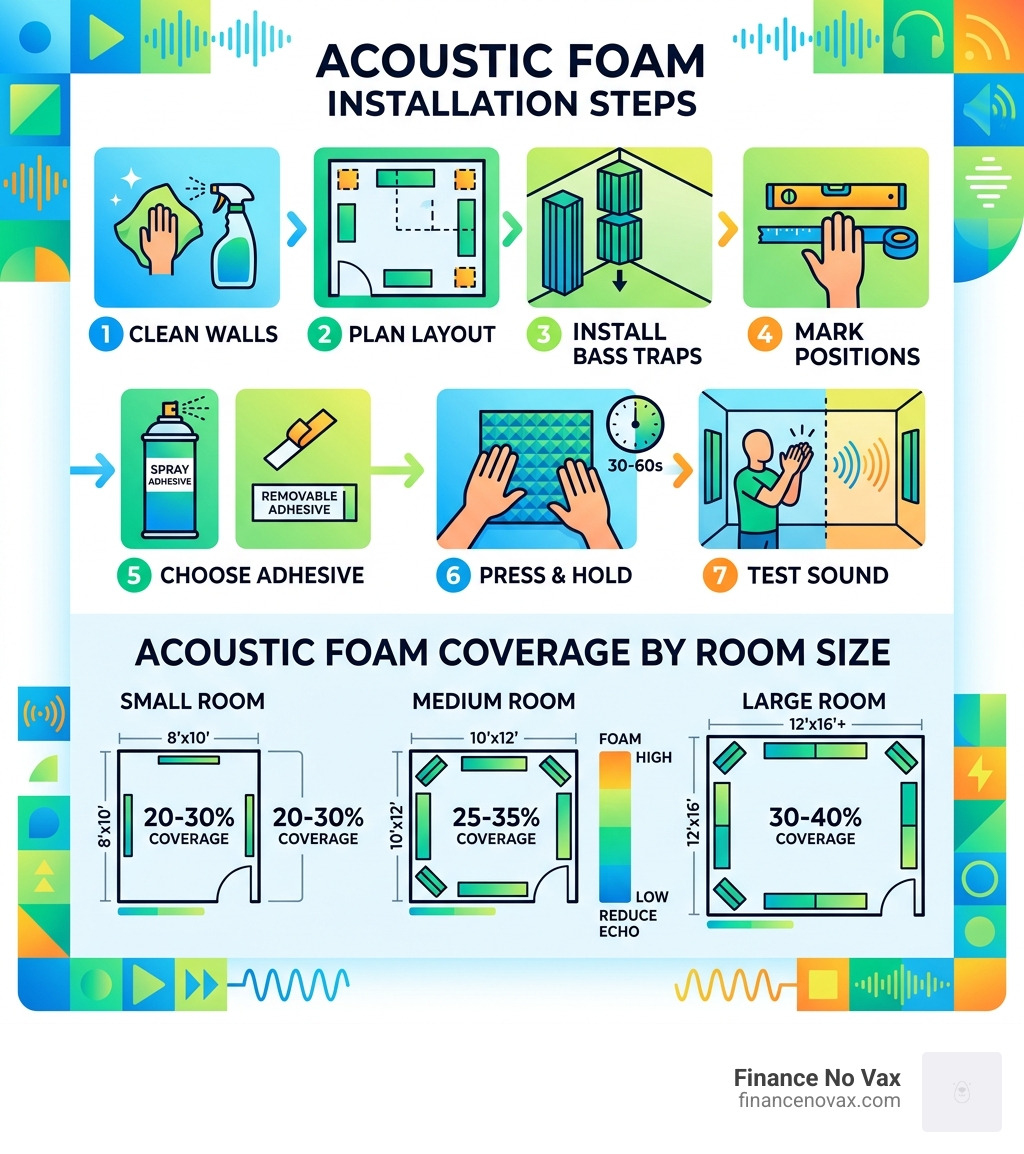
Here’s a quick overview of how to install acoustic foam correctly:
- Clean your walls with isopropyl alcohol and let them dry fully
- Plan your layout – aim to cover 20-40% of your room’s surface area
- Start with bass traps in the corners of your room
- Mark panel positions using painter’s tape and a level
- Choose your adhesive – spray adhesive for permanent installs, Command strips for renters
- Press and hold each panel for 30-60 seconds after mounting
- Test the results with a clap test before and after
If you work from home, bad room acoustics aren’t just an annoyance. Every call, recording, or video meeting is affected by the echo and reverb bouncing off your walls. That hollow “bathroom sound” makes you harder to hear and harder to take seriously.
The good news? Acoustic foam is one of the most affordable and beginner-friendly fixes available. Most people install it themselves in a single afternoon.
But placement and method matter. Slapping foam randomly on walls won’t get you far. Done right, strategic acoustic treatment can reduce echo by up to 80% in a recording space.
This guide walks you through everything — from choosing the right foam type to mounting it without wrecking your walls.
Understanding Your Materials: Types and Functions
Before we pick up a level or a can of spray adhesive, we need to talk about what we are actually putting on our walls. Acoustic foam isn’t just “sponge.” It is typically made from open-cell polyurethane or melamine foam. The “open-cell” part is the secret sauce; it allows sound waves to enter the material, where they get trapped in a maze of tiny pores and converted into low-grade heat through friction.
However, not all foam is created equal. When you start shopping, you’ll see a variety of shapes that look like they belong in a sci-fi movie. Each has a specific job:
- Wedge Foam: These are the classic “ridges.” They are excellent for general sound absorption and reducing flutter echoes.
- Pyramid Foam: Because of their four-sided shape, these scatter sound waves more effectively than wedges, making them great for rooms with high reverberation.
- Bass Traps: These are much thicker and denser, designed specifically to fit into corners. Low-frequency sound waves (the “boomy” stuff) love to congregate in corners, and standard thin foam won’t touch them.
- Acoustic Panels: While foam is great, you might also consider exploring the effectiveness of acoustic foam vs panels to see if fabric-wrapped mineral wool panels might better suit your aesthetic or frequency needs.
Comparison Table: Foam Types at a Glance
| Foam Type | Primary Strength | Best Placement |
|---|---|---|
| Wedge | Mid-to-high frequency absorption | Side walls, behind monitors |
| Pyramid | Diffusion and high-reverb control | Ceilings, back walls |
| Bass Traps | Low-frequency (bass) control | Trihedral corners (wall-wall-ceiling) |
| Flat Panels | Eliminating flutter echo | Parallel walls |
Planning Your Acoustic Foam Installation Guide Layout
We’ve all seen those studios where the walls are 100% covered in black foam. Unless you are building an anechoic chamber to go slowly insane in, you probably don’t need that much. In fact, over-treating a room can make it sound “dead” and unnatural.
The golden rule for most home studios, offices, and theaters is the 20-40% coverage rule. You want to cover enough surface area to stop sound from bouncing back and forth like a ping-pong ball, but leave enough bare wall to keep the room sounding “alive.”
The “Mirror Trick” for First Reflection Points
One of the most professional tips we can give you is to find your “first reflection points.” These are the spots on your walls where sound from your speakers hits first before bouncing to your ears.
- Sit in your usual listening or recording chair.
- Have a friend slide a mirror along the side wall at your ear level.
- When you can see the reflection of your studio monitor (speaker) in the mirror, mark that spot.
- That is a primary reflection point and is the most important place to put your foam.
For more ideas on which products work best for these spots, check out our guide on the best acoustic panels for home use.
Calculating Coverage for Your Acoustic Foam Installation Guide
How much foam should you actually buy? It depends on your room size. Here are some general statistics to guide your purchase:
- Small Rooms (6-10 sqm): Aim for 1.5 to 3 sqm of foam.
- Medium Rooms (11-15 sqm): Aim for 3 to 5 sqm of foam.
- Large Rooms (16-20 sqm): Aim for 5 to 8 sqm of foam.
If you are treating a home office just to stop your voice from sounding sharp on Zoom calls, 20-30% wall space coverage is usually plenty. For a more detailed breakdown of tile options, see our foam-tiles-for-soundproofing-a-comprehensive-review.
Step-by-Step Acoustic Foam Installation Guide
Now for the “how-to” part. If you’ve ever tried to stick something to a wall only to have it fall off two hours later, you know that preparation is everything.
Step 1: Surface Preparation
Dust is the enemy of adhesive. Use a rag and 70% isopropyl alcohol to wipe down the areas of the wall where the foam will go. This removes oils and drywall dust that prevent glue from sticking. Let it dry completely.
Step 2: Expand Your Foam
Most acoustic foam arrives vacuum-packed and as flat as a pancake. Do not try to install it immediately! Let it sit out for 24-48 hours to regain its shape. If it’s being stubborn, some manufacturers suggest a quick dip in water followed by a thorough drying (though we prefer the “patience” method to avoid mold).
Step 3: Layout Marking
Don’t eyeball it. Use painter’s tape and a level to mark exactly where the top and sides of your panels will go. This ensures your studio looks professional and symmetrical. If you want a deep dive into the physical mechanics of hanging, How to Hang Acoustic Foam: 13 Steps offers a great visual walkthrough.
Step 4: Mounting
Apply your chosen adhesive (see below) to the back of the foam. If using spray, wait about 10-15 seconds for it to become “tacky” before pressing it to the wall. Press firmly for 30-60 seconds.

Choosing the Best Adhesive for Your Acoustic Foam Installation Guide
The “best” adhesive depends entirely on whether you own your home or are renting.
- Spray Adhesive: This is the “permanent” option. It creates a very strong bond. Pro tip: Spray both the back of the foam and the wall for a bond that will outlast the building.
- Command Strips & Velcro: Great for renters. However, Command strips don’t always stick well to the porous back of the foam.
- The Cardboard Hack: This is our favorite renter-friendly method. Glue your foam panels to a piece of lightweight cardboard or Coroplast first. Then, use Command strips to hang the cardboard on the wall. This protects your paint and makes the foam reusable!
- Push Pins/T-Pins: If you have drywall and don’t mind tiny holes, you can simply pin the foam to the wall. It’s fast and causes minimal damage.
For those on a budget, you can even look into creating homemade soundproof panels using frames and insulation.
Optimizing Placement for Professional Results
Where you put the foam is just as important as how you stick it. If you have a limited number of panels, prioritize these areas in order:
- Corners (The Bass Zone): Low frequencies gather in corners. Place your thickest bass traps in the vertical corners behind your desk. If you can, treat the “trihedral” corners where two walls meet the ceiling.
- First Reflection Points: As found with the mirror trick. This cleans up your stereo imaging.
- Behind the Microphone: If you are a podcaster or singer, placing foam directly behind the mic (and behind your head) prevents your voice from bouncing off the wall and back into the microphone.
- The Ceiling (The “Cloud”): If you have hard floors, the ceiling is a major source of echo. Hanging a few panels directly above your desk can make a massive difference.
To avoid “flutter echo” (that metallic ringing sound), try not to leave large areas of parallel walls completely bare. Even a checkerboard pattern of foam can break up those sound waves. If you’re looking for low-cost ways to fill gaps, consider diy-acoustic-foam-alternatives-for-soundproofing.
Frequently Asked Questions about Acoustic Foam
Does acoustic foam block noise from neighbors?
This is the most common myth in acoustics. Acoustic foam does not block sound. It is an absorber, not a blocker. Foam is lightweight and porous; sound waves go right through it and through your walls. To block sound (soundproofing), you need mass (like heavy drywall) and decoupling. Foam simply makes the sound inside your room better. If you need budget-friendly ways to improve your room’s internal sound, look at cheap-acoustic-panels-that-deliver-great-results.
How do I clean and maintain my foam panels?
Foam is a giant dust magnet. Every few months, use the upholstery attachment on your vacuum to gently suck the dust out of the wedges. If they get stained, use a damp cloth with a tiny bit of mild soap. Avoid harsh chemicals, as they can cause the foam to crumble or “off-gas.” Also, keep them out of direct sunlight, which can turn white or grey foam a funky yellow color over time.
Why are my acoustic panels falling off the wall?
If your panels are taking a dive, it’s usually one of three things:
- Dust: You didn’t clean the wall with alcohol first.
- Texture: Adhesive has a hard time sticking to “orange peel” or heavily textured walls. Use the cardboard hack mentioned above.
- Humidity: High humidity can weaken spray adhesives. Make sure your room is climate-controlled during the 24-hour curing process.
Conclusion
Mastering your studio sound doesn’t require a degree in acoustic engineering. By following this acoustic foam installation guide, you can transform a boxy, echoey room into a professional-grade environment for pennies on the dollar.
Once you’ve finished your installation, don’t forget to test it! Do a “clap test” — stand in the center of the room and clap loudly. You should hear a short, dull thud rather than a ringing “zing.” You can also record yourself on your phone before and after the installation; the difference in clarity will likely surprise you.
For more tips on building the perfect workspace, explore More info about acoustic materials on our site. Happy recording!
