
Why Noise Coming Through Your Windows Is Ruining Your Focus (And What You Can Do About It)
Soundproof window inserts DIY is one of the most cost-effective ways to block outside noise without replacing your windows or calling a contractor.
Here’s a quick summary of what’s involved:
- Cut a sheet of 1/4-inch acrylic or plexiglass to fit your window frame
- Apply foam weatherstripping around the edges to create an airtight seal
- Press the insert into the window frame — inside or outside the recess
- Secure it with latches or magnets for easy removal
- Test the difference using a free decibel meter app on your phone
Expected result: Up to 10 dB of noise reduction — which cuts perceived noise roughly in half.
If you work from home, you already know the feeling. You’re mid-meeting or deep in focus, and then — a leaf blower, a delivery truck, or construction noise blasts through your window like the wall isn’t even there.
Windows are the weakest point in any room for sound. Unlike walls, they have almost no mass, no insulation, and — unless they’re sealed perfectly — plenty of tiny gaps for sound to sneak through.
The good news? You don’t need to replace your windows or spend hundreds on custom commercial inserts. A simple DIY panel made from plexiglass and foam tape can dramatically quiet your space for well under $100 in materials.
This guide walks you through exactly how to build and install your own inserts — step by step — even if you’ve never done a home improvement project before.
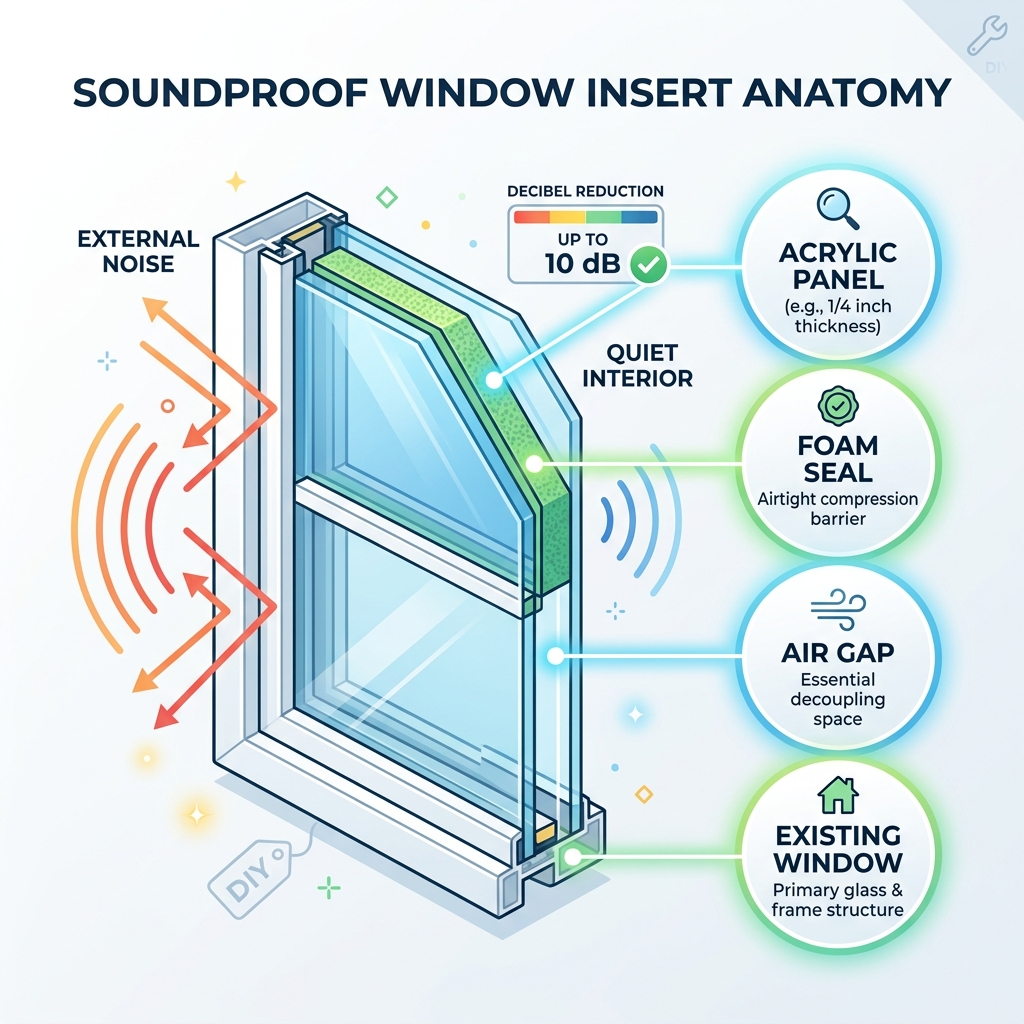
Understanding Soundproof Window Inserts DIY and How They Work
To understand why a simple sheet of plastic can save your sanity, we first need to look at why windows are so “loud.” Most standard windows are thin and often have tiny air leaks around the sashes. Sound waves, much like water, will find the path of least resistance. If air can get through, sound can get through.
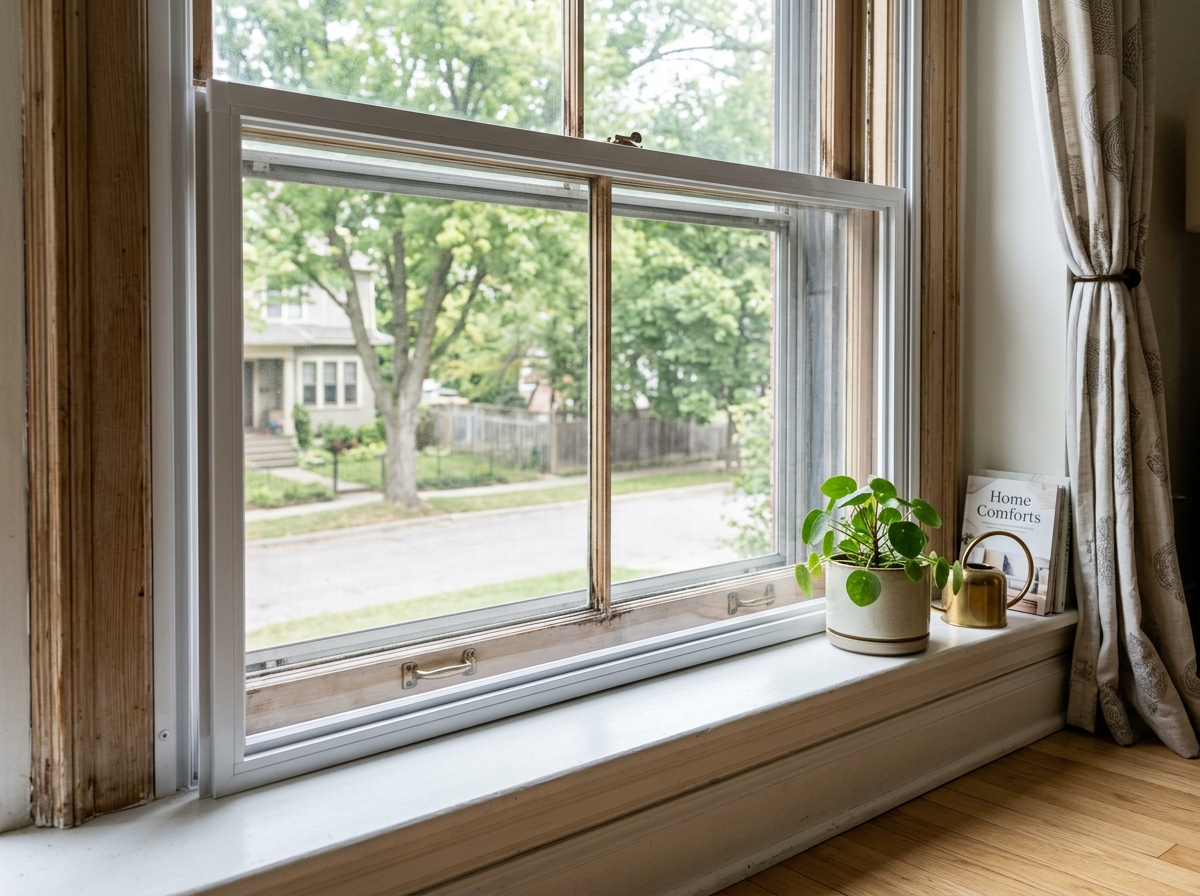
A soundproof window inserts diy project works by addressing the three pillars of acoustics: mass, decoupling, and sealing. When we place a heavy acrylic sheet over the existing window, we are adding mass that reflects sound waves. By leaving a space between the glass and the insert, we create an airspace that acts as a buffer. Finally, by using foam tape, we achieve decoupling—preventing the vibrations of the outer window from passing directly into the inner panel.
For a deeper dive into these principles, check out our guide on how soundproofing works or a beginner’s guide to basic soundproofing.
The Science of Noise Reduction with DIY Window Inserts
In acoustics, we use the Sound Transmission Class (STC) rating to measure how well a barrier blocks sound. A standard single-pane window might have an STC of 25. Adding a well-sealed DIY insert can jump that rating up to 39—a massive 14-point improvement!
The magic number to remember is 10 decibels (dB). Research shows that a 10 dB reduction is perceived by the human ear as cutting the noise level exactly in half. While a DIY insert might not block the low-frequency rumble of a heavy diesel engine as effectively as a concrete wall, it is incredibly efficient at dampening high-frequency “airborne” noises like voices, sirens, and bird chirps.
Thermal Insulation and Energy Efficiency Benefits
We aren’t just blocking noise; we’re blocking drafts too. Because these inserts create an airtight seal, they drastically improve your window’s R-value (thermal resistance).
- Single Pane Improvement: Adding an insert to a single-pane window can increase its R-value by over 100%.
- Condensation Control: By creating a secondary barrier, you reduce the “cold spot” where interior moisture hits the glass, helping to prevent mold and frame rot.
Learn more about transforming spaces with soundproof window inserts to see how these dual benefits can lower your energy bills by up to 40%.
Essential Materials and Tools for Your Project
Before we head to the hardware store, let’s look at what we actually need. You have a few choices for the “transparent mass” part of your insert.
Sourcing Affordable Materials for Soundproof Window Inserts DIY
Commercial inserts can cost $400 to $500 per window—a price some homeowners find “laughably obscene.” By going the DIY route, you can often stay under the $100 mark.
- Plexiglass (Acrylic): This is the most popular choice. It’s lightweight, easy to cut, and provides excellent clarity. A 1/4-inch thick sheet is the sweet spot for soundproofing.
- Polycarbonate: Often sold under brand names like Lexan, this is virtually unbreakable. It has a slightly better STC rating than acrylic but scratches more easily and costs about 20-30% more.
- Acoustic Caulk and Sealants: Unlike regular caulk, acoustic sealant stays flexible for years. This prevents cracks from forming as your house shifts or temperatures change.
| Material | Cost (Approx.) | Sound Blocking | Ease of DIY |
|---|---|---|---|
| 1/4″ Acrylic | $50 – $130 | High | Moderate |
| Polycarbonate | $70 – $160 | Very High | Moderate |
| MDF Plug | $30 – $60 | Extreme | Easy (Blocks Light) |
If you’re on a very tight budget, you might explore DIY acoustic foam alternatives or consider creating homemade soundproof panels for walls.
Required Tools for a Successful Installation
You don’t need a professional workshop, but a few specific tools will make the job much cleaner:
- Tape Measure: Accuracy is everything here.
- Scoring Tool or Jigsaw: For cutting the acrylic sheet.
- Sandpaper (220 grit): To smooth the sharp edges after cutting.
- Caulking Gun: For applying sealant around the permanent window frame.
- Microfiber Cloth: To keep the insert fingerprint-free during installation.
Step-by-Step Guide to Building and Installing Your Inserts
Ready to build? We’ve broken this down into the essential phases to ensure your soundproof window inserts diy project is a success.
How to Accurately Measure Your Windows for Soundproof Window Inserts DIY
Windows are rarely perfectly square, especially in older homes. If you measure just one side, your insert might not fit or—worse—leave a massive gap that lets sound through.
- The Six-Point Check: Measure the width at the top, middle, and bottom. Then measure the height at the left, middle, and right.
- Use the Smallest Dimension: For an internal mount (where the insert sits inside the window “well”), use the smallest measurement and subtract about 1/4 inch to 1/2 inch to account for the thickness of your weatherstripping.
- Expansion Gaps: Plastic expands and contracts with heat. Leaving a tiny bit of “wiggle room” (filled by squishy foam) prevents the panel from warping in the summer.
For more detailed construction tips, see our guide on crafting your own soundproof window.
Creating an Airtight Seal with Weatherstripping
The seal is where the soundproofing happens. If you have even a 1% gap in your seal, you can lose up to 50% of the sound-blocking benefits.
- Foam Tape: Use adhesive-backed closed-cell foam tape (usually 1/2-inch wide and 1/8-inch deep).
- The Compression Fit: You want the foam to be slightly compressed when the insert is in place. This creates a “pressure seal” that blocks air and vibrations.
- Corner Overlap: When applying tape to the edges of your acrylic, overlap the corners slightly to ensure there are no “pinholes” where sound can leak through.
Installation and Removability for Renters
If you’re renting, you probably don’t want to screw anything into the frames. Fortunately, DIY inserts are very renter-friendly.
- Magnetic Strips: You can apply adhesive magnetic tape to the window frame and the insert. This allows you to “snap” the window into place and remove it in seconds.
- Gate Latches: For larger panels, small swivel latches can hold the insert firmly against the foam seal without permanent damage.
- Pressure Fit: If you measure perfectly, the friction of the foam tape alone can often hold the insert in place.
Check out our renters guide to soundproofing or explore more temporary soundproofing solutions for your apartment.
Maximizing Performance and Avoiding Common Mistakes
Even with the best materials, a few small errors can tank your results.
- The “Too Small” Error: If you undersize the insert too much, the foam weatherstripping won’t compress, and sound will pour through the gaps.
- The “Dirty Window” Trap: Clean your original window thoroughly before installing the insert. Once it’s sealed, any streaks or dead bugs will be your new roommates for a long time.
- Ignoring the Air Gap: Try to leave at least 2 inches of space between the existing glass and your insert. This “dead air” is essential for trapping low-frequency vibrations.
Evaluating DIY Inserts: Cost, Aesthetics, and Alternative DIY Solutions
While acrylic inserts are great because they let in light, they aren’t the only option. If you have a window in a bedroom where you don’t care about the view, a Window Plug might be better.
A window plug is usually made from MDF (Medium Density Fiberboard) and stuffed with acoustic insulation or Mass Loaded Vinyl (MLV).
- Pros: Can reduce noise by 40-60% (more than acrylic).
- Cons: Completely blocks all natural light and is much heavier to move.
Frequently Asked Questions about DIY Window Soundproofing
Can DIY inserts block highway traffic noise?
They are very effective against the “hiss” of tires and wind noise (airborne noise). However, the low-frequency “thump-thump” of trucks or the rumble of a nearby train is structural. These vibrations travel through the walls, not just the glass. To combat this, you’ll need the largest air gap possible (3-4 inches) and heavy 1/4-inch acrylic.
What are the best types of plexiglass for soundproofing?
Look for 1/4-inch (6.35mm) cell-cast acrylic. It is denser than the thinner “extruded” acrylic found in cheap picture frames. If your budget allows, laminated acrylic (which has a thin layer of PVB in the middle) is the gold standard for dampening sound vibrations.
How do I test the effectiveness of my new inserts?
You don’t need fancy equipment!
- Download a free decibel meter app on your smartphone.
- Measure the noise level in the room with the window open, then closed, then with the insert installed.
- Perform a “listening check” by moving your ear along the edge of the insert. If you hear a “whistle” or a sudden increase in volume, you have a seal leak that needs more foam tape.
Conclusion
Building your own soundproof window inserts diy is a weekend project that pays dividends in sleep quality and focus. For less than the cost of a nice dinner out, you can reclaim your home from the chaos of the outside world.
Whether you choose a clear acrylic panel to keep your view or a heavy-duty MDF plug for total silence, the key is a tight, airtight seal. Don’t let the “laughably obscene” prices of commercial products stop you from enjoying a quiet home.
For more help with your home projects, explore our DIY projects step-by-step guide to soundproofing a room or browse our full Category: DIY Solutions. At Finance No Vax, we believe peace and quiet shouldn’t break the bank.
