How to Draw a Rosebud and a Half-Open Rose
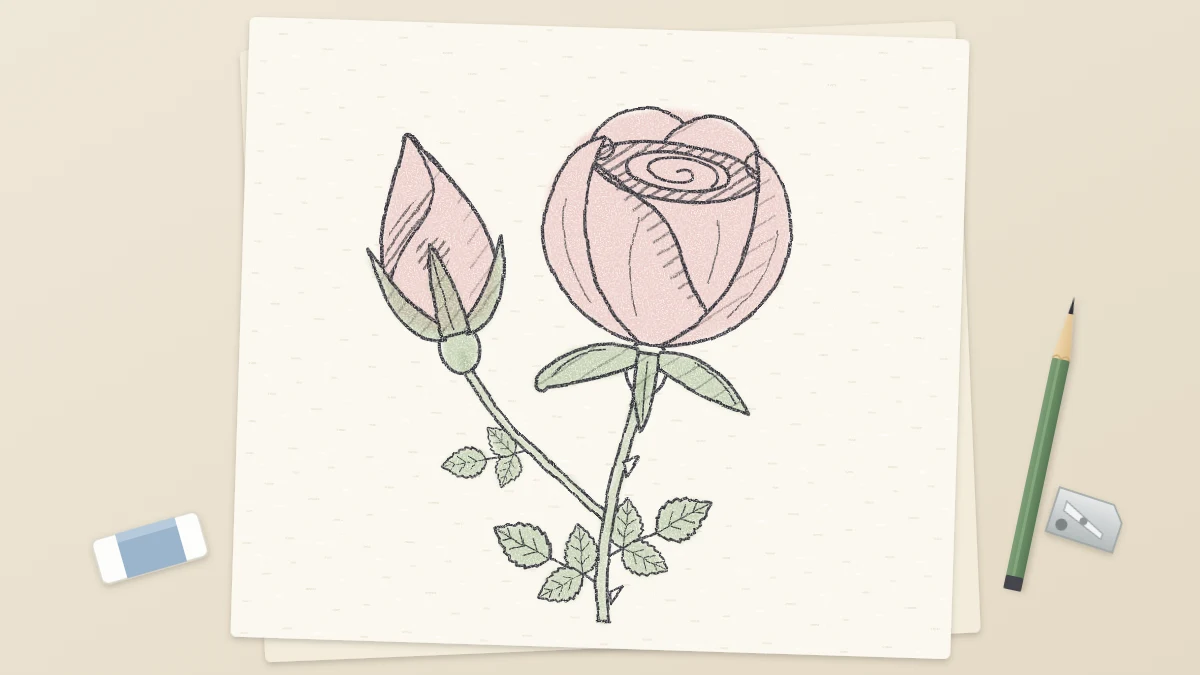
A rosebud is a teardrop on a stem with two overlap lines and narrow sepals. Follow the steps for a tight bud, then widen it into a half-open rose with a spiral at the top.
Tutorial at a glance
What you need
- HB pencil
- 2B pencil
- Kneaded eraser
- Pencil sharpener
- Drawing paper
An open rose asks for a dozen overlapping petals. A bud asks for one shape and two lines. That makes buds the quickest way to add roses to a bouquet, a border or a side spray, and a good warm-up before the full bloom.
This tutorial shows how to draw a rosebud as a teardrop on a stem, then how to open it into a half-open rose with a spiral showing at the top. Both use the same parts: wrapped petals, five narrow sepals and a small swelling that joins the flower to its stem.
Draw the teardrop on a stem
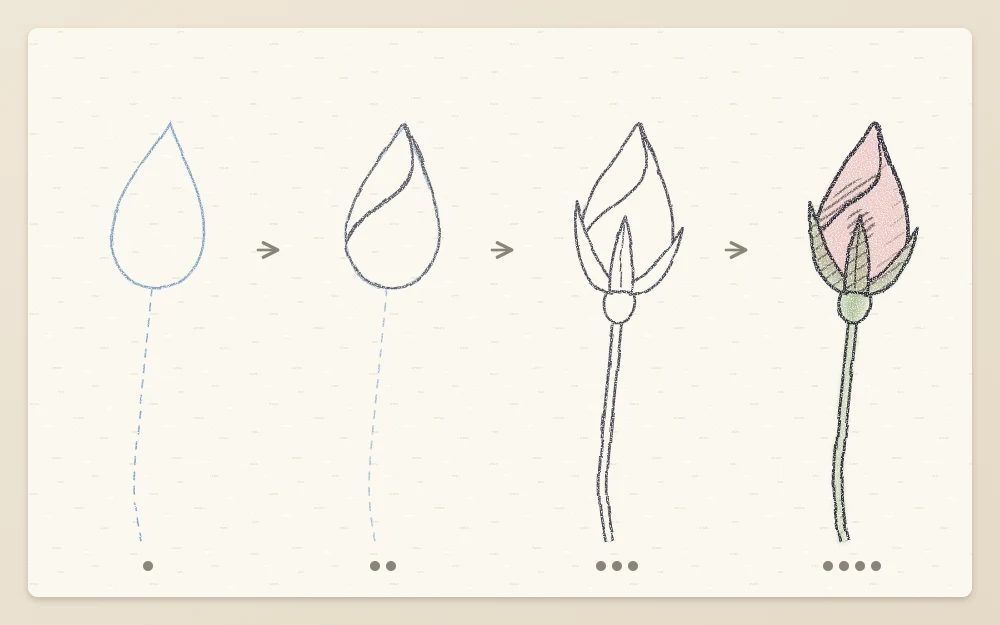
- Stem line. With an HB pencil and light pressure, draw a gently curved line about 5 in (13 cm) long, leaning slightly to one side. This is the center line of the stem, and the bud will sit on its upper end.
- Teardrop. At the top of the stem line, draw a teardrop with its point up. Make it about 2 in (5 cm) tall and a little more than half as wide. The widest part sits about a third of the way up from the base, and the base is rounded, not flat.
- Lean. Tip the teardrop so it continues the curve of the stem line. A bud that stands bolt upright on a curved stem looks stuck on.
Add the two overlap lines
From the outside of a bud you see only the edges where one petal wraps over the next, and two lines are enough to show them.
- The S-shaped line. Switch to a 2B pencil. Start at the tip of the teardrop. Draw a line that swings out to the right, crosses the middle of the bud about halfway down, swings to the left, and ends on the left contour about a quarter of the way up from the base. It should be a long, relaxed S. This is the edge of the outer petal wrapping across the front.
- The second overlap. Start on the right contour, about a quarter of the way down from the tip. Draw a short curve up and to the left that meets the S-shaped line just below the tip. It makes a small pointed shape at the top of the bud: the edge of an inner petal peeking out.
- The tip. Soften the very point of the teardrop into a blunt, slightly uneven end.
Press a little harder on the lower half of the S-shaped line, where the outer petal casts a shadow on the one beneath, and let the line thin out toward the tip.
Add the swelling and the sepals
Under every rose is a small rounded swelling where the flower joins the stem. The sepals grow from the top of it. They are five narrow, pointed, leaf-like parts that hug the bud while it is closed.
- Swelling. Directly under the base of the teardrop, centered on the stem line, draw a small oval about a third as wide as the bud and slightly taller than wide. Its top is hidden by the bud.
- Front sepal. From the top of the swelling, draw a narrow pointed shape lying against the front of the bud, like a long thin leaf. It reaches about a third to half of the way up the teardrop and is about a quarter of the bud’s width at its base.
- Side sepals. Add one on each side, following the contour of the teardrop. Let their tips lift slightly away from the bud, by about the width of a pencil line. From the side you see three of the five sepals; the other two are behind.
- Stem. Draw two lines down from the bottom of the swelling, one on each side of the stem line and close together, so the stem is about a third as wide as the swelling.
For curves, joints and thickness, see the guide to drawing natural flower stems.
Finish the bud
Lift the HB teardrop wherever the sepals now cover it, and erase the stem center line. Go over the contour with the 2B, pressing more on the side away from the light.
Shade with light hatching that follows the length of the bud. Put the darkest value in a narrow strip under the S-shaped line and under each sepal tip. Leave a pale band down the lit side so the bud looks round, and shade the sepals a step darker than the petals.
Draw a half-open rose
As the bud opens, the teardrop widens into a cup and the sepals peel back.
- Cup. With the HB pencil, draw a U shape about as wide as it is tall, on top of a small swelling and a stem line as before. Close the top with a flattened ellipse about a third as tall as it is wide. This ellipse is the rim of the cup, seen from slightly above.
- Spiral. Inside the rim ellipse, draw a small spiral of one and a half turns with the 2B, squashed to fit the ellipse. These are the inner petals, still rolled.
- Wrapping petal. Draw one S-shaped line across the front of the cup, from the left end of the rim down to the right side near the base, just as on the bud.
- Loosening petals. On each side of the cup, add a petal that pulls away from it: start at the base, bow outward beyond the U by about a fifth of the cup’s width, and curve back in to end slightly above the rim with a soft, rolled-over tip.
- Sepals. Draw three sepals from the swelling, now angled outward and downward instead of hugging the flower. Let one curl at its tip.
- Finish. Erase the guides, firm up the contours, and shade the inside of the cup around the spiral darkest.
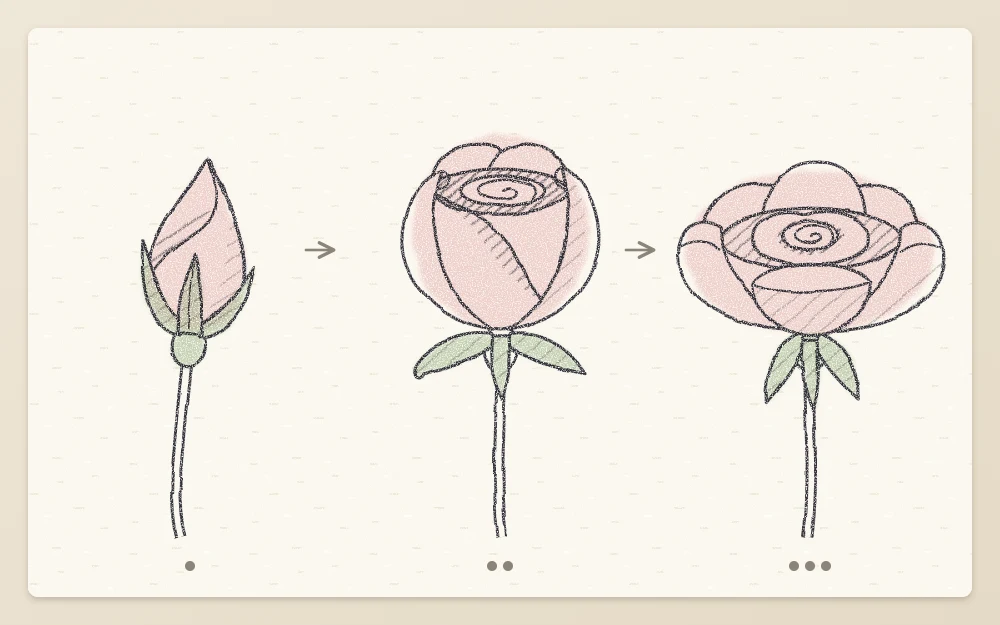
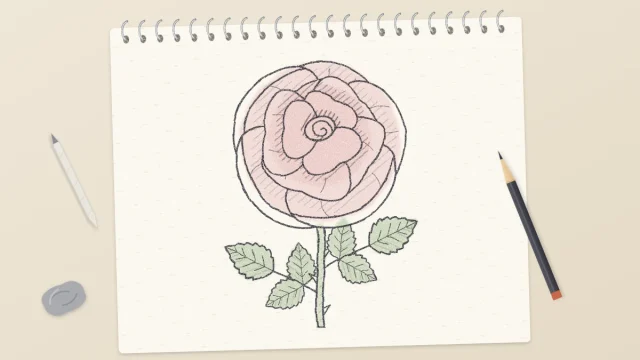
The third stage is the full flower, covered in the tutorial on drawing an open rose step by step.
Common problems
- The bud looks like a flame or a leaf. The base is too pointed. Round it, and add the swelling beneath.
- The sepals look like a collar. They are all the same length and angle. Vary them, and lift one tip.
- The half-open rose looks like a cup with a lid. Break the rim ellipse where the side petals cross it, and let their tips rise above it.
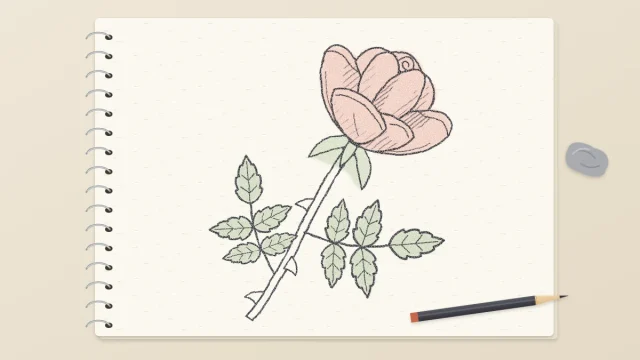
Buds and half-open roses pair well with a bloom drawn in profile. For that, see how to draw a rose from the side with stem, leaves and thorns.
Frequently asked questions
Is a rosebud easier to draw than an open rose?
Yes, for most people. A tight bud is one teardrop shape with two overlap lines and a few sepals, so there are far fewer petals to keep track of. It also teaches the wrapping overlap that the open rose depends on, which makes it a sensible first step.
What are the pointed green parts under a rosebud?
They are sepals. A rose has five of them, narrow and pointed, growing from the small swelling at the top of the stem. They wrap the bud while it is closed and peel back and downward as the flower opens. In a side view you usually see only three.
How do I use rosebuds in a larger drawing?
Place them around or below an open bloom as smaller supporting shapes. Vary their size and lean, point some away from the main flower, and give them less detail and lighter shading. A group of one open rose, one half-open rose and one tight bud usually looks balanced.