
How to Block Noise Like a Pro
Why Noise Is Killing Your Focus (And What the Basics of Soundproofing Can Do About It)
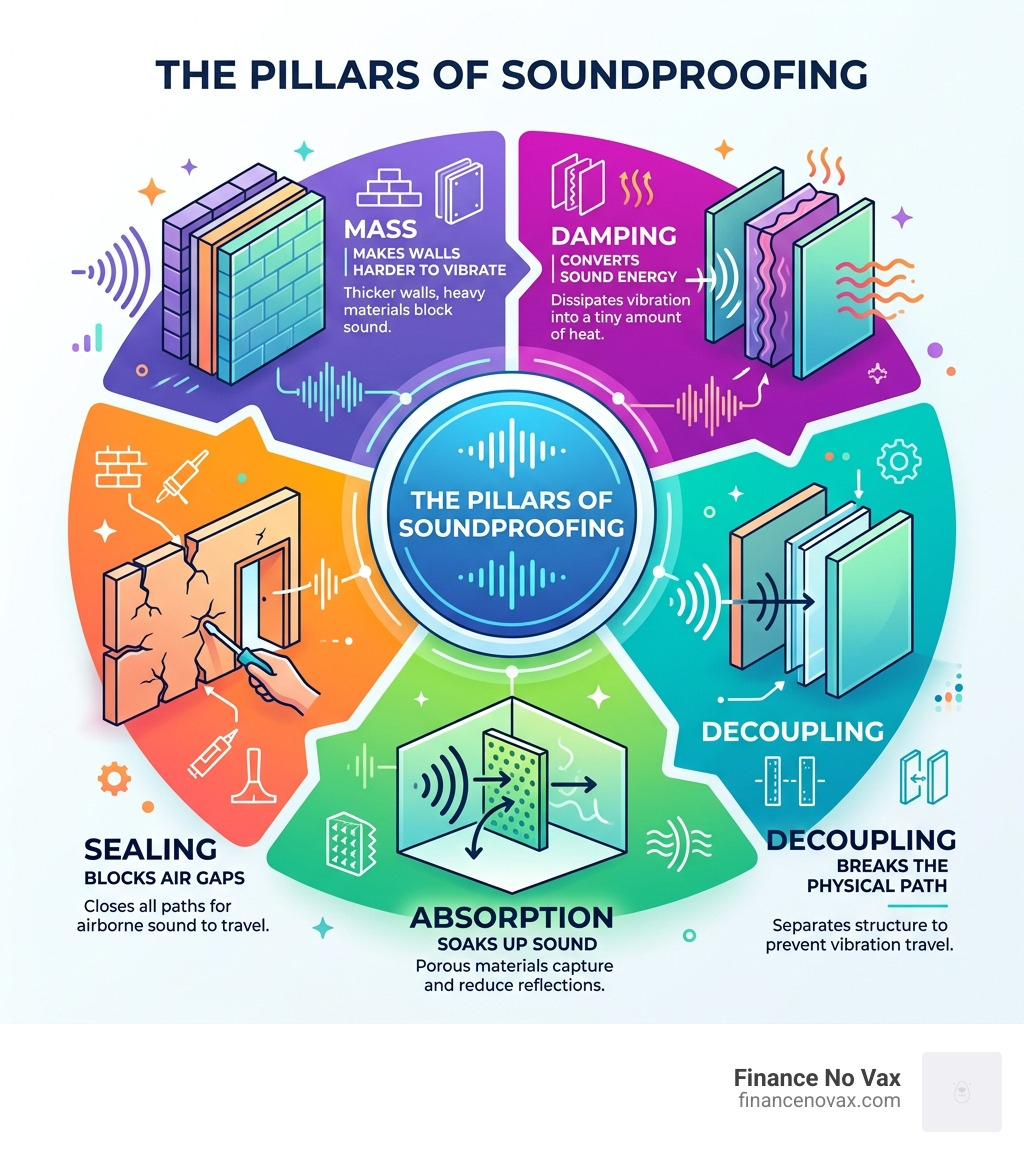
The basics of soundproofing come down to four core principles: mass, damping, decoupling, and absorption — plus one rule that trumps them all: seal every gap first.
Here’s a quick overview:
| Principle | What It Does | Example |
|---|---|---|
| Mass | Makes walls harder to vibrate | Extra drywall, mass-loaded vinyl |
| Damping | Converts sound energy into heat | Green Glue between drywall layers |
| Decoupling | Breaks the physical path of vibration | Resilient channels, staggered studs |
| Absorption | Soaks up sound inside a space | Mineral wool, acoustic panels |
| Sealing | Blocks air gaps sound travels through | Acoustical caulk, door sweeps |
You’re trying to work. But the dog is barking, a delivery truck idles outside, and your upstairs neighbor just started their morning routine. Sound familiar?
Noise isn’t just annoying. Research links chronic noise exposure to elevated stress, disrupted sleep, and even long-term health issues like high blood pressure. For remote workers in April 2026, with home offices now the norm rather than the exception, this has become a very real daily problem.
The good news: you don’t need a construction crew or a massive budget to make a meaningful difference. But you do need to understand how sound actually works — because most people waste money on solutions that barely help (looking at you, egg cartons).
This guide walks you through everything you need to know to block noise like a pro, starting with the science and ending with practical fixes you can use today.
Basics of soundproofing vocabulary:
The Science of Sound and the Basics of Soundproofing
Before we start swinging hammers or buying rolls of vinyl, we need to understand the enemy. Sound is essentially vibrational energy. It travels as waves through a medium — usually air or the solid structure of your home.
When we talk about the basics of soundproofing, we are looking at two distinct types of noise:
- Airborne Noise: This is sound that travels through the air. Think of people talking, the TV in the next room, or a dog barking. It finds its way through gaps, cracks, and even straight through thin walls.
- Impact Noise (Structure-borne): This is the “thud-thud-thud” of footsteps or the vibration of a washing machine. The energy travels through the floor joists and wall studs directly. This is often harder to stop because the entire building acts as a conductor.
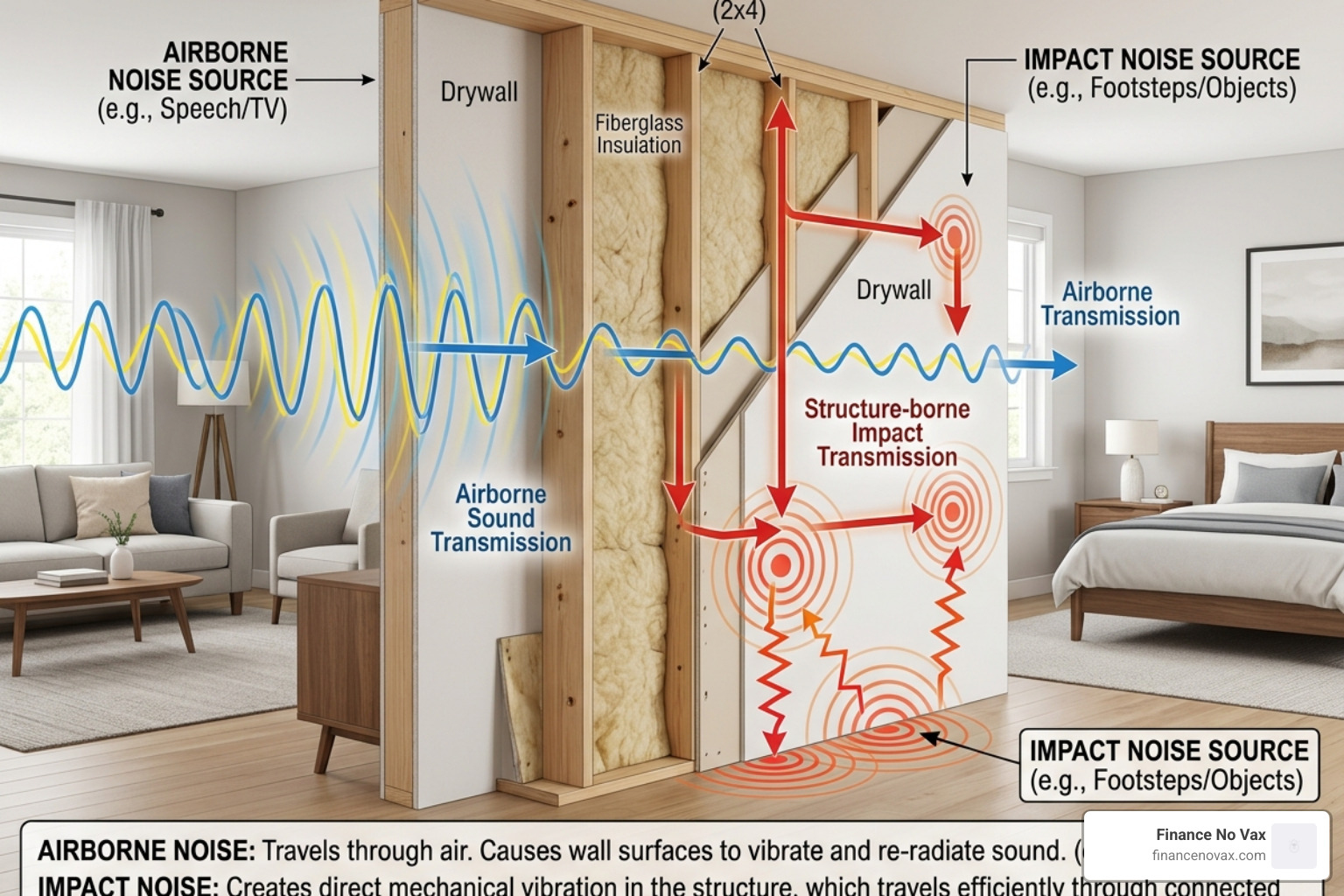
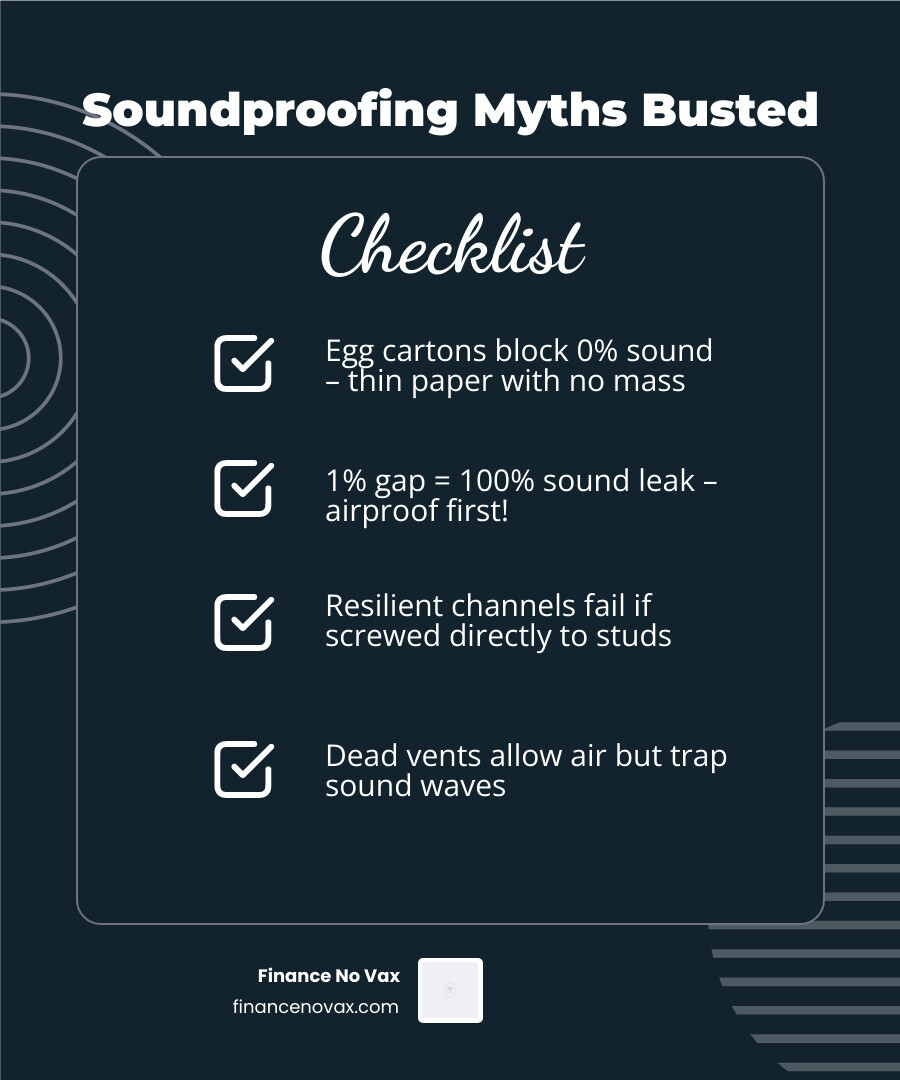
One of the most eye-opening facts we’ve encountered in our research is the 1% Rule. A gap that covers just 1% of a wall’s surface area can allow up to 50% of the sound to pass through. This is why you can hear a conversation in the hallway even if your door is closed — that tiny half-inch gap at the bottom of the door is a massive “sound leak.”
Then there are flanking paths. Sound is like water; it takes the path of least resistance. You might beef up your wall, but if the sound can travel through the shared air duct, the ceiling plenum, or even the floorboards, your efforts will feel wasted.
In acoustics, we measure intensity on the decibel (dB) scale. It’s important to remember that this scale is logarithmic. This means a 10 dB reduction isn’t just a “little bit” quieter — it actually cuts the perceived loudness roughly in half. Understanding the science of noise reduction is the first step toward reclaiming your peace.
The Four Pillars: Mass, Damping, Decoupling, and Absorption
Effective soundproofing isn’t a single product; it’s a system. To get professional results, we use a combination of four core principles. If you only use one, you’ll likely be disappointed.
Soundproofing Metrics to Know
- STC (Sound Transmission Class): This rates how well a partition (like a wall or door) blocks airborne sound. A standard wall is usually around STC 34. A luxury hotel room aims for STC 60+.
- NRC (Noise Reduction Coefficient): This measures how much sound a material absorbs (stops from bouncing back). It ranges from 0.0 (perfect reflection) to 1.0 (perfect absorption).
| Principle | Primary Goal | Best Materials |
|---|---|---|
| Mass | Block sound waves from passing through | Thick drywall, MLV, Concrete |
| Damping | Stop vibrations quickly | Green Glue, Viscoelastic pads |
| Decoupling | Break physical connections | Staggered studs, Isolation clips |
| Absorption | Soak up echoes and resonance | Mineral wool, Acoustic panels |
One warning for the DIY crowd: beware the Triple Leaf Effect. This happens when you add a third layer of material with an air gap in between, which can actually amplify low-frequency sounds (like bass) by creating a resonance chamber. Stick to the proven soundproofing techniques we outline here to avoid accidental amplification!
Adding Mass and Damping for Basics of Soundproofing
Adding mass is the most intuitive part of the basics of soundproofing. The heavier and denser a wall is, the harder it is for sound waves to move it. Think about a heavy velvet curtain versus a sheet of paper.
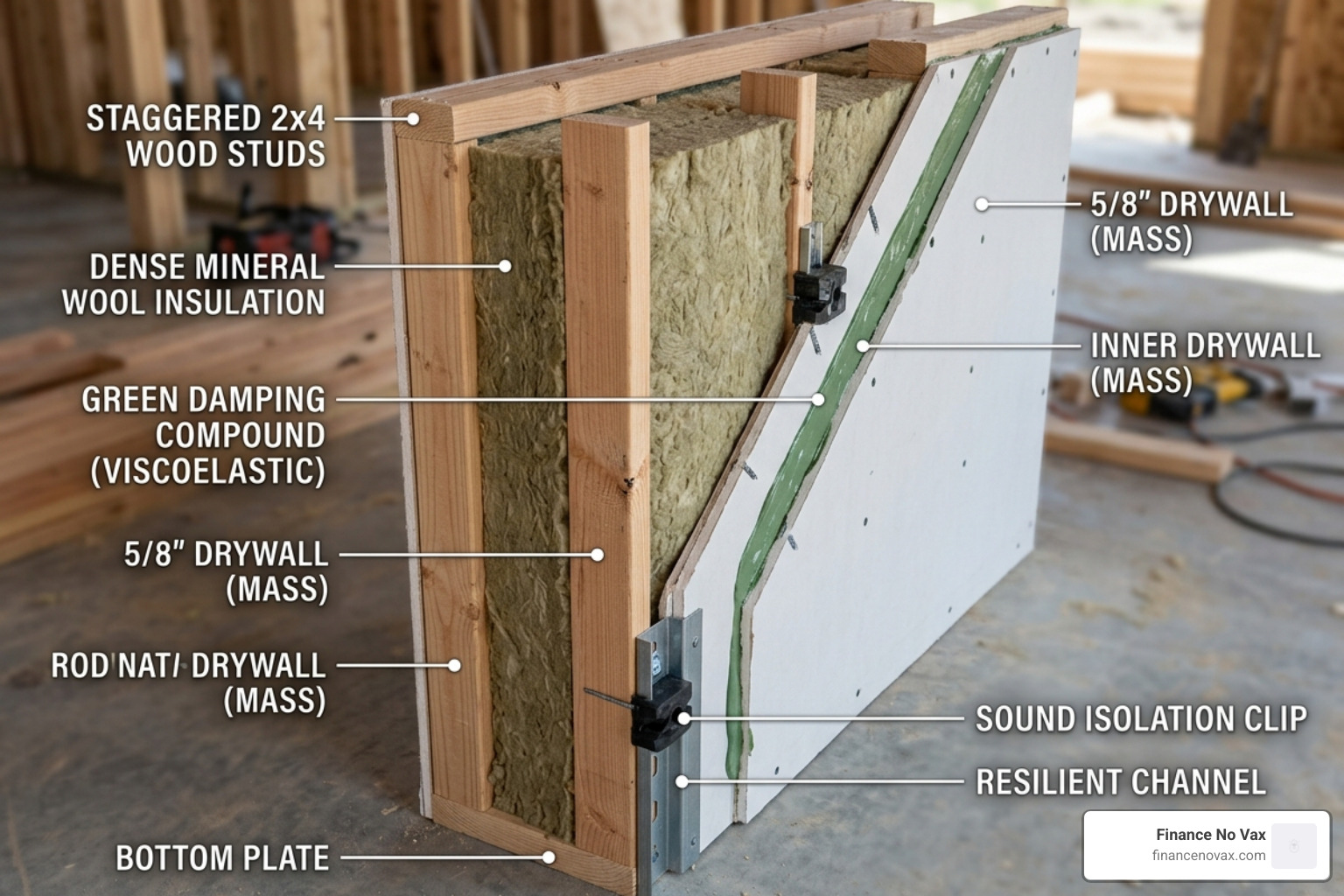
- Drywall: Standard 1/2-inch drywall is okay, but 5/8-inch “Type X” drywall is significantly denser. Doubling up your drywall is a classic pro move.
- Mass-Loaded Vinyl (MLV): This is a thin, flexible, but incredibly heavy material. It’s like a lead sheet without the toxicity. It’s perfect for adding mass to walls without making them a foot thick.
However, mass alone has a limit. That’s where damping comes in. Damping uses viscoelastic compounds — like Green Glue — between layers of mass. When sound waves hit the wall, the damping compound converts that kinetic energy into tiny amounts of heat. It’s essentially a shock absorber for your walls. Applying Green Glue between two sheets of drywall is one of the most cost-effective ways to jump from an STC of 40 to over 50.
For a deeper dive, check out The Ultimate Guide To Soundproofing Your Walls.
Decoupling and Absorption in the Basics of Soundproofing
If you really want to block impact noise (those annoying footsteps), you have to talk about decoupling. In a standard wall, the drywall on both sides is nailed to the same stud. This creates a mechanical bridge for sound to walk right across.
Decoupling breaks that bridge. You can do this by:
- Staggered Studs: Using a wider base plate so that the left-side drywall touches one set of studs and the right-side drywall touches a different set.
- Sound Isolation Clips: These act like little rubber mounts that hold your drywall away from the studs, “floating” it so vibrations can’t pass through easily.
Finally, we have absorption. This is often where beginners get confused. They buy “acoustic foam” (the egg-crate stuff) and think it will block the neighbor’s TV. It won’t. Foam is for absorption — it stops sound from bouncing around inside your room.
For the air cavity inside your walls, you want something denser, like mineral wool (often called Rockwool). Unlike standard pink fiberglass insulation, mineral wool is incredibly dense and excellent at soaking up the sound that manages to get past the first layer of drywall.
Learn more about internal treatments in our Noise Cancelling Panels 101 guide.
Practical Steps: Sealing Gaps, Doors, and Windows
We’ve seen it a thousand times: someone spends $1,000 on high-end insulation but leaves a gap under the door. Remember the 1% rule! The most important first step in any project is “airproofing.” If air can move through a gap, sound can too.
The “Low Hanging Fruit” of Soundproofing
- Acoustical Caulk: Unlike regular caulk, acoustical sealant stays flexible for decades. It won’t crack as the house shifts, ensuring the seal remains airtight. Use it around the perimeter of your walls, electrical boxes, and window frames.
- Door Sweeps and Seals: Most interior doors are hollow-core, which are essentially “drums” that amplify sound. Replacing them with a solid-core door is a huge win. If you can’t do that, install a heavy-duty rubber door sweep and weatherstripping around the frame.
- Window Inserts: Windows are usually the weakest link in an exterior wall. You can add thick, noise-canceling curtains, but for a pro-level fix, look into acrylic window inserts. These create an airtight buffer that can block up to 70% of outside noise.
For more door-specific advice, see our Soundproof Door Solutions 101. You can also find great tips on how to soundproof a room from top experts in the field.
Avoiding Common Mistakes and Managing Expectations
As we move through 2026, we’re still fighting the same old myths. Let’s set the record straight:
- The Egg Carton Myth: Please, stop. Egg cartons do not block sound. They are made of thin paper and have almost zero mass. Worse, they are a massive fire hazard. If you want to absorb echo on a budget, use moving blankets or thick rugs instead.
- Resilient Channel Failures: Resilient channels are metal rails used for decoupling. They work great if installed perfectly. However, if a single screw goes through the channel and into the wood stud (a “short circuit”), the entire decoupling effect is ruined. This is why many pros prefer isolation clips.
- Ventilation Woes: If you make a room perfectly airtight, you might run out of fresh air! Pro soundproof rooms use “dead vents” — zig-zagging ductwork lined with absorption material that lets air in but forces sound waves to bounce around and die before reaching the room.
Renter-Friendly Hacks
If you can’t tear down walls, you can still find peace.
- The Bookcase Strategy: A wall-to-wall bookcase filled with books is a massive, dense barrier that adds significant mass to a shared wall.
- Rugs and Pads: On floors, a thick rug with a high-quality rubber pad underneath can reduce impact noise for your downstairs neighbors (and keep them from banging on their ceiling).
For those living in shared spaces, our Ultimate Apartment Soundproofing Guide is a lifesaver.
Frequently Asked Questions about Soundproofing
What is the difference between soundproofing and sound absorption?
This is the most common point of confusion. Soundproofing is about blocking sound from entering or leaving a room (using mass and decoupling). Sound absorption is about improving the sound quality inside the room by reducing echoes (using foam or panels). You need soundproofing to stop the neighbor’s dog; you need absorption to make your podcast sound better.
How much noise reduction can I realistically expect?
Total silence is nearly impossible and can actually be uncomfortable. A realistic goal for a high-quality DIY project is a reduction of 10 to 20 dB. A 10 dB drop feels like the noise has been cut in half. Professional “room within a room” construction can achieve 30+ dB reductions, turning a loud street roar into a faint whisper.
Is Green Glue better than adding extra drywall?
It’s not an “either-or” situation. Adding a second layer of drywall adds mass. Adding Green Glue between those layers adds damping. Using them together is significantly more effective than just adding a third or fourth layer of drywall alone. It’s the combination of mass and damping that creates the magic.
Conclusion
At Finance No Vax, we believe that your home should be your sanctuary. In an increasingly noisy world, mastering the basics of soundproofing is an investment in your mental health and productivity.
Whether you are sealing a drafty window with acoustical caulk or building a fully decoupled home studio, remember the hierarchy of needs: Seal the gaps, add mass, damp the vibrations, and decouple the structure.
Reclaiming your sanity doesn’t happen overnight, but by following these principles, you can turn down the volume of the world around you. For more deep dives into acoustics, don’t miss The Gospel Of Good Acoustics.
Ready to get started? Explore our full range of resources at https://financenovax.com/category/soundproofing-basics/ and take the first step toward a quieter life today!
