Leaf Shapes for Flower Drawings: Matching Leaves to Flowers
Seven common flowers and the leaves that belong to them, from strap-like tulip leaves to toothed rose leaflets, with a comparison table and a way to observe any plant.
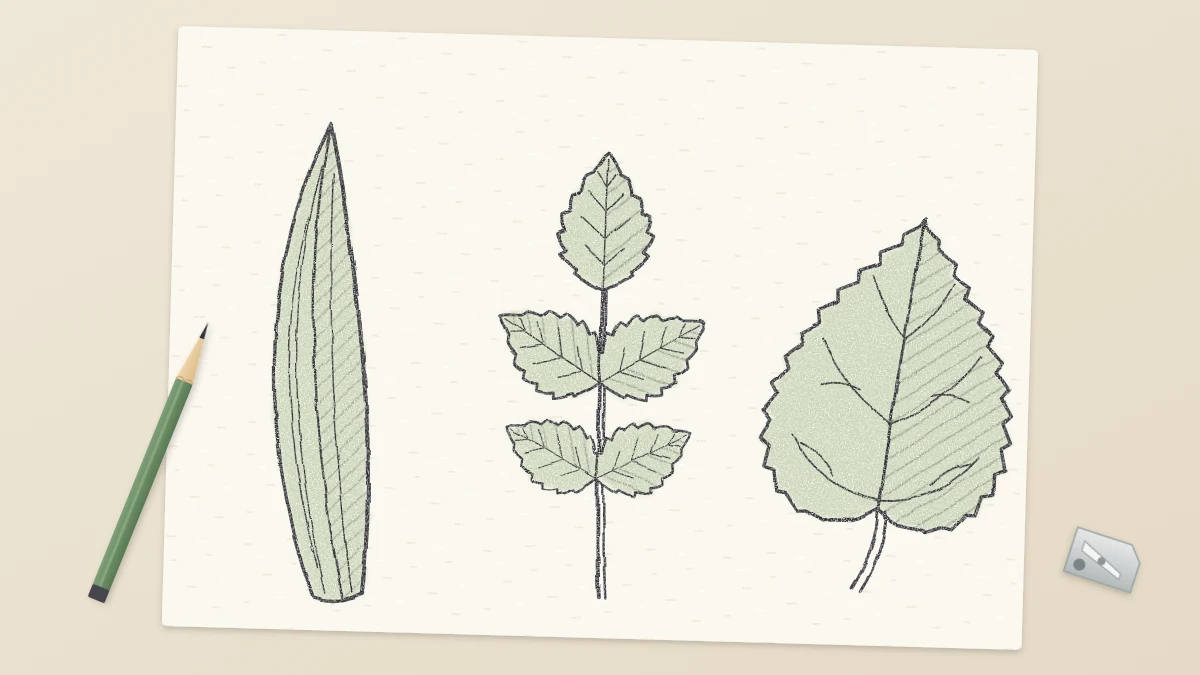
It is easy to spend twenty minutes on a careful tulip and then give it the same pointed oval leaf you would put on a rose, a daisy or anything else. The flower is right, yet the plant looks slightly off, and it is hard to say why.
The reason is nearly always the leaves. Different plants carry very different leaf shapes, and getting them roughly right does a lot to make a drawing read as one particular flower. Below are seven common flowers, the leaves that belong to them, and a way to work out the leaves of any plant you have in front of you.
Why the leaf matters as much as the flower
A leaf tells the viewer three things: its outline, its edge, and where it sits on the plant. A long smooth blade low on the stem says tulip before the flower is even finished. A cluster of toothed leaflets says rose. You do not need to draw every vein. You need the right overall shape in the right place.
If you have not yet practiced the basic construction, with a curved midrib first and the outline second, start with the guide on drawing a single leaf. Everything below builds on that method.
Seven flowers and their leaves
Tulip
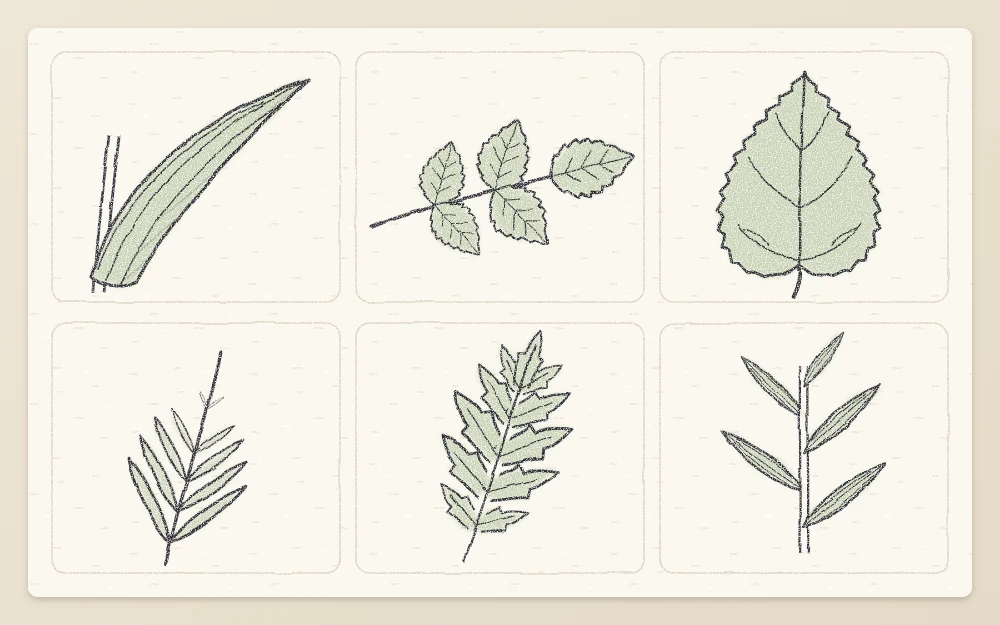
Tulip leaves are long, smooth and strap-like, a bit like a wide ribbon that tapers to a point. They rise from low on the plant, and the base of each leaf wraps around the stem. Draw the midrib as a long curve nearly as tall as the stem, and let the leaf fold or lean outward near the tip. The veins run lengthwise, parallel to the edges, so a few long lines are enough.
Rose
A rose leaf is not one blade but several leaflets on a shared stalk, in groups of three to seven and often five. Draw the stalk first, place one leaflet at its tip, then add the others in pairs along the sides. Each leaflet is a small oval with a toothed edge and a pointed tip. The full plant in profile, with leaves in place, is covered in the tutorial on drawing a rose from the side.
Daisy
The small lawn daisy keeps its leaves low, in a flat cluster at the base of the plant, and sends up a bare flower stalk. Each leaf is spoon-shaped: a narrow stalk that widens into a rounded end. Draw four or five of them fanning out from one point at ground level, and leave the stem itself clean.
Sunflower
Sunflower leaves are large, rough and broadly heart-shaped, with a pointed tip and a coarsely toothed edge. Draw each one on its own stalk, and make the leaf at least as long as the flower’s center is wide. A slightly broken, uneven outline and a few strong veins suggest the rough surface better than neat lines do.
Lavender
Lavender leaves are narrow and gray-green, almost like soft needles. They crowd the lower part of the plant, while the upper stem below the flower spike stays mostly bare. Draw each leaf as a thin, slightly curved sliver with a single center line, in pairs that sit opposite each other on the stem.
Poppy
Poppy leaves are deeply cut and feathery. Start with a midrib and a faint long oval as a guide, then cut into that oval from both sides with deep, irregular notches, leaving narrow pointed lobes with jagged edges. Keep the line loose and a little nervous. A tidy poppy leaf looks wrong.
Lily
Lily leaves are lance-shaped: narrow, smooth-edged and pointed at both ends, and widest near the middle. They sit along the stem from low down almost up to the flowers, getting shorter toward the top. Draw them leaving the stem at an upward angle and then arching outward, with a few lengthwise veins.
Quick comparison table
| Flower | Leaf outline | Edge | Where it sits |
|---|---|---|---|
| Tulip | Long strap | Smooth | Low, wrapping the stem base |
| Rose | Three to seven oval leaflets | Toothed | Along the stem, on stalks |
| Daisy | Small spoon | Smooth or slightly scalloped | Flat cluster at the base |
| Sunflower | Large heart | Coarsely toothed | Along the stem, on stalks |
| Lavender | Narrow sliver | Smooth | Crowded low on the stem |
| Poppy | Long, deeply cut | Jagged lobes | Low and along the stem |
| Lily | Lance | Smooth | All along the stem |
How to observe leaf arrangement on a real plant
For any flower that is not on this list, a real plant will tell you what you need in about a minute. Look at it before you draw and answer four questions.
- Where do the leaves start? At ground level in a cluster, along the stem, or both.
- How do they leave the stem? In pairs opposite each other, one at a time on alternating sides, or several from the same point.
- Is the leaf one blade or several leaflets? Follow the stalk back to the stem. Everything on that one stalk is a single leaf.
- How big is a leaf compared with the flower? Hold your pencil at arm’s length and compare the leaf’s length with the flower’s width.
Write nothing down; make a thumbnail sketch of the answers instead, with simple lines for stem and midribs. Sketch wild plants where they grow, or work from photos you took yourself, including one of the whole plant and one close view of a leaf. This habit of looking first is the core of botanical sketching.
Simplifying leaves without losing the plant
You rarely need every leaf. Two or three well-chosen ones are enough, as long as they keep the features that identify the plant. Keep the outline and the position on the stem, simplify the edge, and reduce the veins to the midrib and a few hints.
Common mismatches to avoid
Common mistake
Drawing one generic leaf on a thin stalk halfway up every stem. It suits very few plants, and it is the main reason different flowers end up looking like the same plant with a different head.
- Broad leaves on a tulip stem. Tulip leaves are long blades from the base, not ovals on stalks.
- Single leaves on a rose. Group the leaflets on one stalk.
- Leaves up a daisy stalk. Keep them in the cluster at the bottom.
- Leaves that are too small. Compare each leaf with the flower head before you commit to its size.
Frequently asked questions
Do I need to draw botanically exact leaves?
No. For a sketch, three things carry the plant: the overall outline of the leaf, the type of edge, and where the leaves sit on the stem. If those are roughly right, viewers recognize the plant. Exact vein patterns and every small tooth can be simplified or left out.
What does a rose leaf look like?
A rose leaf is made of several small oval leaflets on one shared stalk, usually between three and seven and often five. One leaflet sits at the tip and the rest are arranged in pairs along the sides. Each leaflet has a toothed edge and a pointed tip.
How do I find out what leaves a flower has?
Look at a real plant, or at photos you took yourself that show the whole plant and one leaf close up. Note where the leaves start, how they leave the stem, whether each leaf is one blade or several leaflets, and how large a leaf is next to the flower.