
The Best Ways to Silence Your HVAC
Why a Noisy AC Unit Is More Than Just an Annoyance
Soundproofing a noisy AC unit is one of the fastest ways to reclaim peace and quiet in your home — especially if you work remotely and need to focus.
Here are the most effective ways to reduce AC noise, ranked from easiest to most involved:
- Tighten loose hardware and clean dirty coils — free, takes 30 minutes
- Add rubber or neoprene vibration isolation pads under the unit — $20–$60, saves 3–8 dB
- Wrap the compressor with a sound blanket — $80–$200, saves 2–5 dB
- Build a soundproof fence or barrier around the outdoor unit — saves 5–15 dB depending on material
- Seal windows and gaps with acoustic caulk or window inserts — saves up to 80% of noise through glass
- Line ductwork with acoustic liner — $300–$1,500, saves 5–12 dB
It’s the middle of the night. You’re trying to finish a deadline, or just get some sleep — and your AC unit is humming, rattling, or roaring like it has a personal vendetta against silence.
You’re not alone. AC units are one of the most common noise complaints in homes, and the problem tends to get worse as units age. Older systems lack the sound-dampening technology built into modern models, and years of wear add rattles, vibrations, and mechanical hum to the mix.
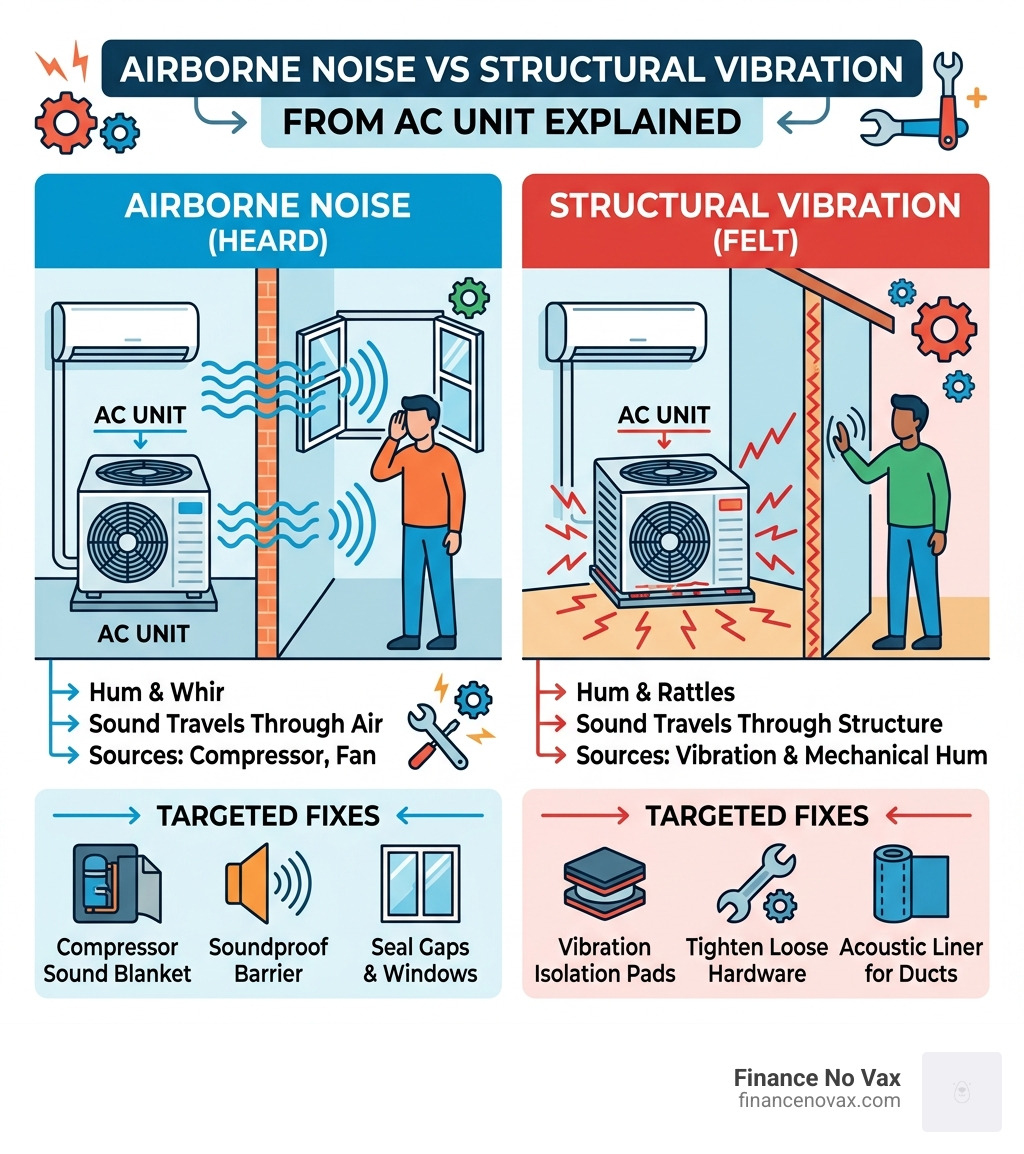
The good news? You don’t need to replace your entire system to get relief. Most AC noise falls into two categories — airborne sound (the hum and whir you hear through the air) and structural vibration (the buzz you feel through walls and floors). Each type has targeted, affordable fixes.
This guide walks you through every proven method, from simple maintenance to building an outdoor enclosure — with real decibel reduction numbers and cost estimates so you know exactly what to expect.
Soundproofing noisy ac unit basics:
Diagnosing and Maintaining Your HVAC System
Before we start throwing money at expensive soundproofing materials, we need to play detective. Not all AC noise is created equal, and some of it is actually a cry for help from your machinery. As of April 2026, many older units are reaching their mechanical limits, and a simple tune-up can sometimes do more than a barrier wall ever could.
Identifying the Three Types of Noise
To effectively silence the beast, we must first understand how the sound reaches our ears:
- Airborne Noise: This is the literal sound of the fan blades cutting through the air and the roar of the compressor. It travels through the atmosphere and enters your home through thin windows or gaps in doors.
- Structural Vibration (Structure-Borne): This is the “buzz” you feel in your feet or the wall behind the unit. The compressor oscillates at about 50-60 Hz, and if it’s bolted directly to a concrete slab or wall bracket without padding, that energy turns your whole house into a giant speaker.
- Duct-Borne Sound: If you hear whistling, rushing, or a deep hum coming directly out of your vents, the noise is traveling through the ductwork itself.
The 180Hz Hum and Mechanical Troubleshooting
A common complaint we hear is a persistent, low-frequency hum around 180Hz. While you might be tempted to slap some insulation on the wall, research shows that even 9 inches of rockwool may only provide a measly 2-3 dB reduction for a hum at this frequency. This is because low frequencies have long wavelengths that pass through light materials easily.
Instead, we should look for mechanical causes first:
- Loose Hardware: Believe it or not, about 42% of wall-unit rattles are caused by nothing more than loose screws. Check the panels, the fan cage, and the mounting brackets.
- Dirty Coils and Debris: When dirt clogs your condenser coils, the unit has to work harder, making the fan spin faster and the compressor run hotter and louder. A quick rinse with a garden hose can drop the decibel level significantly.
- Fan Balance: If a fan blade is bent or coated in heavy gunk, it will wobble. This creates a rhythmic thumping or vibration. Cleaning and “polishing” the blades with paste wax can actually reduce drag and noise.
- Lubrication: Dry bearings in the fan motor will squeal or chirp. A few drops of SAE 20 oil (if your motor has ports) can work wonders. For more on routine maintenance, the Department of Energy provides a comprehensive checklist for homeowners.
Essential Strategies for Soundproofing Noisy AC Unit Components
Once the maintenance is done, we can move on to actual soundproofing. This involves using materials that either block sound (mass) or absorb it (friction).
The Soundproofing Toolkit
We recommend keeping a few specific materials in mind as we go through these steps:
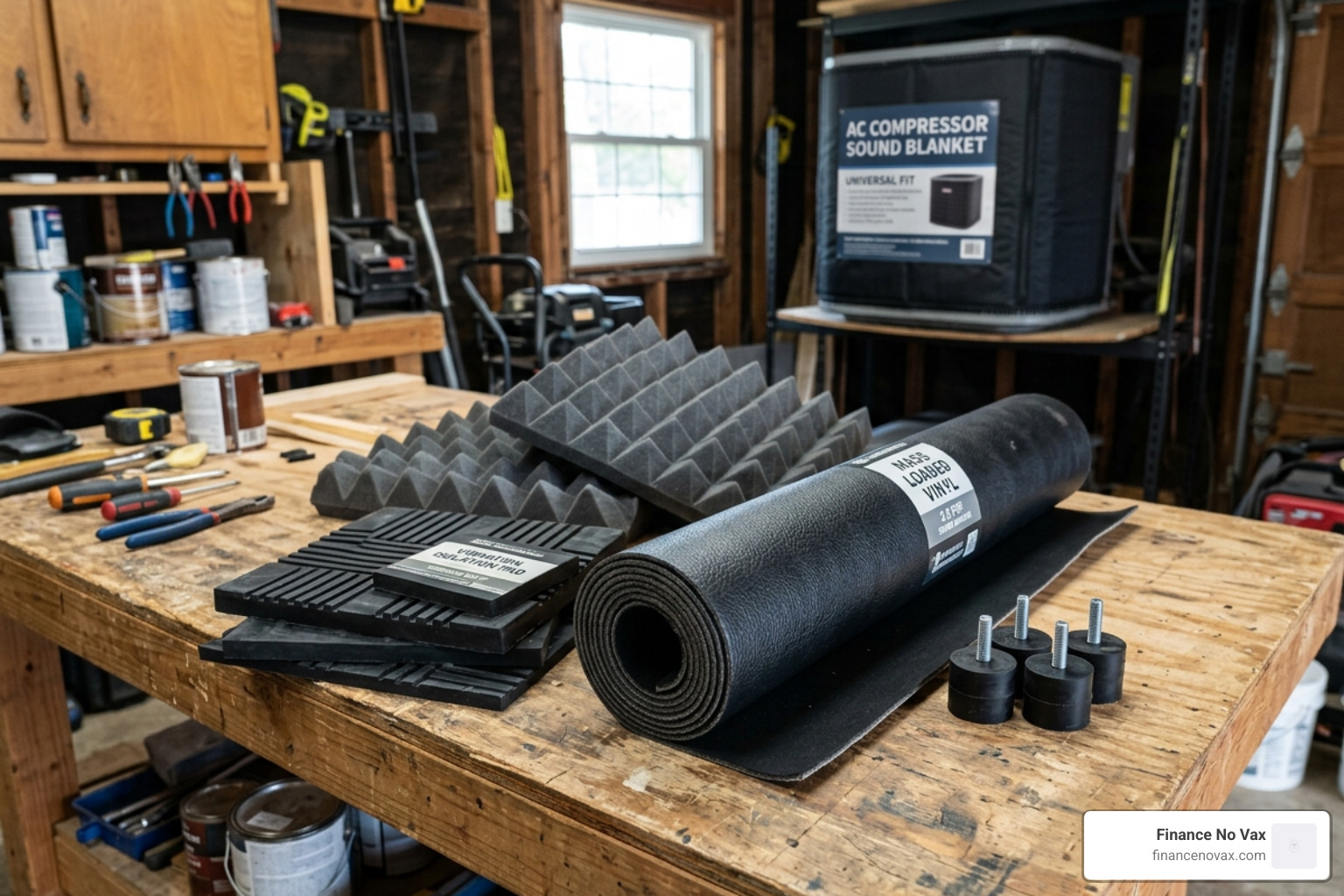
- Mass Loaded Vinyl (MLV): This is the “gold standard.” It’s a dense, flexible material that stops sound waves in their tracks.
- Acoustic Caulk: This stays flexible for years. We use it to seal gaps because sound behaves like water—if there is a tiny hole, the noise will “leak” through.
- Foam Composites: These combine a layer of sound-absorbing foam with a layer of blocking material like MLV.
- Vibration Isolation: This involves “decoupling” the unit from the house.
Soundproofing Noisy AC Unit Compressors with Blankets
The compressor is the heart of the AC, and it’s usually the loudest part. It’s a metal pump that vibrates intensely. A sound blanket is essentially a heavy, insulated “jacket” for your compressor.
How it works: Most sound blankets use a combination of a high-density barrier (like MLV) and a sound-absorbing layer (like fiberglass or polyester). When you wrap the compressor, it traps the mid-to-high frequency whirring and significantly muffles the low-frequency thumping.
Installation Tips:
- Check Fit: You can buy universal blankets or ones specific to your manufacturer.
- Safety First: Never wrap the entire outdoor unit! You are only wrapping the small, cylindrical compressor inside. Wrapping the whole unit will cause it to overheat and potentially catch fire.
- Expected Results: You can expect an immediate 2–5 dB reduction. While that sounds small, a 3 dB reduction is a 50% decrease in sound energy!
Addressing Structural Vibrations and Ductwork
If your walls are vibrating, we need to break the “vibration path.”
Rubber Isolation Pads Instead of the unit sitting directly on a concrete pad or metal bracket, we place it on isolation pads. Neoprene waffle pads are excellent because the “waffle” design allows the rubber to compress and absorb the energy. For every 40 pounds of machinery, we recommend at least one pad.
Flex Connectors and Ductwork For central air systems, the air handler (the indoor part) is often connected to rigid metal ducts. These ducts act like a megaphone for the motor’s vibration.
- Flex Connectors: These are rubberized fabric sections that go between the unit and the metal ducts. They stop vibrations from traveling down the line.
- The 90-Degree Rule: For every true 90-degree turn in your ductwork, you can reduce about 6 decibels of noise. This makes the air about 35% quieter per turn.
- Acoustic Duct Liners: Lining the first 10–15 feet of ductwork with acoustic foam can absorb the “rushing” air sound before it reaches your living room.
Indoor Solutions for Soundproofing Noisy AC Unit Interference
Sometimes, the unit is fine, but your home’s “envelope” is too thin. This is especially true for window AC units or outdoor condensers located right outside a bedroom window.
Window Treatments Windows are almost always the weakest link in soundproofing. If you can hear the AC, it’s likely coming through the glass.
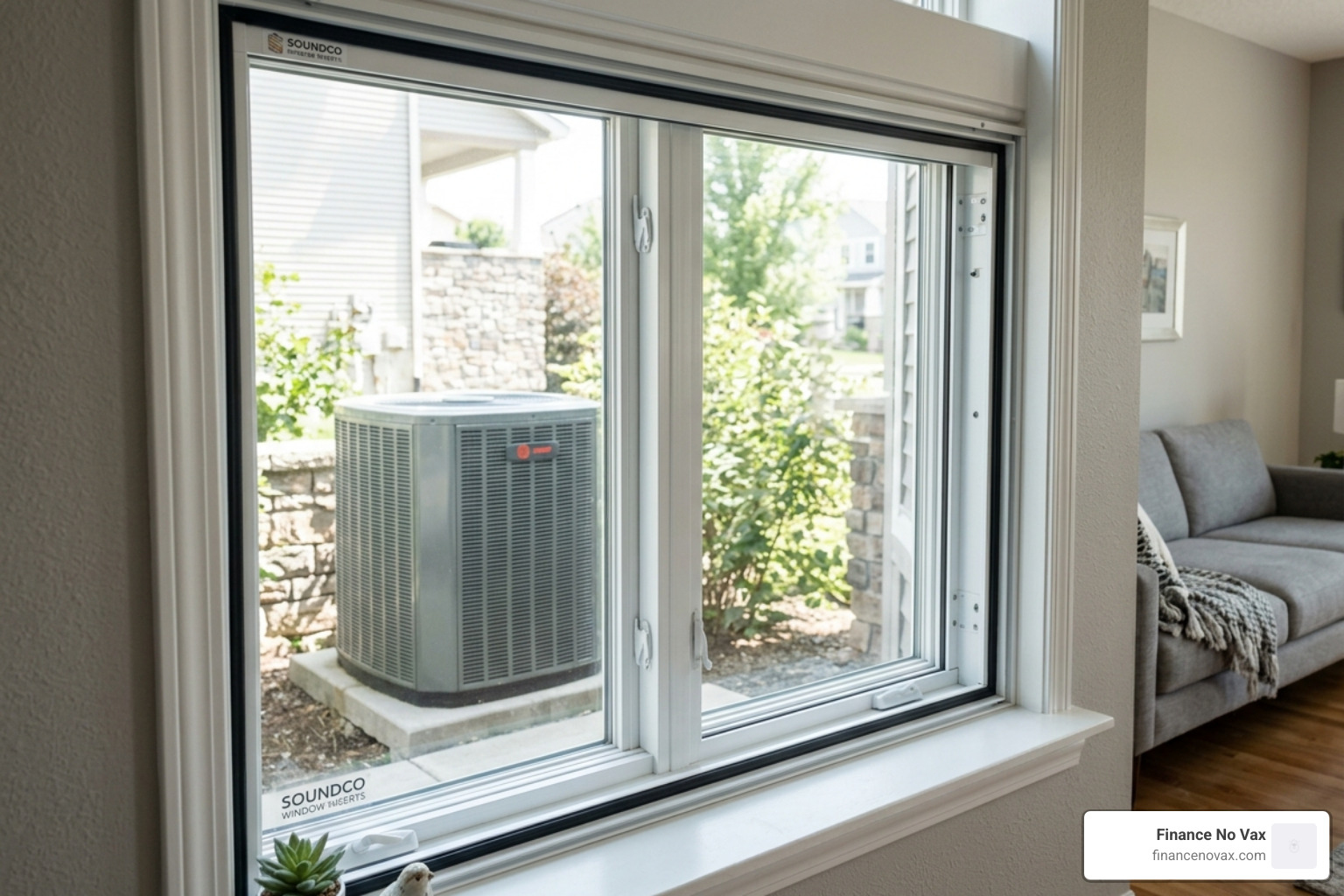
- Window Inserts: These are secondary panes of acrylic or glass that press into your existing window frame. They create an airtight seal and a dead-air space that can block up to 80% of outside noise.
- Acoustic Sealant: Check the perimeter of your window frame. If you see gaps, fill them with professional-grade acoustic caulk.
We have covered window solutions extensively in our other guides. If you are struggling with noise leaking through your glass, check out Silence Your Apartment With These Top Window Solutions or learn How To Block Street Noise For Good.
Building External Barriers and Enclosures
If maintenance and blankets aren’t enough, it’s time to build a physical wall between you and the noise. This is one of the most effective ways to soundproof a noisy AC unit, but it requires careful planning to avoid killing your machine’s efficiency.
The “L-Shaped” Barricade
You don’t always need to build a full box. An “L-shaped” fence that sits between the AC unit and your window can deflect sound waves away from your house.
Design Rules for Maximum Quiet:
- Height: The barrier should be at least 1.5 to 2 times the height of the AC unit. An 8-foot high barricade is often the “sweet spot” for maximum blockage.
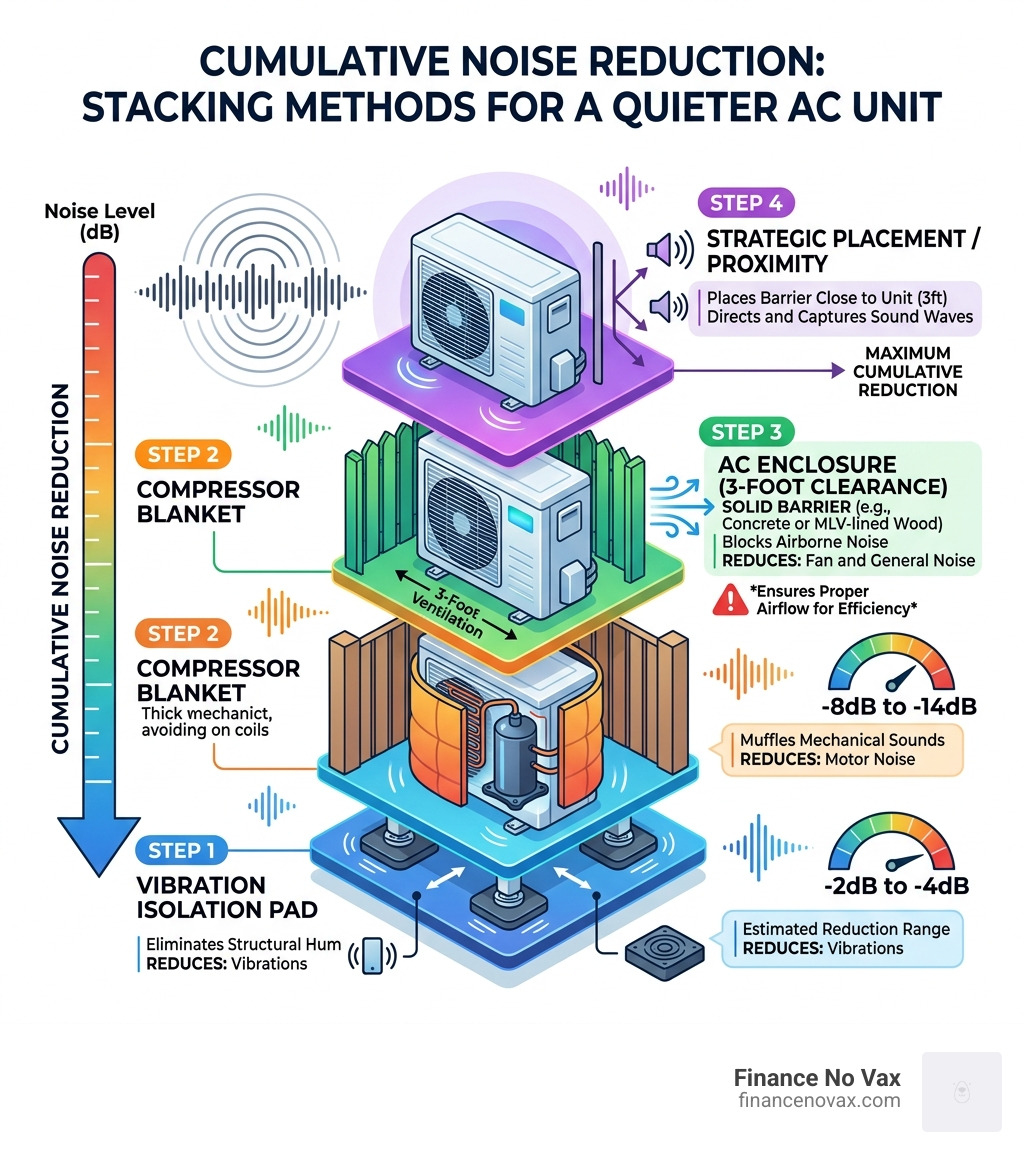
- Proximity: Place the barrier as close to the unit as safely possible (usually 3 feet) to catch the sound waves before they spread out.
- Airtightness: A fence with gaps between the boards is just a decoration. To stop sound, the barrier must be solid. If air can get through, sound can get through.
- Density: Use heavy materials. A thin cedar fence won’t do much. We recommend lining the inside of the fence with MLV or outdoor-rated acoustic blankets.
Barrier Material Effectiveness Comparison
| Material | Noise Reduction (dB) | Cost | Pros | Cons |
|---|---|---|---|---|
| Wood Fence (Solid) | 5–8 dB | $$ | Attractive, DIY-friendly | Needs MLV lining for best results |
| Vinyl Fence (Solid) | 4–7 dB | $$ | Low maintenance | Can vibrate/rattle if not heavy |
| Concrete/Brick | 10–15 dB | $$$$ | Best sound blocker | Expensive, permanent, hard to DIY |
| MLV on Wood Frame | 8–12 dB | $$$ | High performance | Requires building a sturdy frame |
The Ventilation Gap: Don’t Kill Your AC!
This is the most important part of building an enclosure. Your AC works by pulling air in through the sides and blowing hot air out the top. If you restrict this airflow, the unit will overheat, its lifespan will plummet, and your electricity bill will skyrocket.
- The 3-Foot Rule: Always leave at least 3 feet of clearance between the unit and any wall or fence.
- The Open Top: Never put a solid, flat roof directly on an AC enclosure. If you want a roof to block noise from rising to a second-story window, use a slanted roof that is open on at least one side (pointing away from the house).
- Airflow Ratio: If you are building a full four-sided enclosure, ensure the bottom has a gap or the material is breathable enough to allow the unit to “inhale.”
Frequently Asked Questions
When should I replace my AC unit instead of soundproofing it?
If your unit is more than 10–12 years old and the noise is a “grinding” or “screaming” sound, soundproofing is just a bandage on a bullet wound. By April 2026, many older units are far less efficient than modern variable-speed models. A new, high-efficiency unit is often 20–30% quieter out of the box because the compressors can run at lower speeds rather than just “OFF” or “FULL BLAST.” If your repair costs are more than 50% of the cost of a new unit, it’s time to upgrade.
How can I prevent my AC from overheating after adding soundproofing?
The key is clearance and monitoring. If you install a compressor blanket, ensure it is only on the compressor, not blocking the fins of the condenser coil. If you build a fence, keep that 3-foot “breathability” zone. You can also install a simple thermal monitor inside the enclosure to check if the ambient temperature is rising significantly above the outdoor temperature.
What is the most cost-effective way to reduce AC noise?
The “Bang-for-your-buck” winner is the Vibration Isolation Pad. For under $50 and 10 minutes of work, you can often eliminate the most annoying part of AC noise—the structural hum that vibrates your house. Following that, a DIY “L-shaped” wooden fence lined with a remnant of MLV provides the best airborne noise reduction for the price.
Conclusion
At Finance No Vax, we believe that your home should be a sanctuary, not a construction zone. Soundproofing a noisy AC unit doesn’t have to be an all-or-nothing project. You can start with simple maintenance and isolation pads today, and if the noise persists, move on to sound blankets or external barriers.
By tackling both the airborne roar and the structural vibrations, you can achieve a “stack” of noise reduction that makes your HVAC system something you feel (in the form of cool air) rather than something you hear. If you’re dealing with a particularly stubborn noise issue, don’t hesitate to consult with an HVAC professional to ensure your soundproofing isn’t compromising the unit’s mechanical integrity.
For more tips on keeping your living space serene, check out our More info on soundproofing basics to learn about blocking noise from neighbors, traffic, and more. Quiet living is possible—you just have to break the vibration path!
