
How to Install MLV Sound Barriers for Quiet Walls
Why Mass Loaded Vinyl Walls Are the Smartest Fix for a Noisy Home
Mass loaded vinyl walls are one of the most effective ways to block unwanted noise from entering or leaving a room — and they work for both new builds and existing walls.
Here’s a quick summary of what MLV walls can do for you:
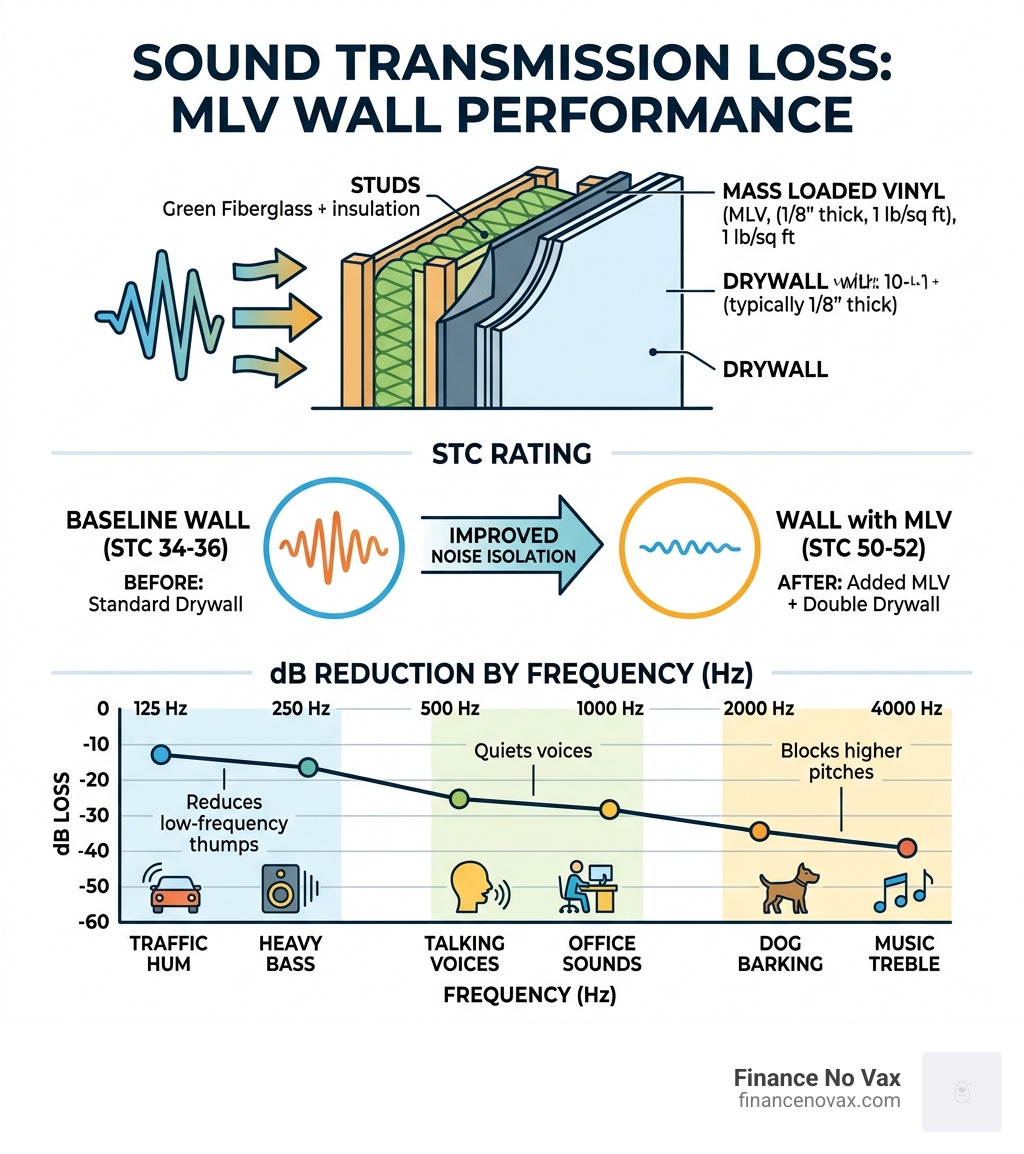
- What it is: A thin, dense, flexible barrier (typically 1/8″ thick, 1 lb per sq ft) that blocks sound transmission
- How well it works: Standalone STC rating of 26 for 1 lb MLV; up to STC 32 for 2 lb MLV
- Noise reduction range: Works from 125 Hz to 4000 Hz — covering voices, traffic, music, and more
- Where it’s used: Home offices, bedrooms, home theaters, recording studios, shared walls in apartments
- How it’s installed: Fastened to studs before drywall, or retrofitted onto existing walls with furring strips
- Key benefit: Adds significant sound-blocking mass without taking up much space
If you work from home, you already know the problem. A coworker on a video call. A dog barking next door. Traffic outside. These aren’t just annoyances — they chip away at your focus and productivity hour by hour.
Most people try rugs, curtains, or foam panels first. Those help with echo inside a room, but they don’t stop sound from traveling through your walls. That’s a completely different problem.
Mass loaded vinyl (MLV) solves the through-wall problem. It works by adding dense mass to your wall assembly, which forces sound waves to lose energy as they try to pass through. Think of it like trying to throw a baseball through a heavy, flexible blanket — the material absorbs and dissipates the energy rather than letting it pass.
MLV was introduced in the 1960s as a safer, more practical alternative to lead sheeting. Today it’s one of the go-to materials for architects, contractors, and DIYers who need real noise reduction without tearing down walls or pouring concrete.
The best part? You can install it yourself. This guide walks you through everything — from how it works, to how to install it, to what results you can realistically expect.
Simple mass loaded vinyl walls glossary:
Understanding Mass Loaded Vinyl Walls and How They Work
To understand why mass loaded vinyl walls are so effective, we first have to look at the physics of sound. Sound is energy that travels in waves. When those waves hit a standard wall, they cause the wall to vibrate. That vibration then pushes the air on the other side, recreating the sound in the next room.
MLV changes the game by introducing “limp mass.” Unlike rigid materials like wood or standard drywall, which can act like a drumhead and vibrate easily, MLV is heavy and flexible. It doesn’t want to vibrate. In the industry, we call this a “limp mass barrier.” When sound hits it, the material absorbs the energy and converts it into a tiny amount of heat rather than passing the vibration through the structure.
Key Specifications of MLV
When you start shopping for materials, you’ll notice a few standard numbers. Most residential projects use the 1 lb. per square foot variety. Here is the breakdown of what that looks like in April 2026:
- Density: 1 lb. per square foot (often referred to as 1 lb MLV).
- Thickness: Approximately 1/8 of an inch.
- STC Rating: A standalone Sound Transmission Class (STC) of 26.
- Frequency Range: Highly effective from 125 Hz to 4000 Hz.
For those dealing with extreme noise — think a drum kit or a heavy industrial generator — there is a 2 lb. version. This is 1/4″ thick and boasts an STC rating of 32. However, for most home theaters and bedrooms, the 1 lb. version provides the best balance of cost, weight, and performance.
Beyond Just Mass: The Reflective Barrier
MLV isn’t just about weight; it acts as a reflective barrier. While materials like acoustic wall foam or fiberglass insulation are designed to absorb sound (trapping it in fibers), MLV is designed to block it.
By adding MLV to your wall assembly, you are effectively decoupling the surfaces. When you hang MLV loosely across studs, it creates a “curtain” effect inside the wall. This prevents the sound vibrations from jumping directly from the outer drywall to the inner studs.
A Safe, Modern Alternative
We often get asked if MLV is safe for indoor use. In the past, lead was the only material dense enough to block sound this effectively. Obviously, we don’t want lead in our bedroom walls! Modern MLV is typically made from a proprietary blend of PVC and inert materials like calcium carbonate or barium sulfate. It is non-toxic, odorless, and compliant with modern building codes.
Step-by-Step Guide to Installing Mass Loaded Vinyl Walls
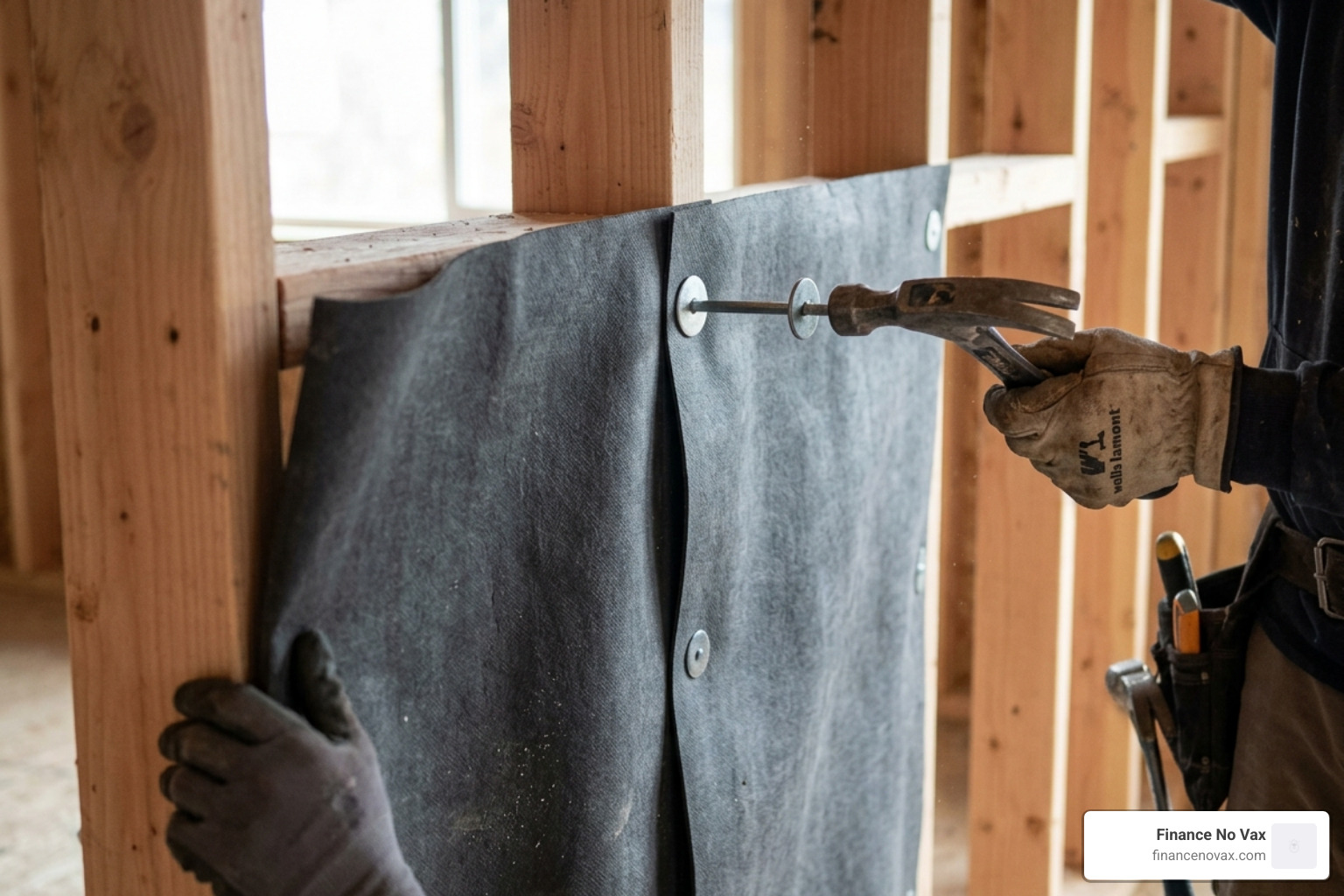
Installing mass loaded vinyl walls is a two-person job. Why? Because a standard 4′ x 25′ roll of 1 lb MLV weighs about 105 pounds. It is floppy, heavy, and definitely doesn’t want to stay up by itself while you’re trying to reach for your stapler.
Tools and Materials Needed
Before we start, ensure you have the following:
- A utility knife (with plenty of spare blades, as MLV dulls them quickly)
- A T-square or straight edge
- A heavy-duty stapler or a hammer with wide washer head nails
- PVC seam tape
- Acoustic caulk
- A partner to help hold the material
The Installation Process
- Measure and Cut: Measure the height of your wall. We recommend cutting the MLV about 1/4″ shorter than the total height to leave room for a perimeter gap (which we will seal later).
- Position the First Sheet: Start in a corner. Have your partner hold the top of the sheet against the top plate of the wall.
- Fasten to Studs: Use wide washer nails or heavy-duty staples every 8 to 12 inches along the top plate and down the length of the studs. It is vital to use wide washers; otherwise, the weight of the material can cause it to “zip” right through the fastener and fall.
- Overlap or Butt Seams: You have two choices for the seams. You can butt the edges together directly over a stud, or you can overlap them by about 2 inches. Overlapping is generally more effective for soundproofing but can create a slight “bump” in your finished drywall.
- Seal the Seams: This is the most important step. Sound is like water; it will find the smallest leak. Use PVC seam tape to cover every single joint between sheets.
For a deeper dive into the mechanics, check out The Ultimate Guide To Mass Loaded Vinyl Installation.
MLV Specifications Table
| Density | Thickness | Standalone STC | Weight (100 sq ft roll) |
|---|---|---|---|
| 0.5 lb/sq ft | 1/16″ | 20 | 50 lbs |
| 1.0 lb/sq ft | 1/8″ | 26 | 105 lbs |
| 2.0 lb/sq ft | 1/4″ | 32 | 210 lbs |
Preparing Your Space for Mass Loaded Vinyl Walls
Preparation is what separates a “good” soundproofing job from a “great” one. Before unrolling the vinyl, you need to prep the “skeleton” of your room.
- Stud Finding: If you are retrofitting, you must find and mark your studs accurately. The MLV needs to be anchored into the structure, not just the drywall.
- Surface Cleaning: If you are using a PSA-backed MLV, the surface must be clean and free of dust for the adhesive to bond.
- Perimeter Gaps: Leave a 1/4″ gap at the floor and ceiling. Fill this gap with acoustic caulk. This prevents the wall from being “tightly coupled” to the rest of the house, which stops structural vibration.
- Electrical Boxes: Don’t just cut a hole and leave it. Use acoustical outlet backer putty pads around the back of your electrical boxes. This prevents sound from leaking through the “hole” you just cut in your sound barrier.
Advanced Techniques for Mass Loaded Vinyl Walls
For those who want the absolute best performance, consider these advanced methods:
PSA Backing (Pressure-Sensitive Adhesive) Some MLV products come with a “peel-and-stick” backing. This is a lifesaver for DIYers. Products like SilentWrap™ PSA allow you to stick the material directly to the substrate, which acts as an extra layer of damping and makes the mechanical fastening much easier.
Reinforced Scrim If you are hanging MLV vertically over a large area (like in a warehouse or a tall studio wall), look for “reinforced” MLV. This version has a fiberglass or polyester mesh embedded inside. It increases the tensile strength to over 1100 psi, ensuring the material won’t stretch or tear over time under its own weight.
Air-Tight Sealing We cannot stress this enough: an air-tight seal is mandatory. If 1% of your wall is left unsealed, you can lose up to 50% of your soundproofing effectiveness. This is why we use acoustic caulk and seam tape religiously. If you’re building a truly high-end space, you might even consider Double Wall Soundproofing in combination with MLV.
Best Practices for New Construction and Existing Walls
The way we approach mass loaded vinyl walls depends entirely on whether we are looking at open studs or a finished wall.
New Construction (Open Studs)
This is the ideal scenario. You install the MLV directly to the studs before the drywall goes up.
- Pro Tip: Hang the MLV horizontally. This reduces the number of vertical seams you have to tape.
- The Sandwich: For maximum results, place mineral wool insulation in the stud cavities, hang the MLV over the studs, and then install your drywall. For a “super wall,” use two layers of drywall with Green Glue damping compound between them.
Retrofitting Existing Walls
What if you can’t rip down your existing drywall? You have two main options:
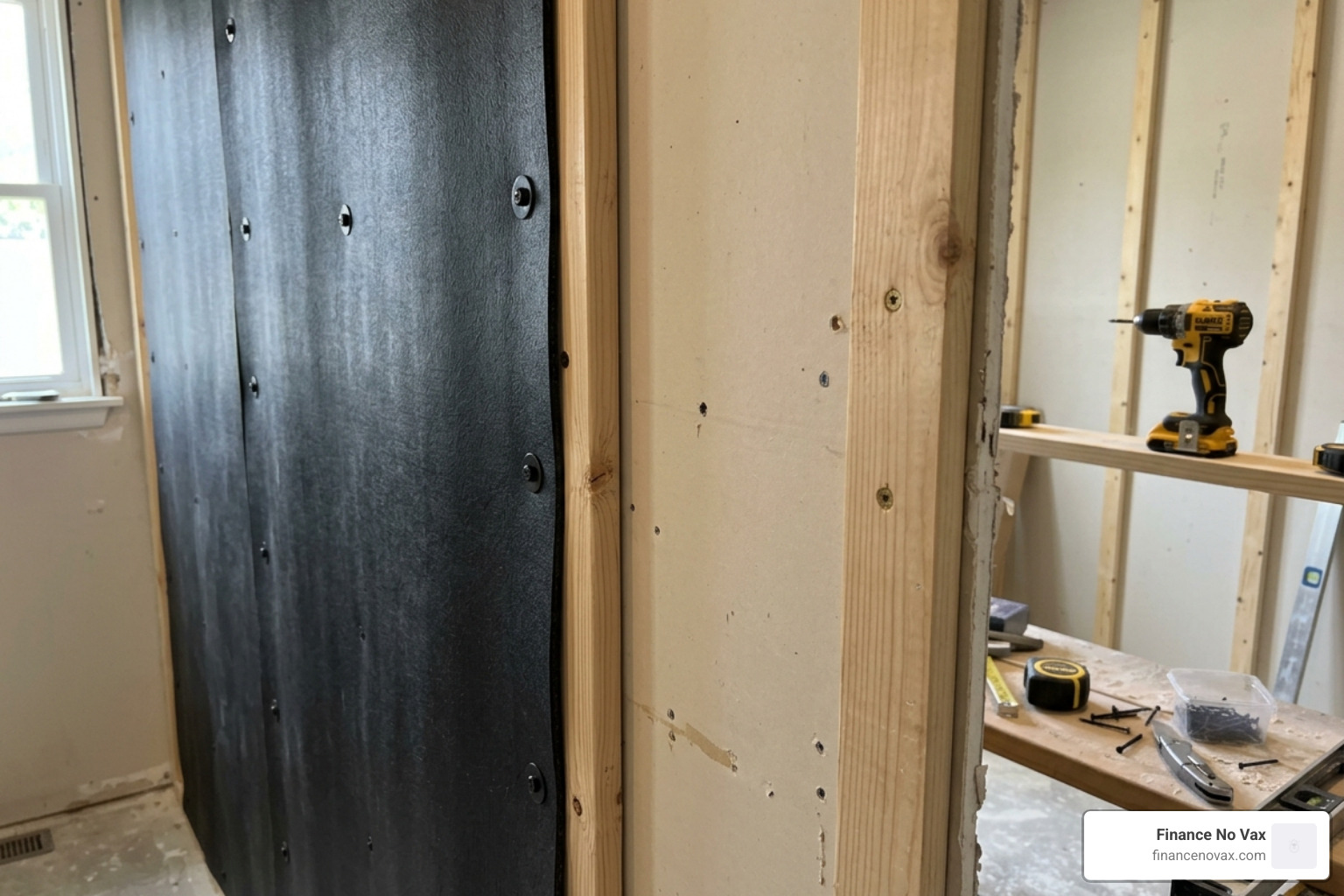
- The Furring Strip Method: Screw 1″ x 3″ wood furring strips vertically into your existing studs. Install the MLV onto these strips, then add a new layer of drywall over the top. This creates a small air gap that allows the MLV to act as a “limp mass barrier,” which is significantly more effective than pinning it tightly between two rigid layers.
- Direct Application: You can glue and screw MLV directly to your existing wall and then add another layer of drywall. While not quite as effective as the furring strip method, it is much thinner and easier to execute for DIY soundproof panels.
If you’re on a tight budget, take a look at our guide on Silence On A Shoestring for more cost-saving tips.
Performance, Safety, and Material Comparisons
When choosing materials for your mass loaded vinyl walls, it helps to see how they stack up against the competition.
MLV vs. Drywall
To get the same sound-blocking power as a 1/8″ sheet of MLV, you would need to add several extra layers of 5/8″ drywall. Not only does that eat up valuable floor space, but it also adds massive weight to your floor joists. MLV provides the same “stopping power” as several inches of concrete but in a footprint thinner than a pancake.
Decibel Reduction Metrics
Research shows that 1 lb MLV provides impressive transmission loss across the frequency spectrum:
- 125 Hz: 16 dB reduction (Low bass, heavy engines)
- 500 Hz: 22 dB reduction (Human speech)
- 1000 Hz: 27 dB reduction (High-pitched voices, TV)
- 4000 Hz: 36 dB reduction (Whistling, sirens)
Safety and Compliance
In April 2026, building codes are stricter than ever. Most high-quality MLV products, like Technowall, are made from 100% recycled PVC. They are:
- Fire Rated: Many meet Class A or E84 flammability standards.
- Odorless: Unlike cheap rubber alternatives, high-quality MLV won’t make your room smell like a tire shop.
- ASTM Certified: Look for materials tested under ASTM E90-97 standards to ensure the STC ratings are verified.
Frequently Asked Questions about MLV
Can I install MLV over existing drywall?
Yes, you absolutely can. As mentioned earlier, the best way to do this is by using furring strips to create a small decoupling gap. However, if space is at a premium, you can use a PSA-backed MLV to stick it directly to the wall, followed by a second layer of drywall. This is a popular choice for living room soundproofing where you don’t want to lose 3 inches of room width.
How much does MLV cost per square foot?
Prices in 2026 generally range from $1.50 to $3.50 per square foot, depending on the density and whether it has an adhesive backing.
- Standard 1 lb rolls (4′ x 25′) are the most cost-effective.
- Peel-and-stick versions carry a premium but save you hours of labor and the cost of separate adhesives.
- Bulk discounts are common when buying 4 or more rolls, which is usually enough for a standard-sized room.
Is MLV safe for indoor use in 2026?
Yes. Modern manufacturing has moved away from the harsh chemicals of the past. Today’s MLV is typically made from virgin or recycled PVC and is often reinforced with natural minerals. It is lead-free, non-toxic, and safe for use in sensitive environments like bedrooms and nurseries.
Conclusion
At Finance No Vax, we believe that a quiet home is a productive home. Whether you are building a world-class recording studio or just trying to get some sleep while your neighbor’s teenager practices the drums, mass loaded vinyl walls are the gold standard for noise control.
By adding mass, damping vibrations, and acting as a reflective barrier, MLV tackles sound in a way that foam and curtains simply can’t. It is a one-time investment that pays off in years of silence and peace of mind.
Ready to take the next step in your soundproofing journey? Explore more of our DIY solutions to find the perfect combination of materials for your specific project. Don’t let noise dictate your lifestyle — take control of your environment today!
