Flower Drawing Supplies: Pencils, Paper and Erasers for Beginners
The short list of supplies a beginner needs to draw flowers in pencil: which pencil grades to pick, why two erasers help, what paper to choose and what can wait.
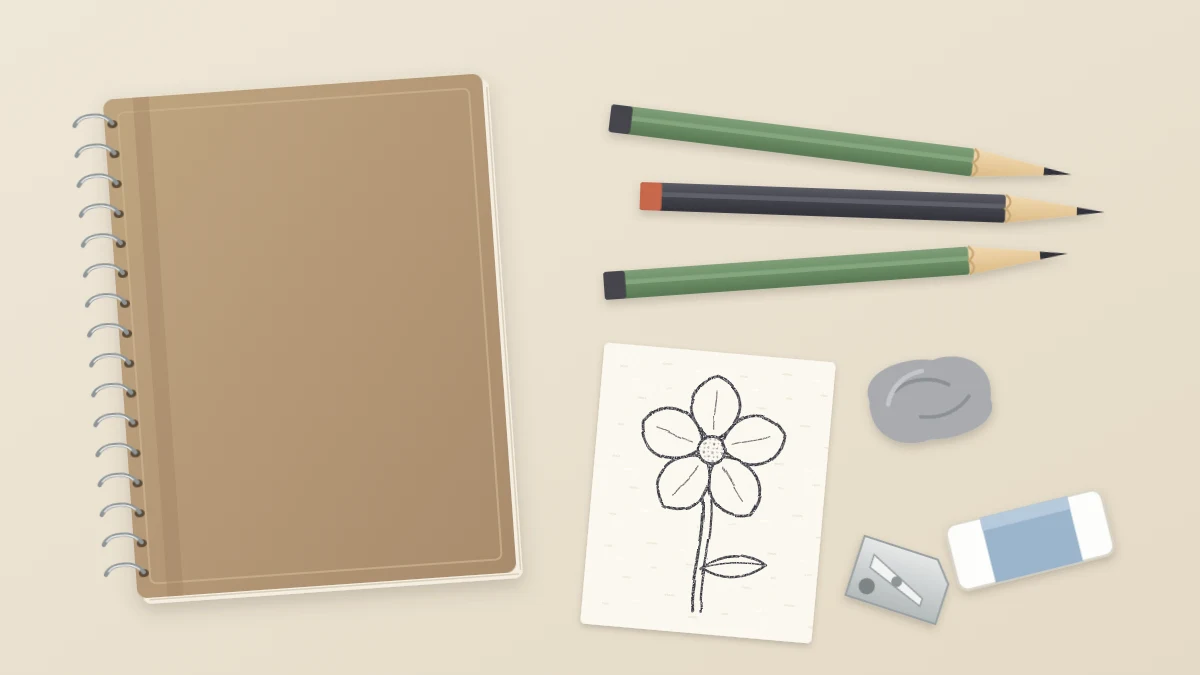
Art store shelves suggest that drawing needs a great deal of equipment. It does not. The flower drawing supplies that matter for a beginner fit in one hand: two pencils, two erasers, a sharpener and some paper.
What follows is a short list of what to gather, what each item is for, and what can wait until you have filled a few pages. Everything is described by type, so you can pick whatever plain version is available to you.
The minimum kit
- An HB pencil for light construction shapes and first sketches.
- A 2B pencil for finished lines and soft shading.
- A kneaded eraser for lifting and lightening.
- A white vinyl eraser for removing lines cleanly.
- A simple pencil sharpener.
- A sketchbook or drawing paper with a smooth to medium surface.
A 4B pencil is a useful seventh item for the darkest accents, but it is optional at the start. If you have only one ordinary writing pencil in the house, begin with that today and add the rest later.
Pencils: what the grades mean
Graphite pencils are graded by how hard the core is. H stands for hard and B for black. Harder cores leave a lighter, thinner line and hold a point for longer. Softer cores leave a darker, broader line and wear down quickly. HB sits in the middle. The higher the number beside the letter, the further the pencil sits toward that end, so a 4B is softer and darker than a 2B, and a 2H is harder and lighter than HB. There is more background on how pencil grades work if you are curious.
| Grade | Mark it makes | Use in a flower drawing |
|---|---|---|
| 2H | Very light, crisp | Optional; faint guides on smooth paper |
| HB | Light to medium gray | Construction shapes, center lines, first petal placement |
| 2B | Medium to dark, soft | Final contour, veins, light and mid shading |
| 4B | Dark, rich, smudges easily | Deepest shadows between petals and in the center |
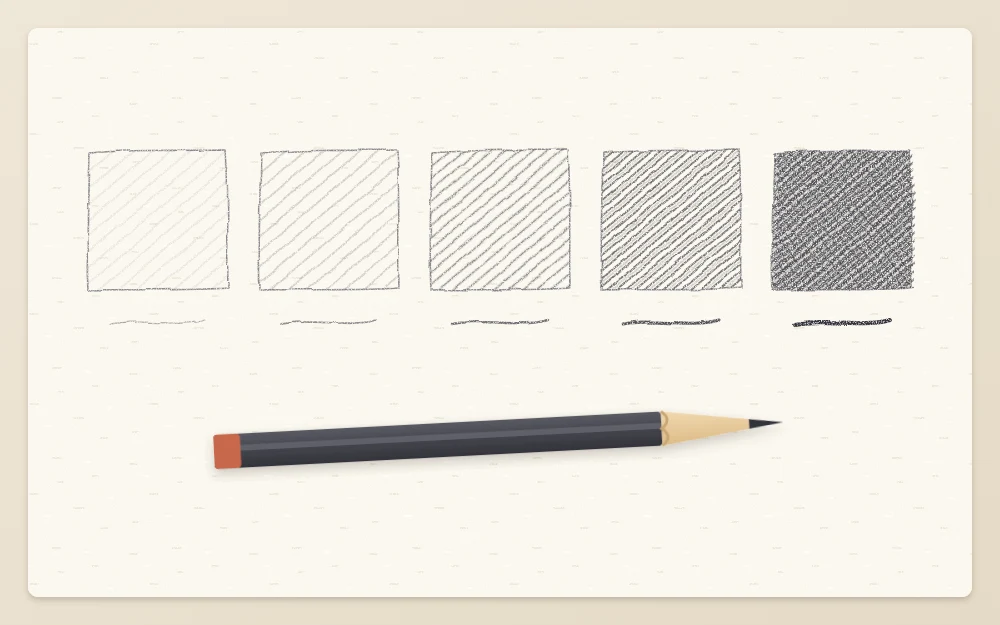
The swatches above run from very light to very dark. A single 2B can produce most of that range if you vary the pressure and build up layers, which is why the list of pencils is so short. The harder and softer grades simply make the two ends of the scale easier to reach.
Common mistake
Using a soft pencil for the first construction shapes. A 4B guide line is dark, smears under your hand and leaves a gray ghost when erased. Keep soft pencils for the final stage.
Erasers: one to lift, one to remove
The two erasers do different jobs, and having both saves a lot of frustration.
A kneaded eraser is a soft gray putty that you can shape with your fingers. Pressed onto the paper and lifted straight off, it picks up graphite without rubbing, so it fades a construction shape to a whisper while leaving the paper surface intact. Pinched to a point, it lifts a small highlight on a petal. When it turns dark, fold and stretch it to bring a clean surface forward.
A white vinyl eraser is firmer and removes a line completely. Use it for stray marks outside the drawing and for mistakes in the final contour. Rub gently in one direction and brush the crumbs away with a clean, dry brush or a tissue rather than the side of your hand, which can smear the drawing.
Sharpener
A small handheld pencil sharpener is all you need. A model with a container catches the shavings and keeps graphite dust off the page. Replace it when it begins to chew the wood or snap the core, since a dull sharpener wastes pencils.
Sharpen often. A sharp point gives thin, controllable lines for petal edges and veins, while a slightly worn point is better for soft shading. Many people keep the HB sharp and let the 2B round off a little.
Paper and sketchbooks
Paper has a surface texture called tooth. It decides how the graphite sits on the page.
- Smooth paper gives clean, sharp lines and suits detailed line drawings, but it holds fewer layers of shading.
- Medium-tooth paper has a slight grain that grips graphite, so shading builds up evenly and darks get darker. It is the most versatile choice for flower studies.
- Rough paper breaks lines up and is harder to control. Leave it for later.
Look for paper labeled for drawing or sketching rather than thin copy paper, which dents and tears under an eraser. Copy paper is still fine for warm-ups. A spiral-bound sketchbook lies flat, and a size around 9 by 12 in (23 by 30 cm) gives room for several small studies on a page. A smaller book is easier to carry if you plan to sketch outdoors.
Tip
Slip a loose sheet of scrap paper under your drawing hand. It keeps the oils of your skin off the page and stops your palm from dragging graphite across finished areas.
Optional extras
None of these are needed at first. Each solves one specific problem, so add them only when you meet that problem.
- Blending stump. A tightly rolled paper stick for softening shading into a smooth tone. The guide on shading flowers with pencil explains when to blend and when to leave the hatching visible.
- Fineliner pen. For inking a clean final outline over a pencil sketch. Let the ink dry fully before erasing the pencil beneath it.
- A few colored pencils. Two greens, a yellow, a pink or red and a violet are enough to tint a finished pencil flower.
- A ruler. Only for dividing a page into study boxes. Stems and petals are always drawn freehand.
What can wait
Large pencil sets with a dozen or more grades, mechanical pencils, special papers, easels and spray fixative can all wait. Fixative is a spray that reduces smudging on finished drawings. If you do use it someday, spray it outdoors or in a well-ventilated room. A sheet of clean paper laid between sketchbook pages protects drawings well enough for practice work.
Putting the kit to use
Once the supplies are on the desk, try each one before starting a flower. Draw a faint line with the HB and lift it with the kneaded eraser. Shade a small patch with the 2B from light to dark. Erase a line with the vinyl eraser and see how clean the paper stays.
From there, a short routine of warm-up exercises for pencil control shows you what your pencils can do, and the overview of where to start with flower drawing lays out which flower to try first.
Frequently asked questions
Can I draw flowers with just one pencil?
Yes. An ordinary HB or 2B pencil can make both faint guide lines and fairly dark shading if you change how hard you press and build tone in layers. A second, softer pencil mainly makes the darkest values easier to reach, so it is a convenience rather than a requirement.
What is the difference between HB and 2B pencils?
HB has a firmer core and leaves a lighter line that erases easily, which suits construction shapes. 2B has a softer core and leaves a darker, slightly wider line, which suits final contours and shading. The 2B also smudges more readily, so it is best saved for the later stages of a drawing.
Is regular copy paper good enough for practicing?
It is fine for warm-up lines, curves and quick shape studies. For drawings you plan to shade or erase repeatedly, drawing paper is a better choice because it is thicker, has a little tooth to hold graphite and stands up to an eraser without dents or tears.