Easy Flower Drawing Ideas: 12 Simple Flowers to Sketch
Twelve small flowers you can sketch in a few minutes each, with the construction shape to start from and the one detail that makes each flower recognizable.
Some days you want to draw something small and finish it before your coffee goes cold. These twelve easy flower drawings are built for that: each one starts from a single construction shape and has one detail that makes it recognizable, so you can stop early and it still reads as the right flower.
Pick one, give it about five minutes, and move on to the next. None of them needs more than an HB pencil for the light guides and a 2B pencil for the finished lines.
How to use these ideas
Every idea below follows the same three moves. Draw the construction shape lightly with the HB pencil, pressing so gently that the line almost disappears when you tilt the page. Add the petals inside or around that shape. Then go over the lines you want to keep with the 2B pencil and lift the guides with a kneaded eraser.
Keep each sketch small, about 2 in (5 cm) across.
Six classics that start from a circle or a cup
1. Daisy
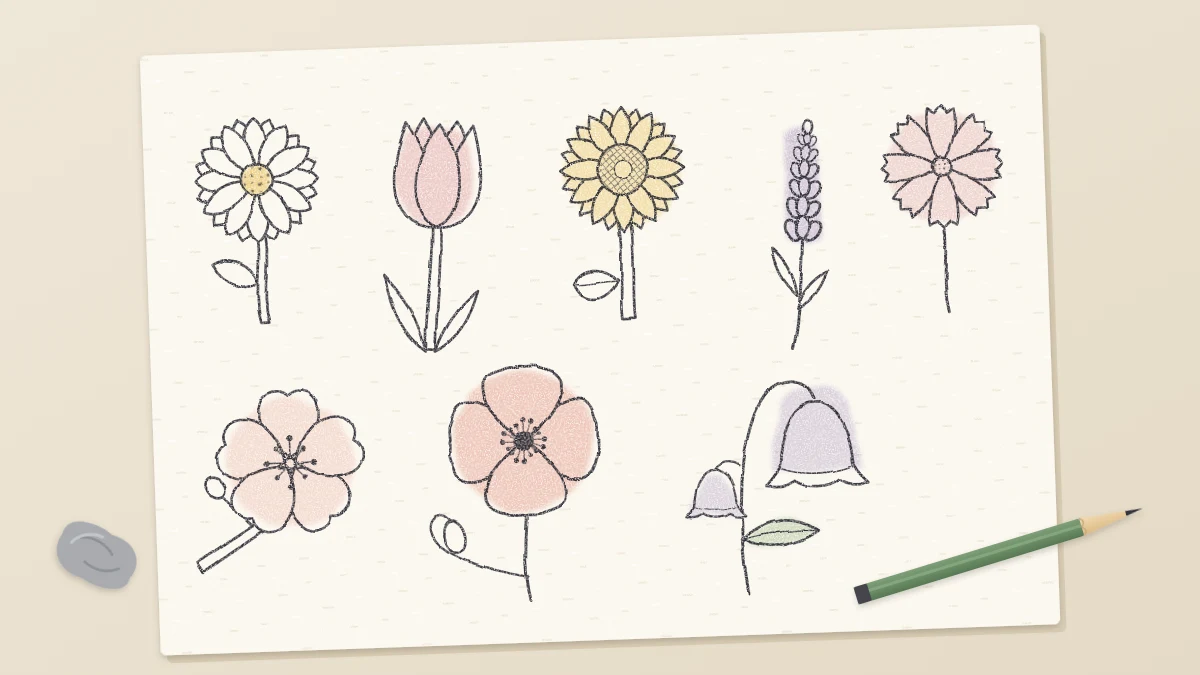
Construction shape: a small circle inside a larger one, the big circle about three times as wide. Long narrow petals run from the small circle to the big one. The detail that sells it is the center, a slightly domed disc of tiny florets, which you can suggest with a few dots along its lower edge. The full method is in the step-by-step daisy tutorial.
2. Tulip
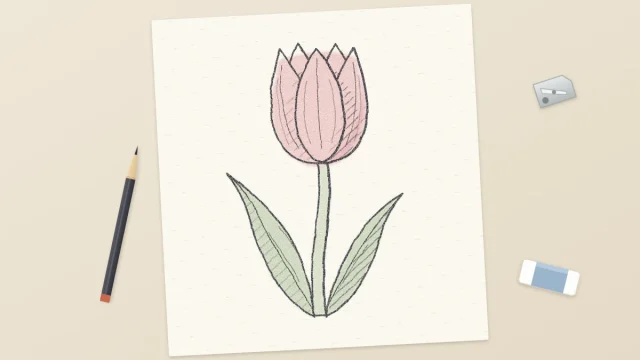
Construction shape: an egg standing on its narrow end, or a simple U-shaped cup. One petal sits in front, and two more wrap around from the sides and overlap it. The recognizable detail is the row of three soft points along the top edge. See the tulip drawing guide for the complete steps.
3. Lavender sprig
Construction shape: a long, slightly curved center line with a narrow spindle around its top third. Small bud shapes sit in stacked rings along the spindle, with little gaps of bare stem between the rings. Those gaps are the detail that keeps it from looking like a wheat ear. The lavender tutorial covers the full spike.
4. Cherry blossom
Construction shape: a circle divided into five equal wedges, like a star drawn very lightly. Each wedge holds one rounded petal. The detail is the small notch at the tip of each petal, plus a few fine lines radiating from the center. A whole branch is explained in the cherry blossom lesson.
5. Sunflower
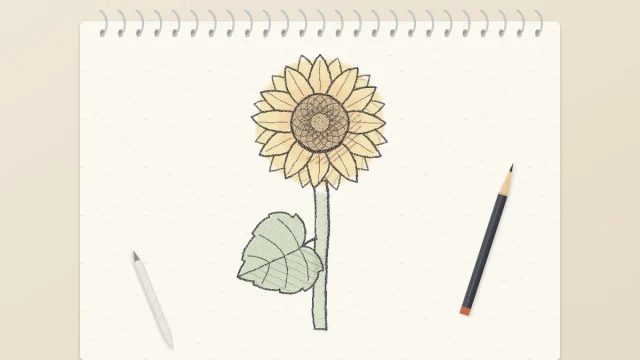
Construction shape: two circles again, but this time the inner circle is large, about half the width of the outer one. Pointed petals fill the ring, with a second row peeking out behind the first. The detail is the big center: a few curved lines crossing in two directions hint at the spirals of seeds.
6. Poppy
Construction shape: a shallow bowl, wider than it is tall. Draw four to six broad petals with loose, slightly crumpled edges that overlap each other. In the middle goes a small round seed pod with a ribbed cap, drawn as a tiny circle with short lines radiating from its center. That pod is the detail to keep.
Six more quick sketches
7. Forget-me-not
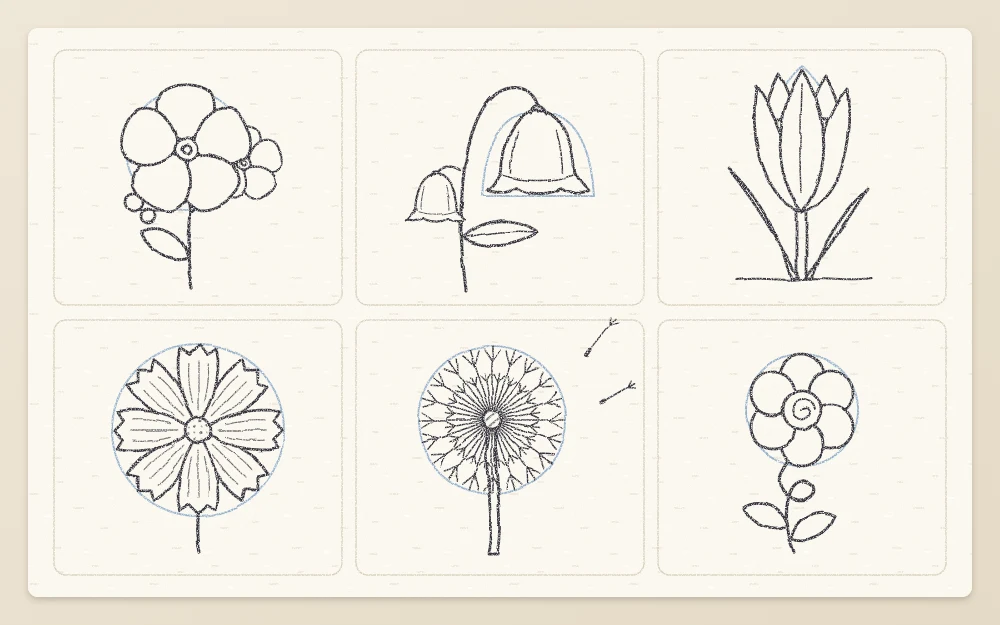
Construction shape: a small circle, no wider than your thumbnail. Five rounded petals touch edge to edge around a tiny ring in the middle. Draw three or four of them clustered together, because the cluster is what makes it recognizable.
8. Bell-shaped flower
Construction shape: an upside-down cup hanging from a stem that arches over like a walking cane. Flare the rim outward and cut it into a few shallow scallops. The curved stem and the downward tilt do most of the work.
9. Crocus
Construction shape: a narrow teardrop, point up, sitting almost directly on the ground line. Draw one pointed petal in front and one on each side, then let the tips of the back petals show between them. Add two or three thin, grass-like leaves rising beside it.
10. Cosmos
Construction shape: two circles, the inner one small. Eight wide petals fan out, each one broader at the tip than at the base. The detail is the tip itself: give each petal two or three shallow notches so the edge looks lightly torn.
11. Dandelion seed head
Construction shape: one light circle with a dot in the center. Draw thin straight lines from the dot to the circle, like spokes, and end each line with a tiny V or star. Leave the circle itself undrawn in the final version, and let one or two seeds float away to the side.
12. Doodle flower on a curved stem
Construction shape: a circle with a looping line around it. Draw five or six rounded scallops around a center dot without lifting the pencil much, then add a stem that curls at the bottom and one simple leaf.
Fill a sketchbook page with small studies
A page of small flowers is more useful practice than one large, careful drawing. A simple way to plan it:
- Lightly mark six to eight spots across the page, spaced unevenly so it does not look like a grid.
- Draw the construction shapes for all of them first. This warms up your hand and stops you from fussing over the first flower.
- Vary the size and direction: turn one flower sideways, tilt another away from you so its circle becomes an ellipse.
- Finish with the 2B pencil, and leave one or two sketches at the guide stage as a record of how they were built.
Where to find flowers to look at
Real flowers teach more than memory does. A single stem in a glass, a pot on a windowsill or a plant in a park all work. Sketch wildflowers where they grow and leave them in place. When there is nothing in bloom, work from photos you took yourself, and look for the construction shape before any detail.
When a quick sketch goes wrong
Common mistake
Pressing hard on the construction shape. A dark guide cannot be erased cleanly, and it shows through the finished petals. Keep the first lines faint and save pressure for the last pass.
If petals come out uneven, check their spacing first: mark where each one sits on the circle with a small tick before drawing any of them. If the whole flower looks flat, let one petal overlap its neighbor. Results vary from day to day, so if a sketch does not work, start the next one beside it.
Frequently asked questions
What is the easiest flower to draw for a complete beginner?
A daisy or a simple doodle flower is a common starting point, because both grow from two circles and a ring of similar petals. A tulip is a close second, since it is one cup shape with three overlapping petals. Start with whichever shape feels more comfortable in your hand.
How long should a quick flower sketch take?
Roughly five minutes is enough for a small study about two inches across. Spend the first minute on the light construction shape, a couple of minutes on petals, and the rest on darker final lines. Stopping early is fine, because the construction shape already carries the flower.
Do I need special paper or pencils for small flower sketches?
No. An HB pencil for the faint guides, a 2B pencil for the finished lines, a kneaded eraser and any smooth sketchbook page will do. Softer pencils and textured paper become useful later for shading, but they are not needed for quick line studies.